How To Make (lots of) Curved Brackets


I use brackets a lot in my projects.  I like the look of little brackets spaced at intervals along a band of wood, like you see in old craftsman houses.  They add structure as well as charm.  As I’m re-doing all the trim pieces in the house, the new trim is going to have plenty of these little curved brackets for added support, as well as architectural style.

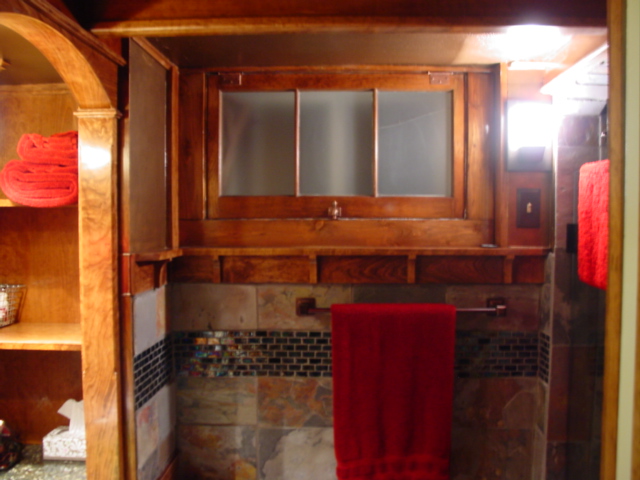
Here’s an example of ones I did in a past project:
example

So they run along a band of wood with a little shelf on top, which makes for a convenent place to put your beer, collect D&D lead figures, or simply accumulate dust.  But I think it adds some character.  Anyway, in this house, I’ll probably need about 100 to 200 of these brackets.  When you need that many, you need to find a way to make lots of them and all the same size and shape.

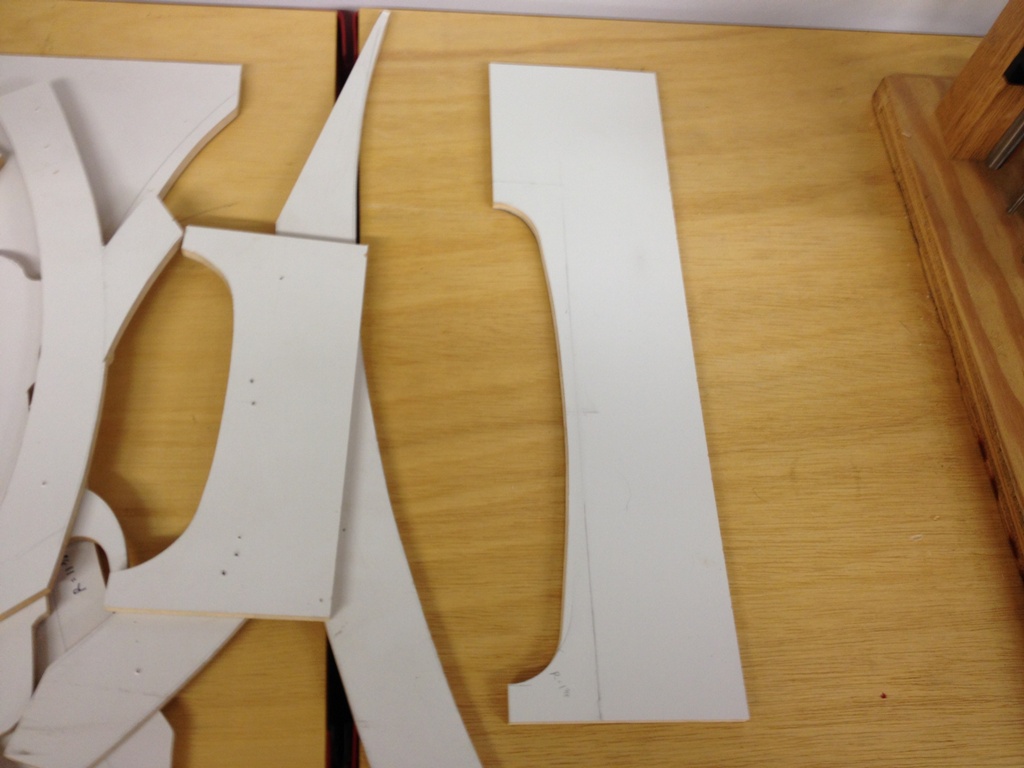
I start by making a template.  I use 1/4″ laminated MDF.  It’s very easy to work with and retains its shape well as long as it’s not abused.  I’ve got a growing collection of templates for various brackets and curves that I’ve done.  I first make a rough cut with a coping saw, then file it smooth, then sand it even smoother, checking the final shape for symmetry and correct geometry.  The one on the right is the one I’ll be using.
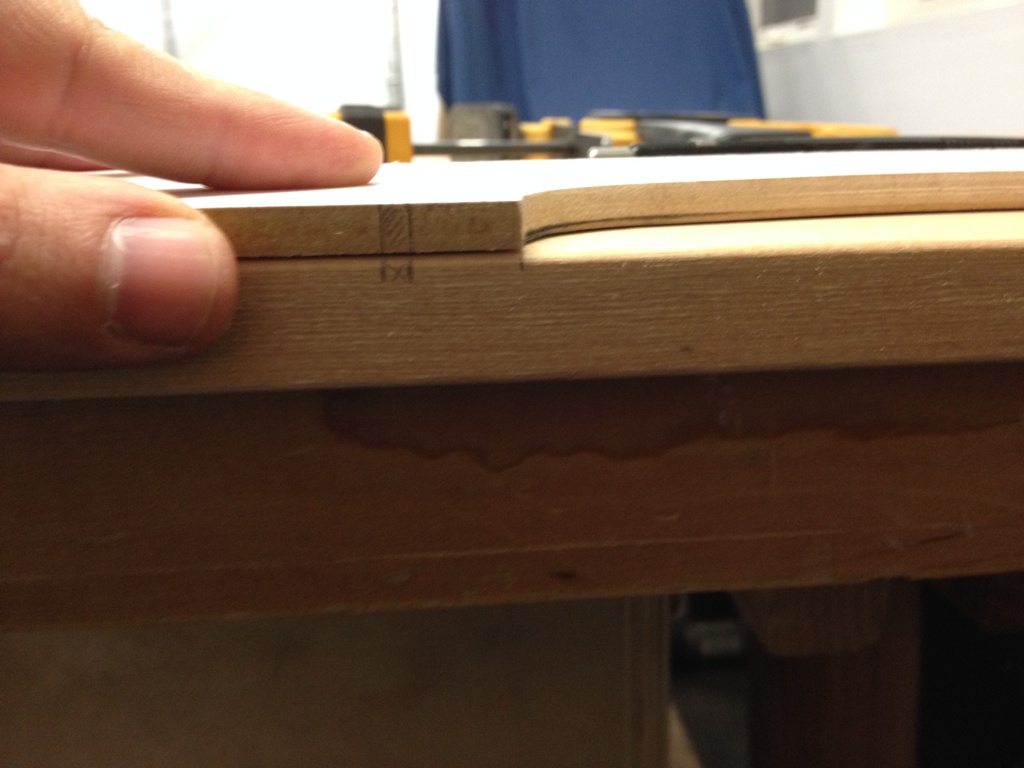
FormsUsing the template, I scribe out the line I need to cut on the wood.  I make a fine line right along the edge, then use a bolder pencil to line out where I’m going to cut with the jigsaw.  The idea is that the rough cut is not going to go all the way to the line, it’ll leave about 1 or 2 mm of wood left to shave off.  See, I’m so freaking close to Canada that I’m starting to use metric units.
Marking


Each piece is very carefully marked.  That little hatched area is the area the saw will cut away.
Cutting


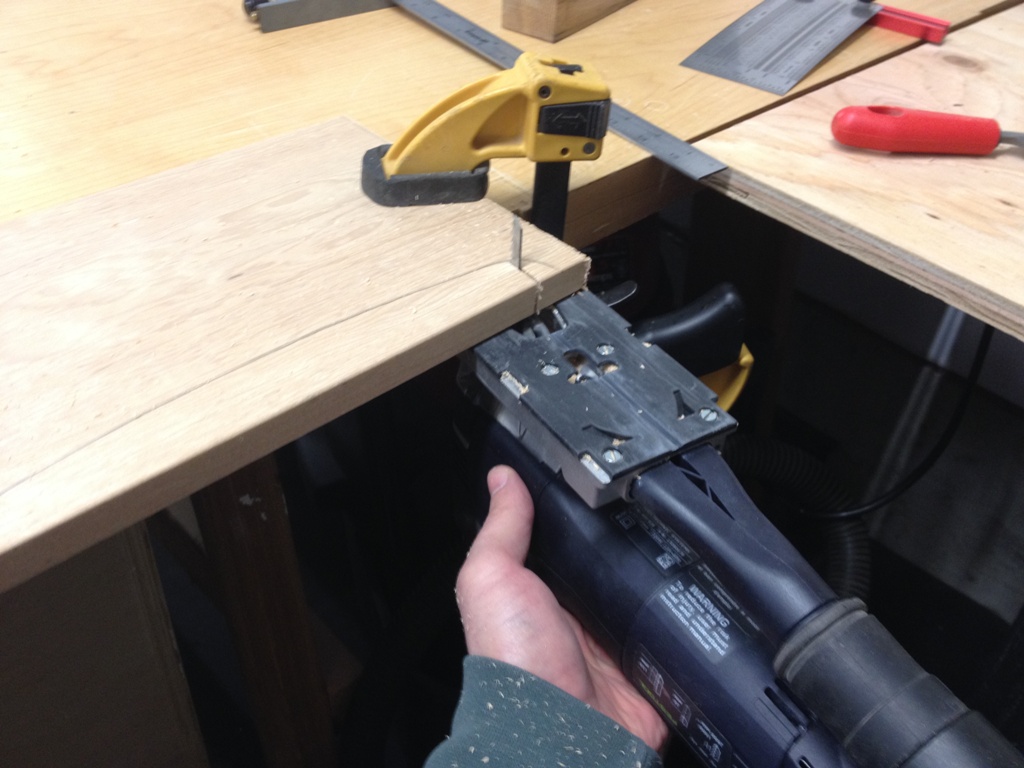
With this jigsaw, I like to cut from underneath the piece.  This way you see exactly where the blade is cutting.  The trick is to keep the jigsaw plate square to the wood.  If it’s not square, or if there’s some movement or vibration in the wood, you run into trouble.  Press firm.  Watch the blade carefully.  Cutting freehand along a scribed line is not something I’m particularly good at, so I need to take my time with this step.Festool Jigsaw
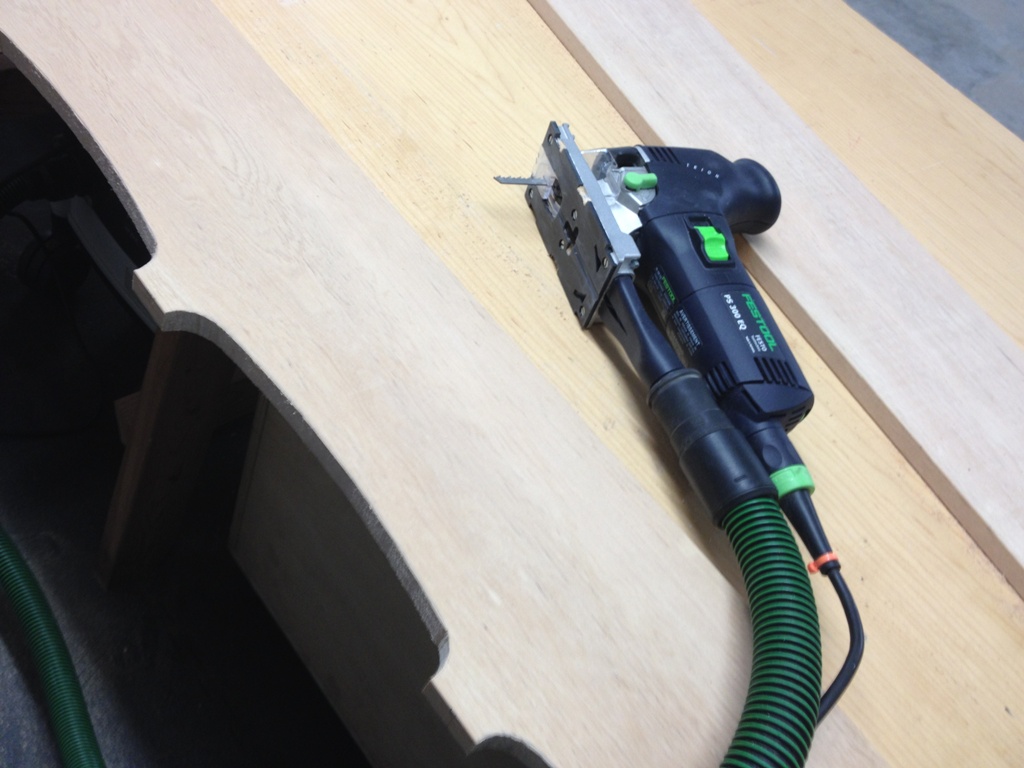
Again, Festool makes short work of the project.
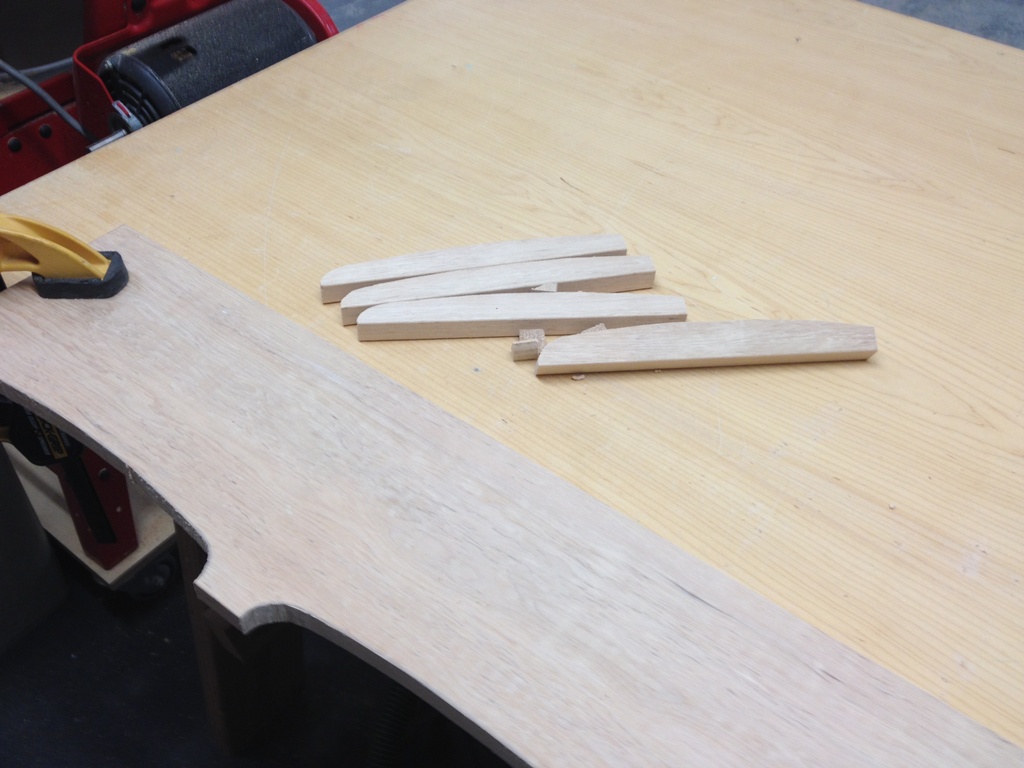
Kindling


The nice thing about being a woodworker and owning a wood burning stove is that every project I work on makes my house warmer.  As I type this blog post, those little pieces of wood are on fire and heating my home.  We don’t let much go to waste out here.

Next thing I do is affix that template to the work piece and give it a few passes on the router.  Using a nice smoothing bit, it cuts right along the template edge, and gives me an exact cut that’s going to be the same shape every time and typically I don’t even need to sand it.
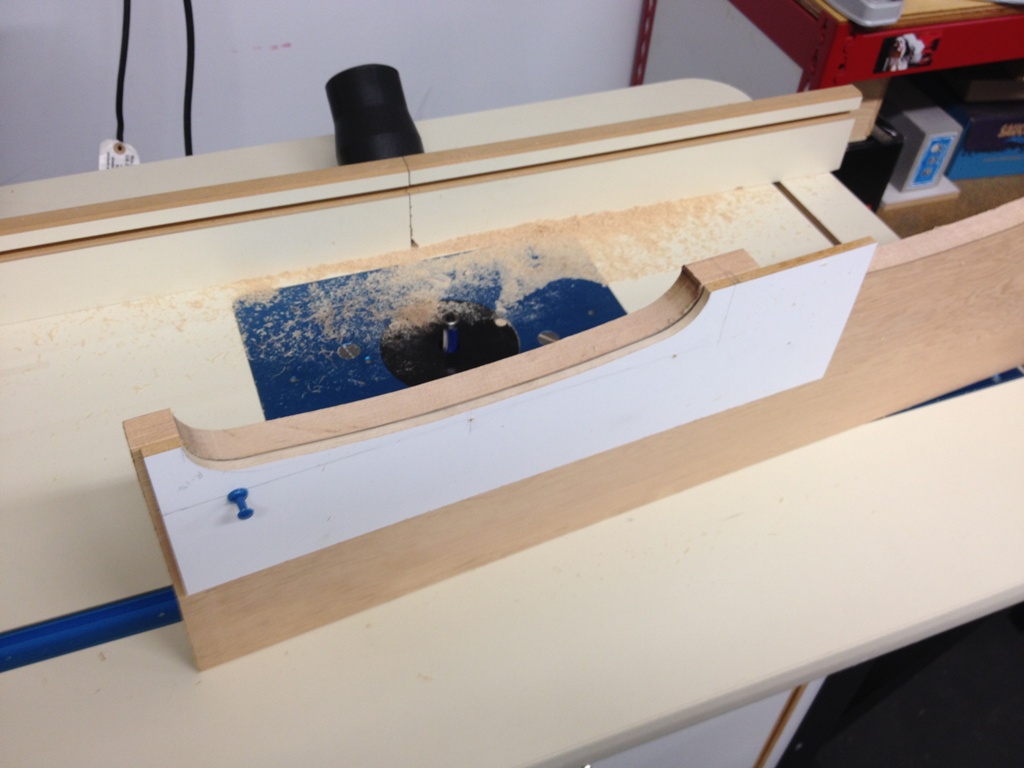
Router Work


I attach the template to the board using push pins.  Yes, push pins.  I used to have push pins made entirely of steel but they are now lost and I have no idea where they are.  They went to push pin heaven or something.  Now all I have is a dwindling number of plastic push pins that tend to break when I push them into the wood.

Now if you plan this appropriately, you can drive the pin through a section of the wood that’s going to get sawn off.  Therefore there’s no need to fill or repair the hole it made.  But I’ll be honest here.  I’ve made a lot of brackets and the vast majority of them have little pin holes in them where the template attached, and I made no attempt to repair them.  And no one ever notices.  Anyway, these particular brackets will have the hole marks sawn off.
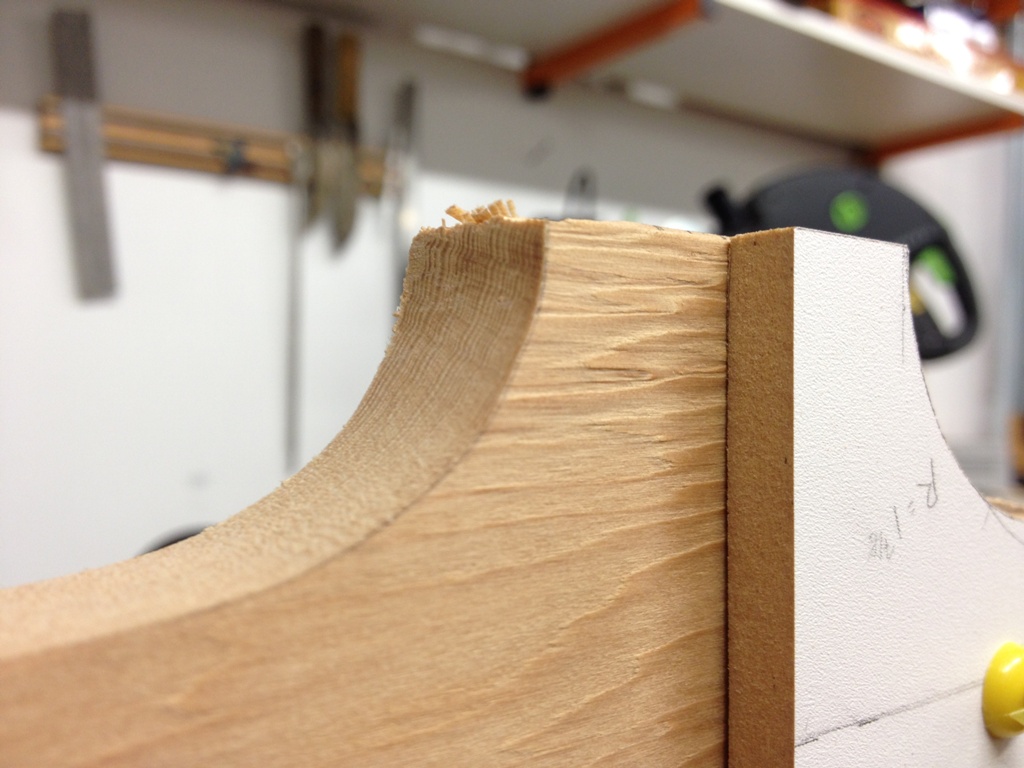
Tearout

Now there is a problem with tear out when you do it this way.  That’s when the router bit tears the wood at the corner, like in the pic above.  Sometimes it’s pretty minor, sometimes it ruins the piece.  There’s a few ways to avoid tearout but the method I prefer is to cut the wood with a chisel right where the router bit is going to tear.
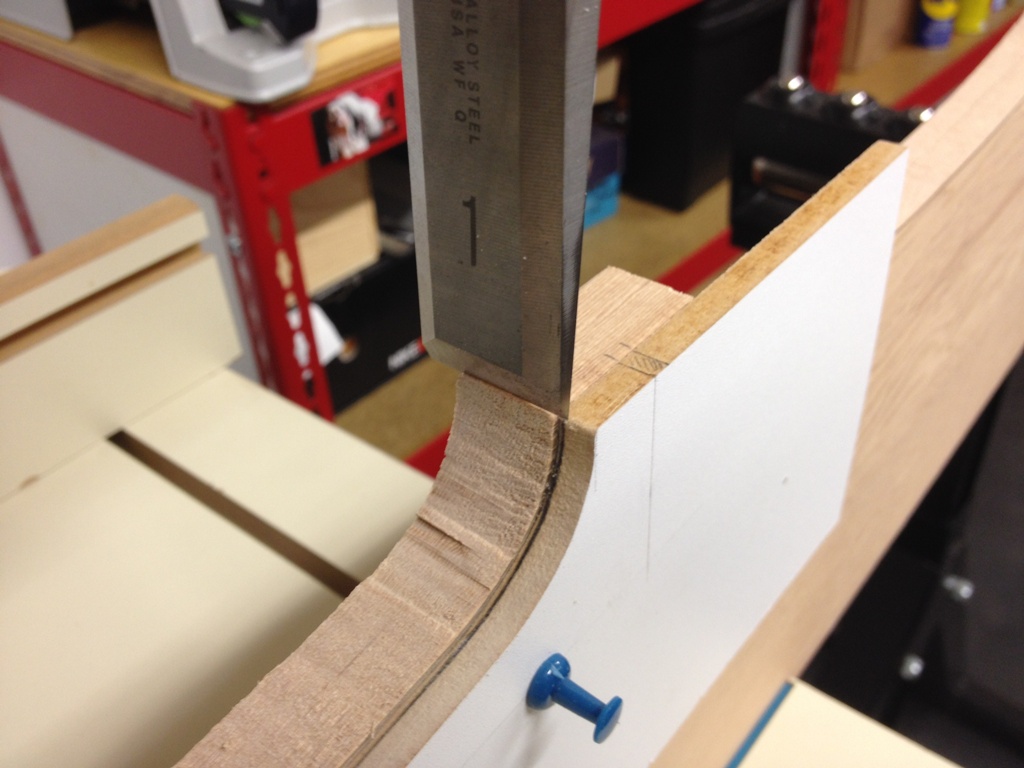
Chisel


It’s a pain in the butt to do it for every single bracket, but you really want that point to look neat and clean.  It’s going to be the most prominent point on the bracket, very visible.  So I take the time to do it right and ensure a clean look.

Once each bracket is hollowed out, it’s time to rip it down to the correct width.
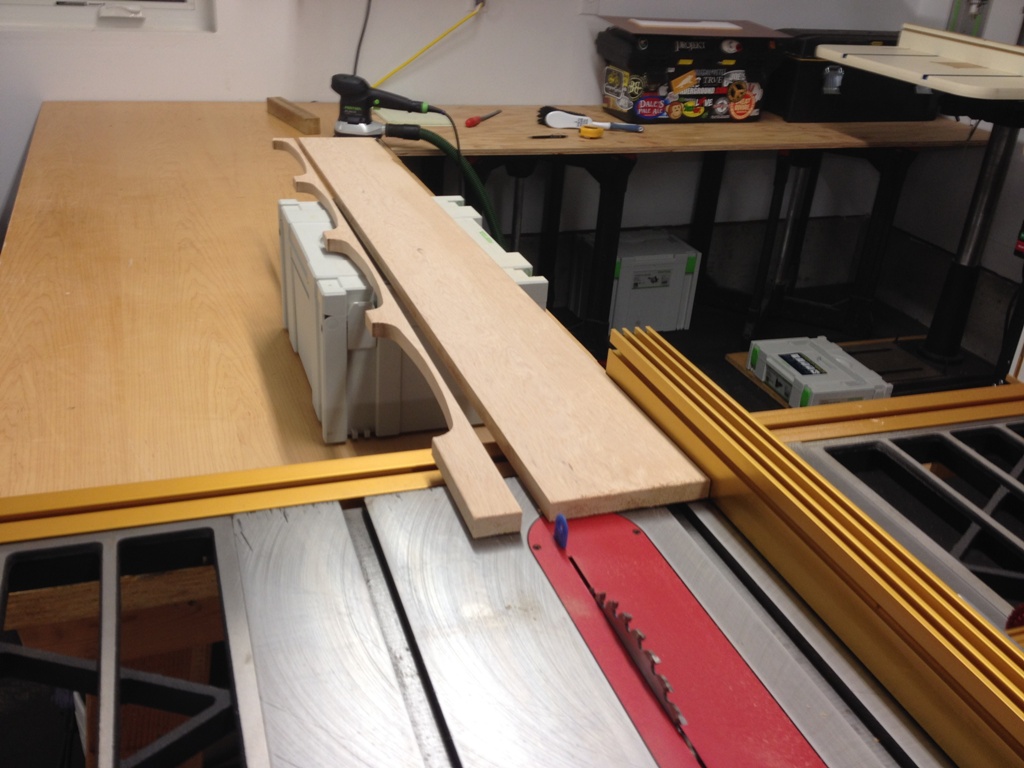
Ripping


The table saw made this cut flawlessly and effortlessly.  Which is pretty much the only thing that has gone flawless and effortless since I moved to this island and started working on projects.  So immediately my guard was up, waiting for the next thing to go wrong.

I cut out the individual brackets on the chop saw.  I don’t like cutting small pieces on the table saw, as small things have a tendency to want to go flying and poke someone’s eye out.
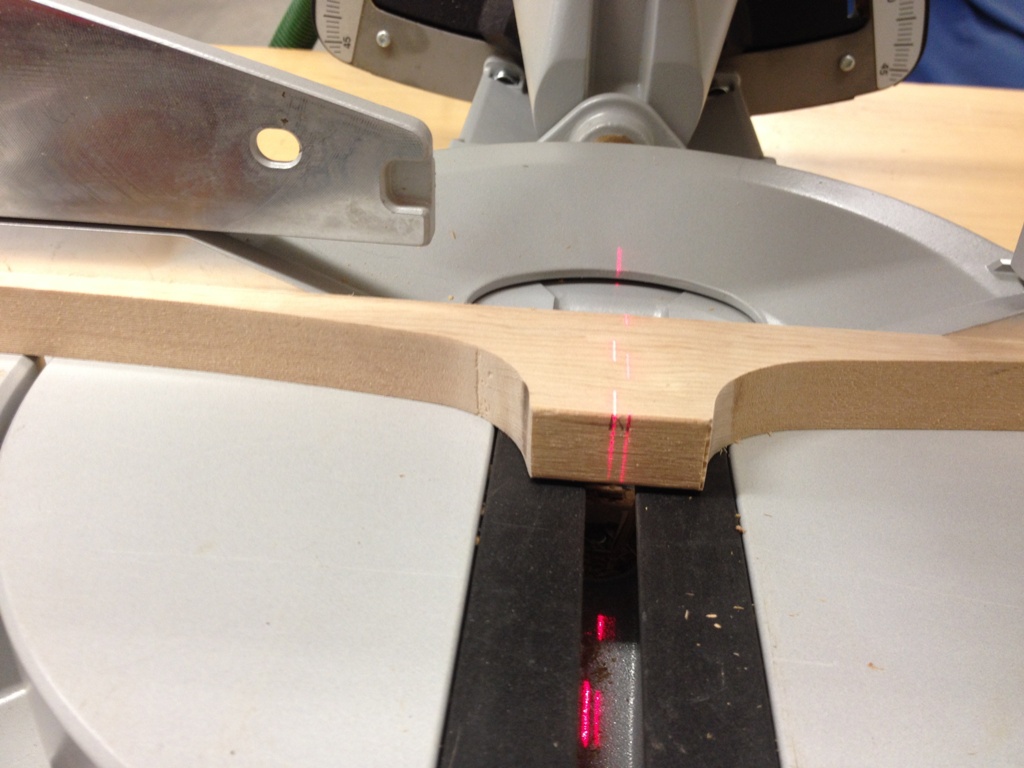
Final Cuts


My template pre-marked where the saw needs to cut to make each bracket symmetrical.  After cutting this way, it looks like I have a stack of ribs, ready to make a boat or something.
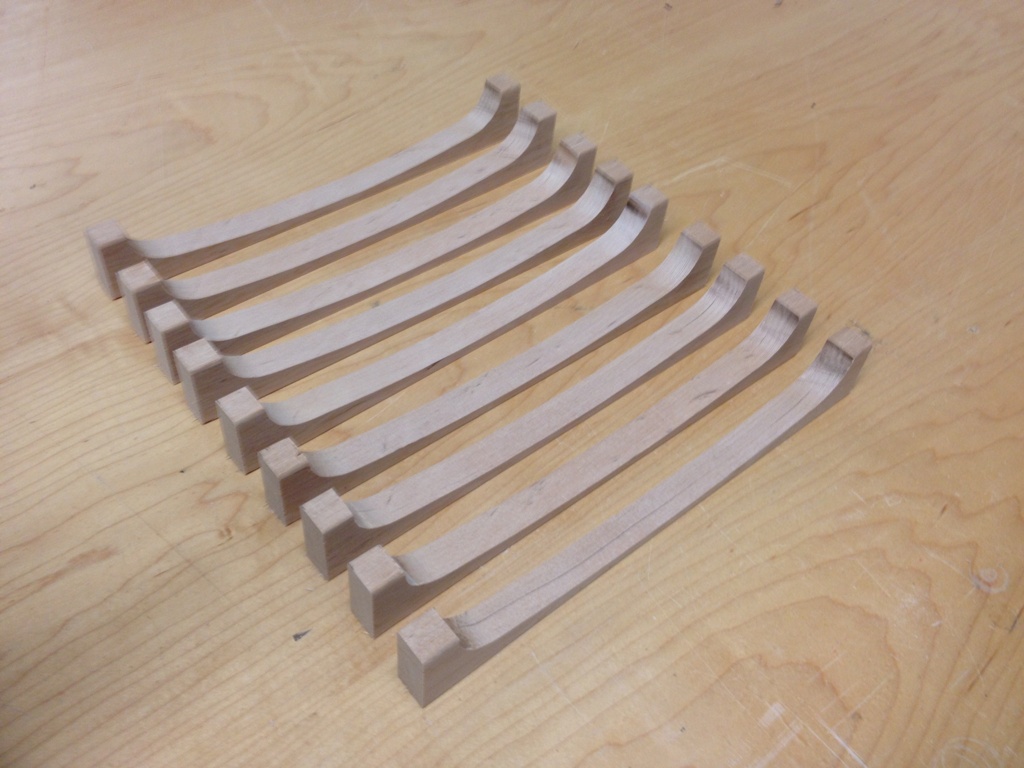
Ribs


Ha ha!  A boat.  That would imply I have time for recreational activities.  Ha ha ha.  I’m so funny.

Back to reality.  One more cut and they finally look like brackets.
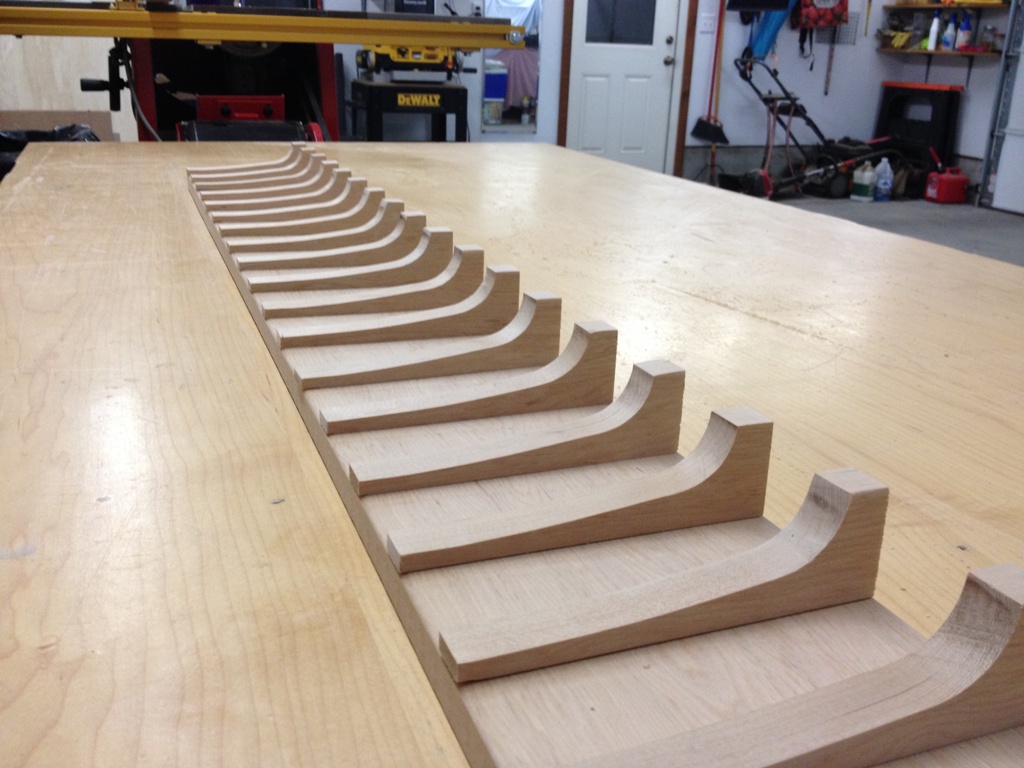
Brackets


Just some final sanding needed now to get rid of those stubborn burn marks.  A nice drum or spindle sander should get rid of those marks pretty easily (problem:  I don’t own a drum or spindle sander).

This is a good technique to make any number of curved pieces with repeatable accuracy.  These brackets are going to be along a band and shelf that goes around most of the interior of the house so it’s important they all look uniform.  They don’t need to be down to the tenth of a millimeter or anything, but they have to look the same when viewed with the eye.


How To Cut a 20 Foot Long Piece Of Lumber

Rip Cut

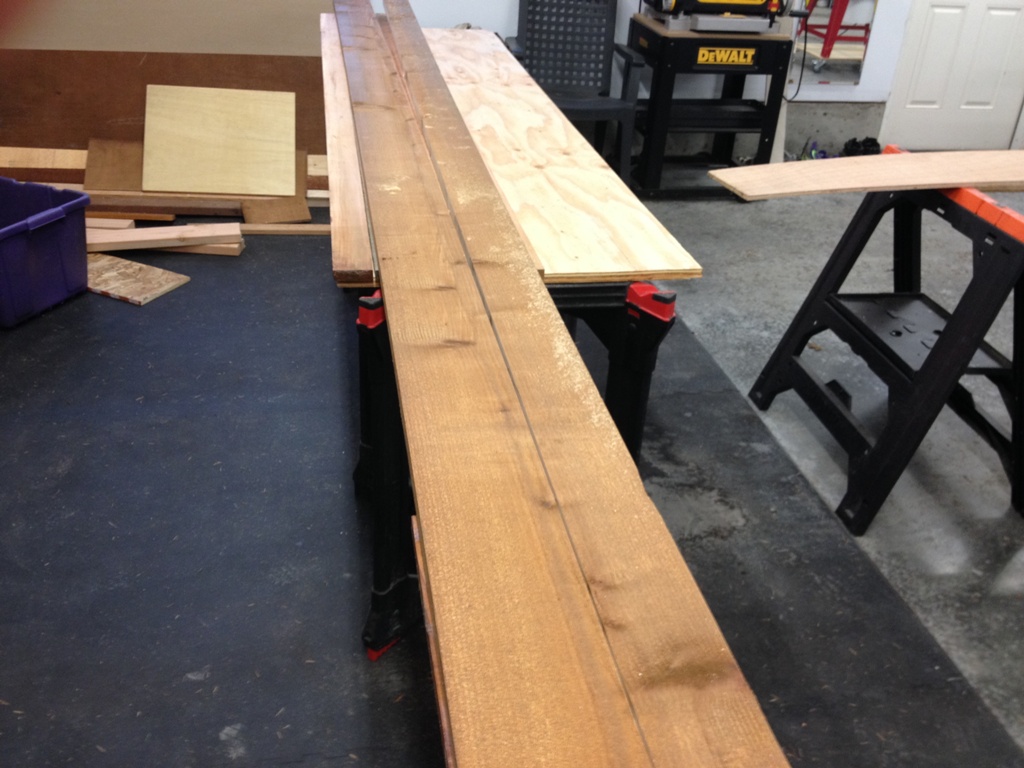
So I have this piece of rough hewn cedar leftover from the garage construction.  It’s about 1″ thick and 10″ wide, and 20 feet long.  Yes, 20 feet long.  Hell, until I moved to Orcas I didn’t even know they made trees that high.  I can’t imagine what it cost.  I held onto it, of course.  You see, woodworkers are also wood collectors, and the more active ones can accumulate 35 pounds of scrap wood per month.  We keep it all.  You never know when you’ll need a piece of wood just that size.

twenty feet long

Well, it turns out I did need this 20′ monster beam for some trim work, but it needed to be 5 1/2 inches wide.  All I’d need to do is run a saw blade in a straight line all down it’s full length.  That’s called a rip cut, when you cut along the length of a beam of wood.  I was going to do this on the table saw and I even set everything up and then decided that was absurdly unsafe.  It would have gone down as one of the top ten stupidest things I’ve ever done.  That’s a tough list to get on, believe me.

Wood is normally solid and strong, but at that length it’s like a heavy, floppy piece of rubber with the added benefit of generating skin-boring splinters.  One dry run over the table saw (with the blade down and the saw unplugged) and I could see right away there was no way the wood would remain straight and flat on the table surface.  It would bow, twist, bend, and just generally be a turkey.  The table saw blade could bind and shoot the lumber into the air like a 20′ bullet, or pieces could splinter off in an exploding grenade fashion, or it could simply catch fire from the friction.  Yeah, dumb idea.

Festool Rocks

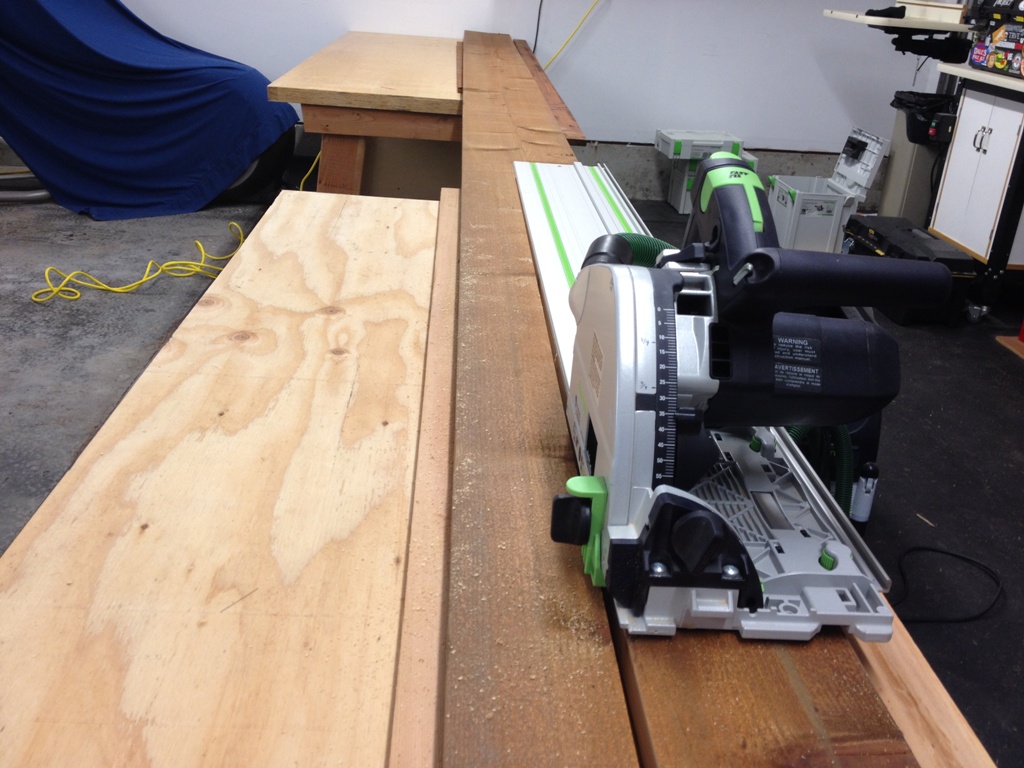
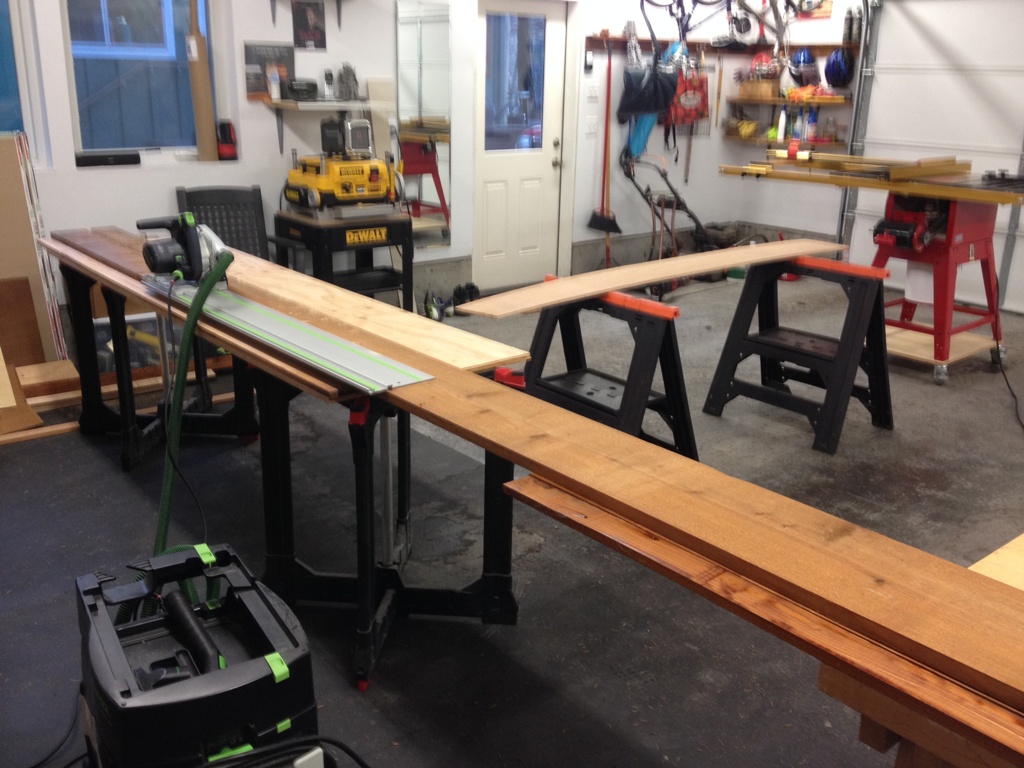
So, Festool to the rescue.  Their tools have a good combination of safety, accuracy and comfort.  Their plunge saw is pretty good and I have a little rail system that keeps it in a straight line and puts the saw blade exactly where you want it to go.  Just to be safe I first cut halfway through the lumber, then made a second pass all the way through.  The rails ensured each cut was in exactly the same place.  The final cut was seamless, with nary a saw mark along its length.

Because my rail is about 1/6 of the length of the lumber, it took a few passes to get through the whole thing.  And fortunately the beam didn’t want to pinch together when it was cut apart.  Wood sometimes does that, since wood fibers are like a series of little springs.  This particular board spread apart when cut.  That was lovely.  Sometimes it wants to pinch together, and you have to use little wedges and spacers as you cut it apart.  Otherwise it will pinch the saw blade, causing it to bind and creating a very unsafe place to be.

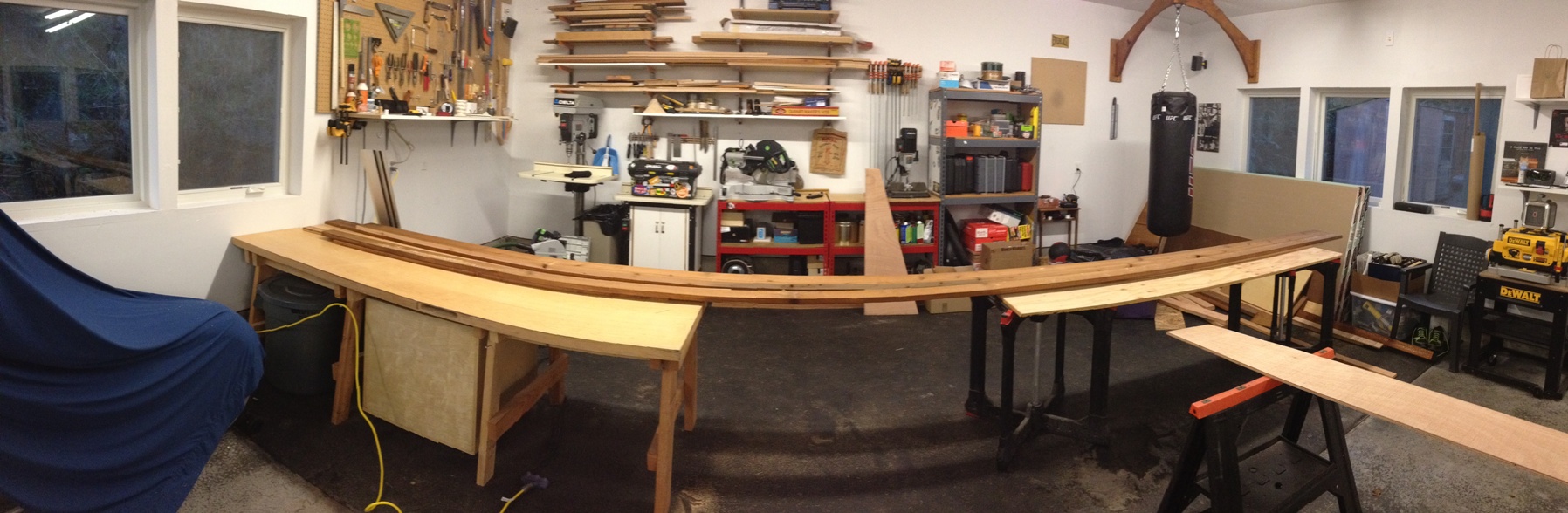
Panoramic Shop

There’s a panoramic pic of the whole thing (click on it to see full size).  It ran the entire length of the back of my shop.  I know you non-woodworkers are shrugging your shoulders like it’s no big thing, but to me this is one of those milestones, like bench pressing 365 pounds, or making homemade tamales for the first time.  It’s a woodworking thing.  You wouldn’t understand.

I dont understand

A to Z Plans

A brief glimpse into the mind of an Orcas Island Homeowner.

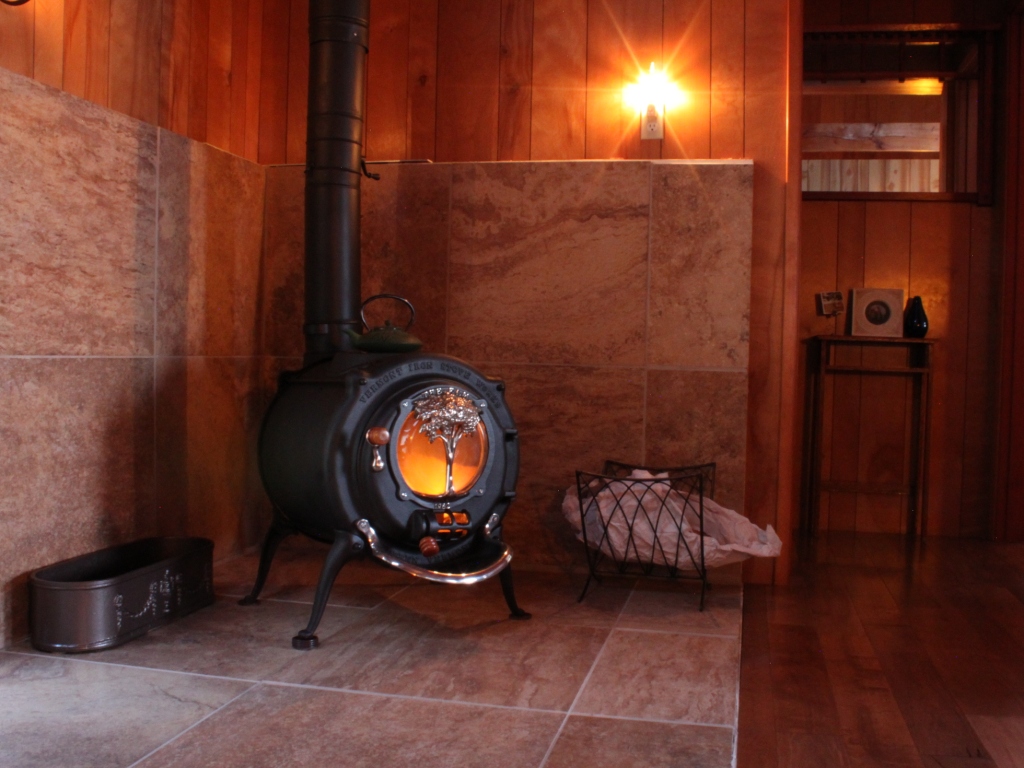
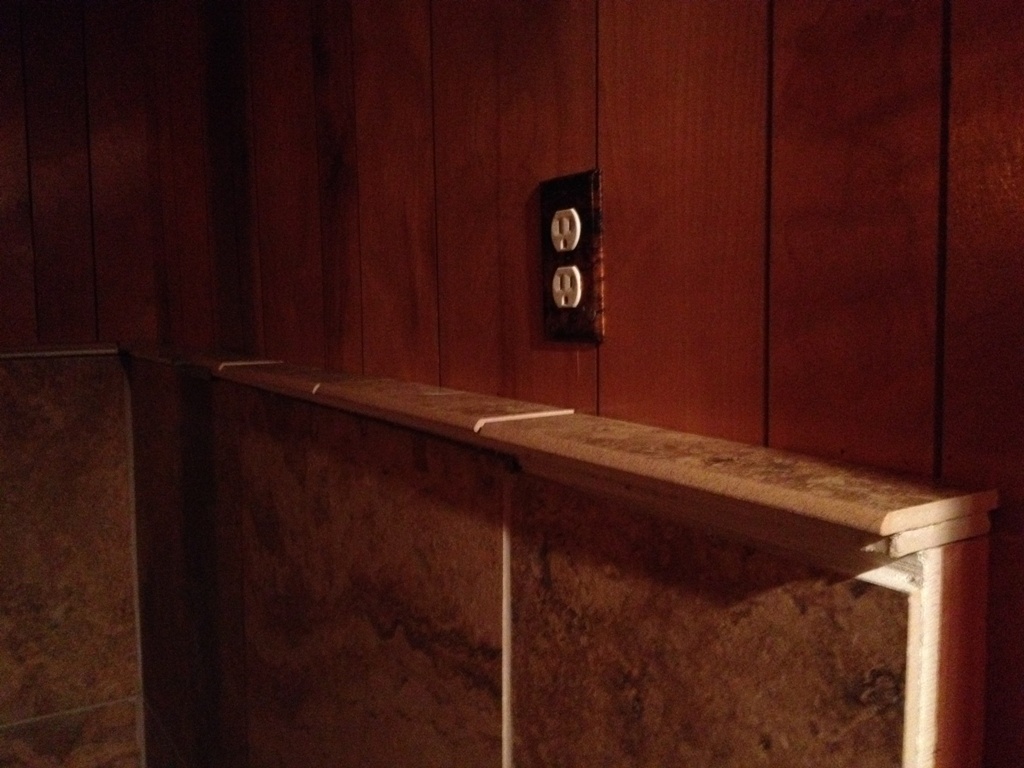
So, about a year and a half ago I installed some big 24” pieces of ceramic tile around our wood stove.  It looked lovely and was nice and fireproof but area above the tile has remained unfinished.  In fact, it’s on a long, long list of unfinished projects.  As with every project, it goes through a number of iterations before it reaches its final state.

Wood Stove Before

Plan A:  I’ll just drywall it.  Put a little wooden shelf over the tile and put drywall on the wall behind it.  Problem:  Okay, that area gets hot.  I put my hand on the wood paneling above the stove when it was burning and it was almost too hot to touch.  I’m surprised that wood paneling hasn’t ignited by now.  It’s a deathtrap the way it is.

Plan B:  Okay, not a wooden shelf but a stone shelf.  Long blocks of cultured stone set into place right on top, and we’ll figure out a wall surface later.  Problem:  Never did find stone that I liked.  I’d have to find something that matched the ceramic tile, which isn’t as easy as it sounds.  And attaching it would be problematic.

Plan C:  Build a hardwood shelf since I think that would look best.  But treat it with some kind of fireproofing compound.  Problem:  Good luck finding a fireproof compound that doesn’t stink or look horrible.  No point making a nice wooden mantle just to ruin it with the fireproofing agent.

Plan D:  Build a metal shelf.  I have stacks of roof metal sheeting left over from the prior owner’s project.  I could strip that down, paint it whatever color I like and it would be completely fireproof!  Problem:  Okay, I spent about six hours cleaning, cutting, bending and filing that crap and the final product looked awful.  Absolutely cheesy.  Stupid.  I hated it.  Can’t I just make the mantle out of wood, a material I know how to use?  No!  Wood is flammable.  Choose something else.

Plan E:  Fine.  I have a bunch of leftover ceramic tile from the wood stove surround.  I can rent a tile saw, cut them into strips, and make a shelf and a little runner to go along the front so it looks like it’s a little sturdy.  Let’s just do that.

MantelPlan F:  The idea of renting a tile saw when it’s 36° F outside just horrifies me.  It sprays water everywhere.  Your hands get drenched in it and they will freeze.  So I’ll just use some edging pieces that I have that don’t look as nice but I don’t want to cut big pieces of tile in this weather.

Plan G:   No front strip either.  Hey, I can use a piece of window flashing to at least make a metal lip that will cover the backerboard.  I can even paint it copper.  I have some hammered copper spray paint that looks great.

Plan H:  The copper spray paint isn’t made for hot applications.  Need to special order high heat paint.

Plan I:  How about the area over the tile?  Painted drywall would probably work ok, as long as you get the special stuff with no combustible paper.  Hey, how about copper sheets!  That would look so freaking cool!!

Plan J:  Copper sheeting would run about $800.  A pity, that’s $700 more than I wanted to spend on this crap.  Maybe I can cut up some of that metal roofing material I have in surplus.  I have enough to roof a small airplane hangar.

Plan K:  No, that would look hideous and take way too much work.  Hey, the hardware store sells these 24” steel sheets for like $6 each.  I could buy a bunch of those, paint them copper, set them in a diamond pattern and it would look great!  Like a copper backsplash.

Plan L:  Sorry, they’re $16 each.  And they only had enough to do most of that wall.  Not all of that wall.

Plan M:  I can do a built in bookshelf on the section of wall it won’t cover.  It’s in an area that doesn’t get hot at all.  Problem solved.

Plan N:  Alkyd based paints will not adhere to galvanized steel.  F#@&^#!

Plan O:  They sell primers that adhere to galvanized steel, but they’re water based latex.  I’m not sure how they will take to heat.

Primer

Plan P:  High heat engine paint is proof up to about 800°.  As long as they’re not exposed to direct flame they are good.

Plan Q:  High heat paints should not be used with a primer, so sayeth the label.  HOWEVER – they are toluene based which means they will adhere to galvanized steel without a primer!!  I can just paint the stupid things.  This is the first thing that has gone right on this project since its inception.

Plan R:  Some of the tiles are coming loose from the wall.  The temperature variation is not good for them.  Get some epoxy resin that will take the heat, and attempt to fit it into the cracks to keep them affixed.

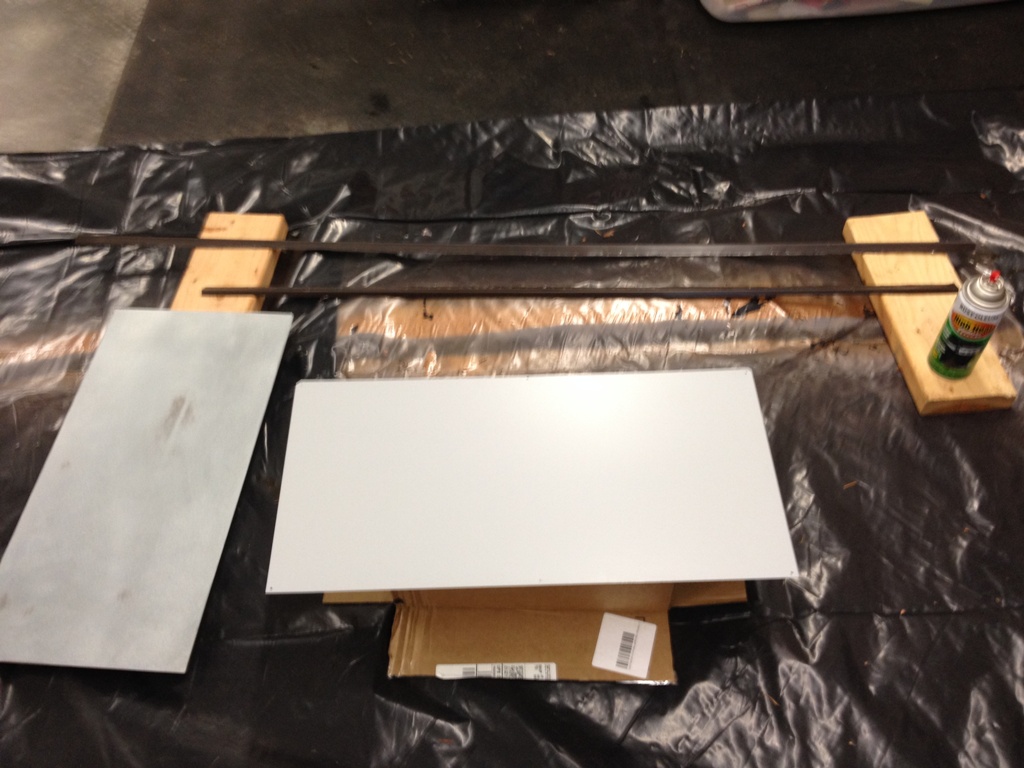
Plan S:  Paint some test sheets of galvanized steel with my high heat paint.  One was primed, the other was not.  The two strips of flashing are not galvanized and I actually don’t care if they rust, melt, rot or jump out of the wall.  I’m using them and that’s that.

Will Paint

That’s where I’m at now.  Maybe in a month or so it will all be finished and I can show you how it turned out. Still need to move some electrical, mill some trim pieces, and get everything situated so it’s safe and fireproof and doesn’t look embarrassing.

Plan Z:  If all of the above fails, I will just order the stupid copper sheets for $800 and nail it to the wall with a nail gun.  By the time we get to this letter of the alphabet, I won’t care what it looks like or how much it costs anymore.

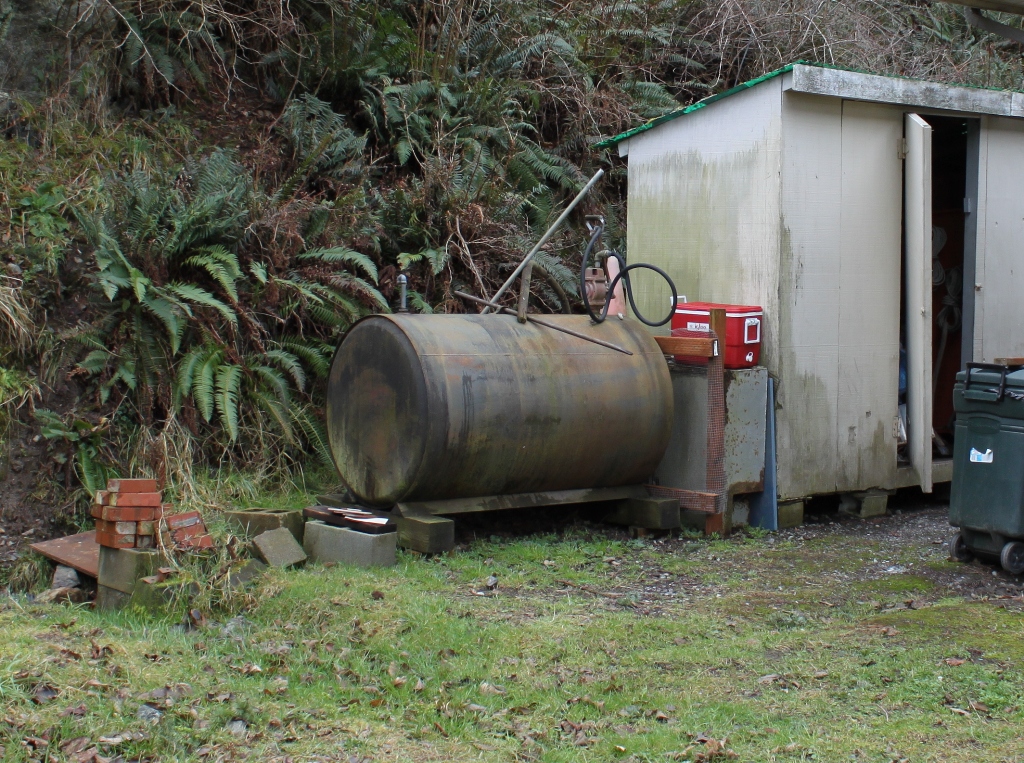
It’s finally gone

yuck


That’s the old oil tank.  It held the fuel that fed our dilapidated furnace.  It had no redeeming qualities.  It weighed about 600 pounds when empty and Zeus only knows what when full.

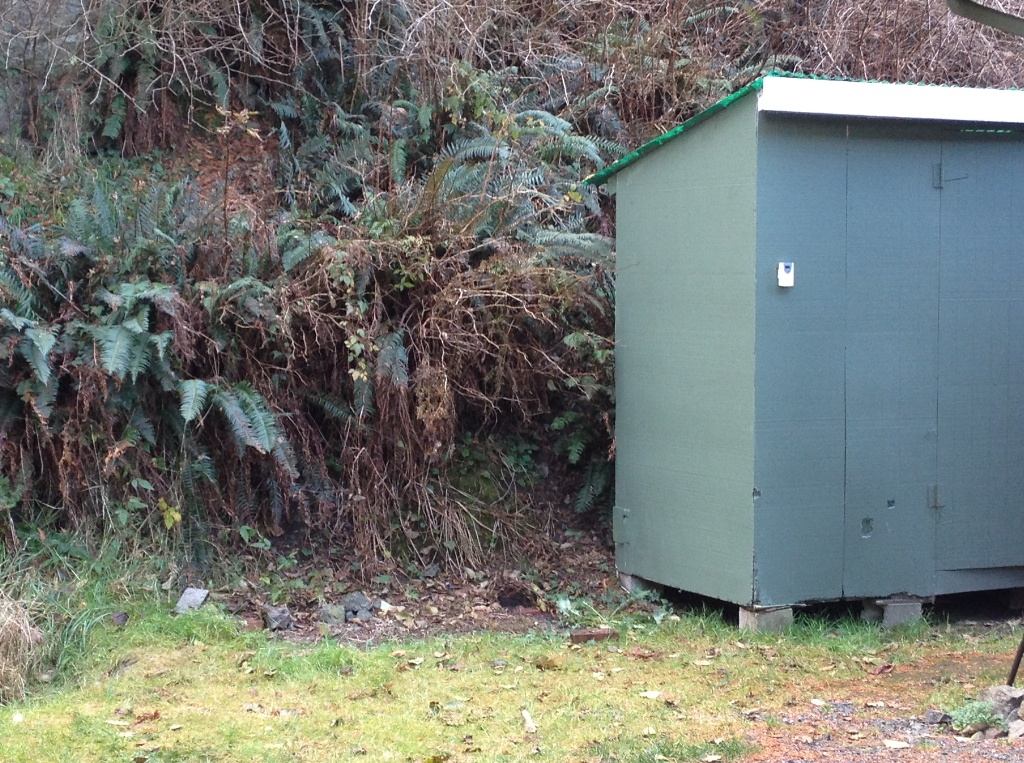
it's goneYeah, now we know how Frodo felt when he finally got rid of the Ring of Doom.  Seriously it is like a huge weight lifted off our minds, something far heavier than steel and hundreds of gallons of diesel fuel.

The plants back there may look a little dead, but you’ll be surprised how rapidly the earth takes it back and makes it lush and verdant again.  It’ll soon look fine. Now that the tank is gone, the healing process can get underway.

This was kind of the last domino before we could start landscaping.  I couldn’t finish the shed with the tank in the way.  Now that it’s gone, I can work on that ugly shed, lay down a brick patio, put up some deer fence and make a nice courtyard garden.


How “Island Time” Affects Home Improvement Projects

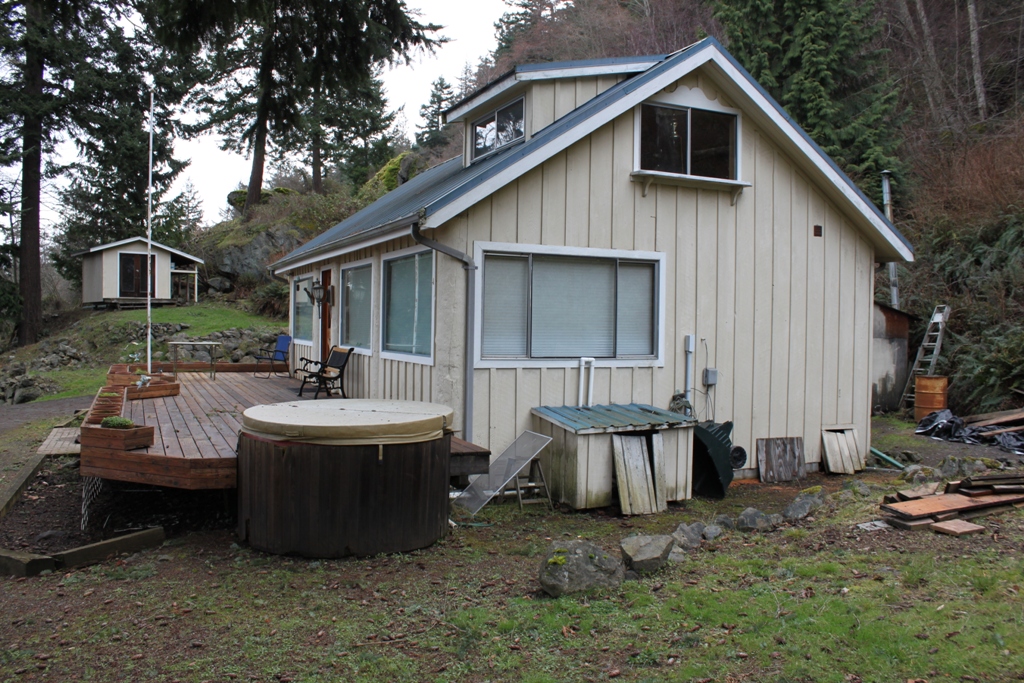
Project:  Install two vinyl replacement windows, replacing 20 year old aluminum sliders.  As always, we’ll start with the Before Picture.  The window to be replaced is at the corner of the house.  There is another just like it on the opposite side.

The Before Picture

August 3rd.  Decide to place order with vendor for two vinyl replacement windows.  Need the exact measurements for the rough opening.

August 15th.  Measure the opening.  Realize that there’s no way to really tell the exact measurement until the existing windows are out.

7:20 p.m.  Do a little surgery.  Peel back the paneling and trim pieces to see where the studs are.  Measure again.  Realize how poorly the existing windows are installed.

August 20th.  Place order for windows.  Once the windows are ready, they will be on the truck the next time it comes over to the island, which could be weeks.

September 3rd.  Windows arrive.  Decide what corner of the garage I want them in.  Instruct deliverymen to set them there.

12:22 p.m.  Change mind about where I want the windows.  Move them myself to the opposite corner.

October 4th.  Stare at the windows in my garage and realize they’ve been sitting there for several weeks and I haven’t installed them yet.

October 12th.  Begin collecting materials and hardware I will need for the window install.  Make a shopping list.

October 13th.  Buy half the stuff on the shopping list.  The hardware store didn’t have the other half of the stuff.

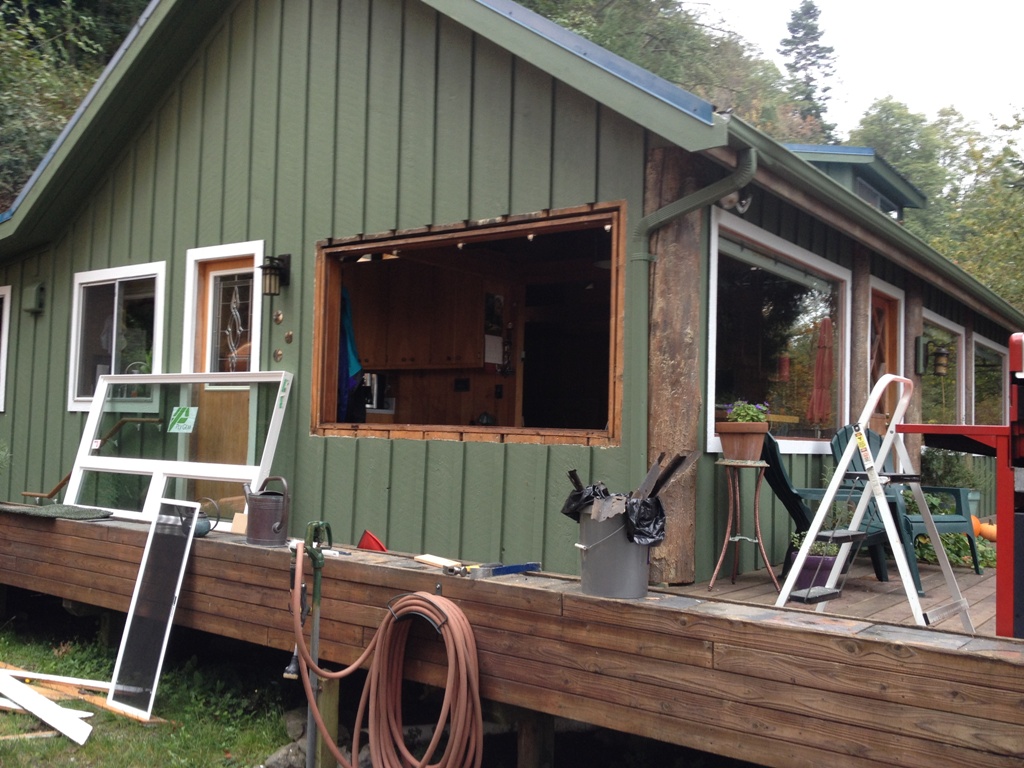
Letting the Outdoors In

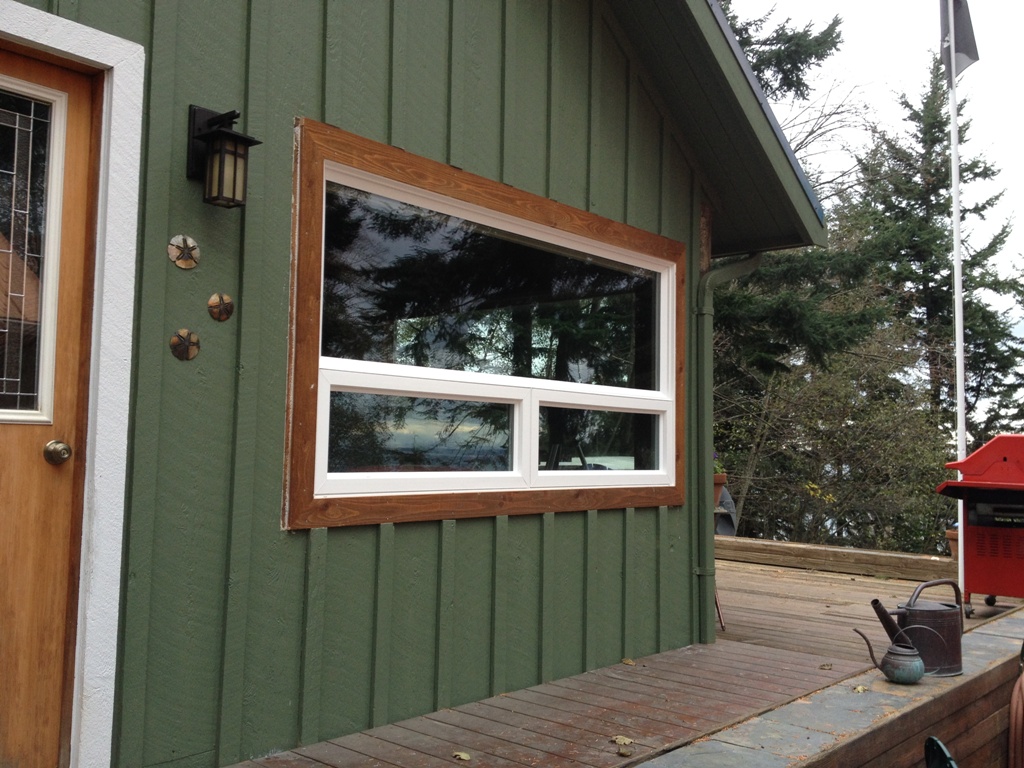
October 19th.  Take out dining area window and begin the install.  Take old window to the dump and pay $18 to dispose of it.  Buy more supplies at hardware store.

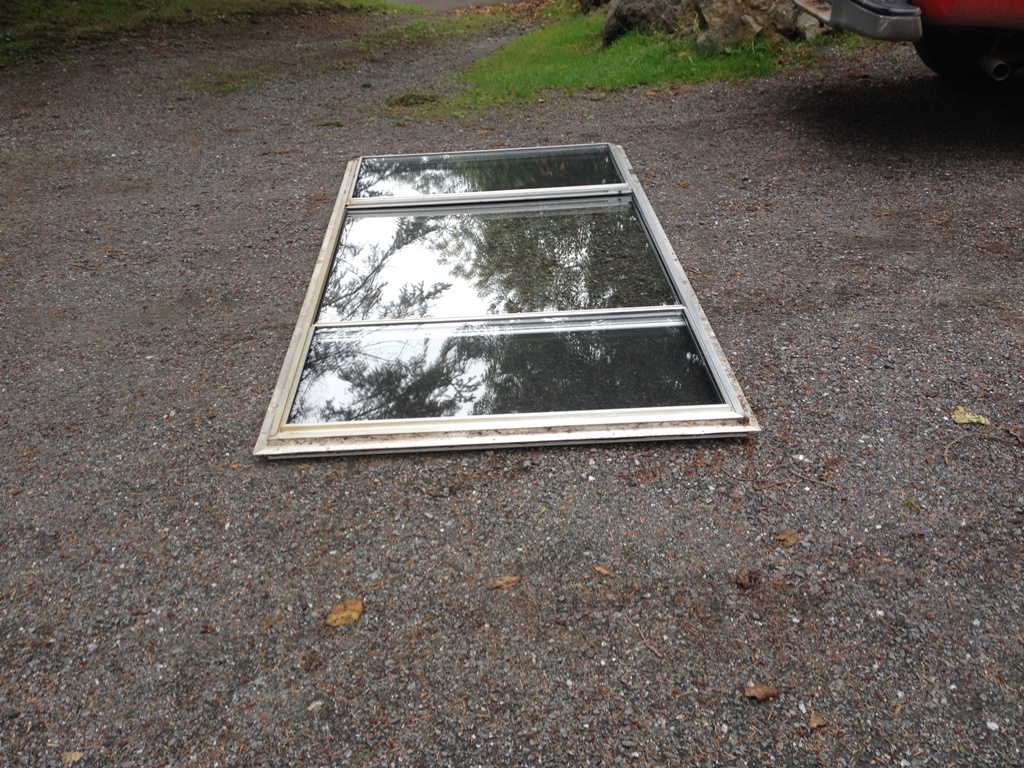
Dead Window

2:25 p.m.  Since we let the new windows sit in the garage for so long, all the adhesive labels and packaging have pretty much cured themselves to the surface, and now require a straight razor to scrape them off.

7:17 p.m.  Realize I’m not going to finish the window install today.  The window is in but there are ¼” to ½” gaps around it that let cold air in.  Put masking tape over the gaps, which seems to be better insulation than the old windows.

October 20th.  Finish dining room install.  Very tired.  Decide to tackle the bedroom window next weekend.

October 26th.  It’s next weekend.  Tired from a long week at work.  Decide to install the bedroom window tomorrow as I can probably knock it out in a day.

October 27th.  Decide that I don’t want to start the install on a Sunday in case I need the next day to finish it.  It’s the bedroom so I can’t leave it unfinished for long.

October 30th.  Buy more rough cedar trim pieces and decide to treat them with Sikkens before I nail them in place.  Open the lid to the can of Sikkens and discover it’s turned into a gelid cylinder of toxic waste.  Realize that the local hardware stores here don’t sell Sikkens.  Ask Jamie to get some next time she’s off island.

6:02 p.m.  Wonder how to legally dispose of the old can of Sikkens.

November 2nd.  It’s the following weekend.  Poured rain all day, so could not install bedroom window.

November 3rd.  Got an early start and took out old bedroom window.  Got the new window in place and sealed up.

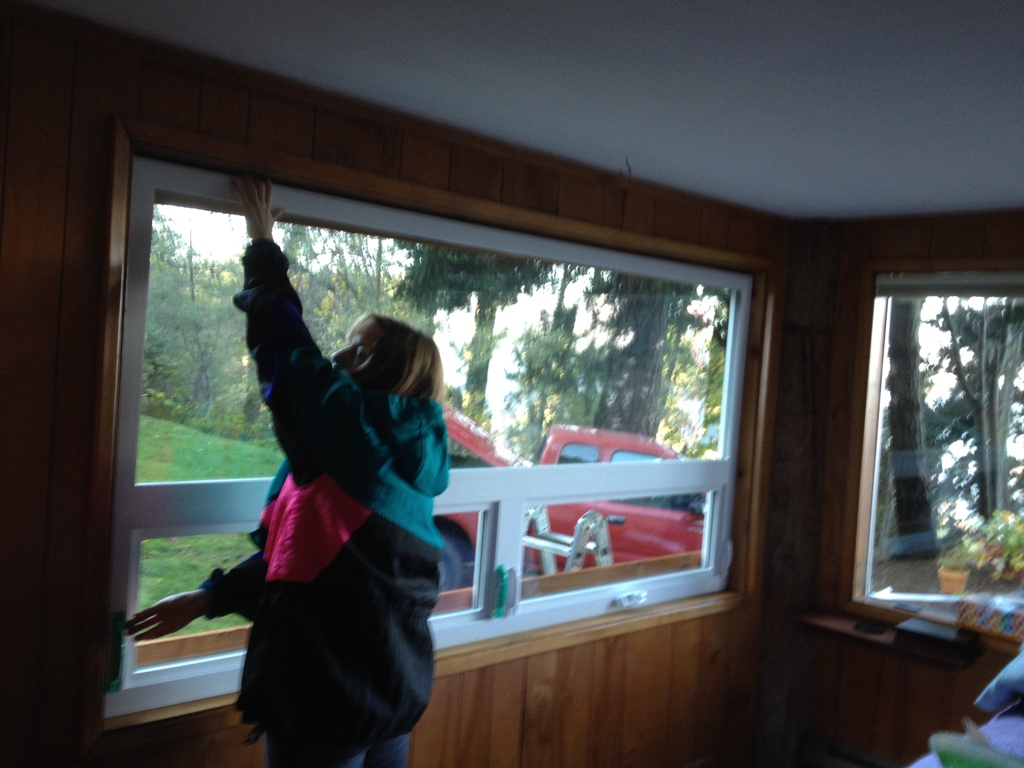
Window Holding Duty

3:00 p.m.  Started installing the trim pieces, which turned out to be more laborious as the bedroom window is located further away from my table saw than the living room window was.  So there was a lot of running back and forth to get things cut to the correct length.

4:00 p.m.  It’s getting dark, and I still need to install the flashing and the top trim piece.  It’s tricky, because it has to fit like a puzzle, except the puzzle pieces are nine feet long and one of them is a sharp piece of metal, and you’re assembling the puzzle while standing on a ladder on uneven ground in the dark.

4:15 p.m.  Not enough light to see.  I have my truck’s headlights pointed at the window but it’s still not enough light.  Hold flashlight between my teeth to see.

4:20 p.m.  Realize I haven’t eaten all day.  And the flashing is stuck on something I can’t see.

4:30 p.m.  Have to call it quits without the flashing installed and without the top trim piece caulked.  Left it in there with a couple nails.  It’s not waterproof, and the forecast calls for rain for the next ten days straight.

November 4th.  Staple a piece of plastic over the top of the window to keep the rain out.

November 9th.  It’s a three day weekend so I should have plenty of time to get the flashing in and that last trim piece weatherproofed.

November 10th.  Had to go to the mainland.  Got home late, grumpy and tired.

November 11th.  Go to a wedding.  Entire weekend went by and I never worked on the window.

November 16th.  Decide today is the day to finish the install.  Removed the stupid piece of plastic and got it ready for the flashing and the last trim piece.

10:30 a.m.  The flashing is galvanized steel, and it looks tacky.  Decide to paint it copper.

10:45 a.m.  Finish prep work for paint.  Read label to determine drying times before I can handle the painted flashing.

11:26 a.m.  Multiply dry times by six to get the Orcas Island dry time.

1:40 p.m.  Use a blow dryer to dry the paint the rest of the way.  Don’t care if it works or not.

2:31 p.m.  Realize the final trim piece is too wide and must be resawn.  Spend 30 minutes picking dried caulk off it so it can go over the table saw without making a mess.

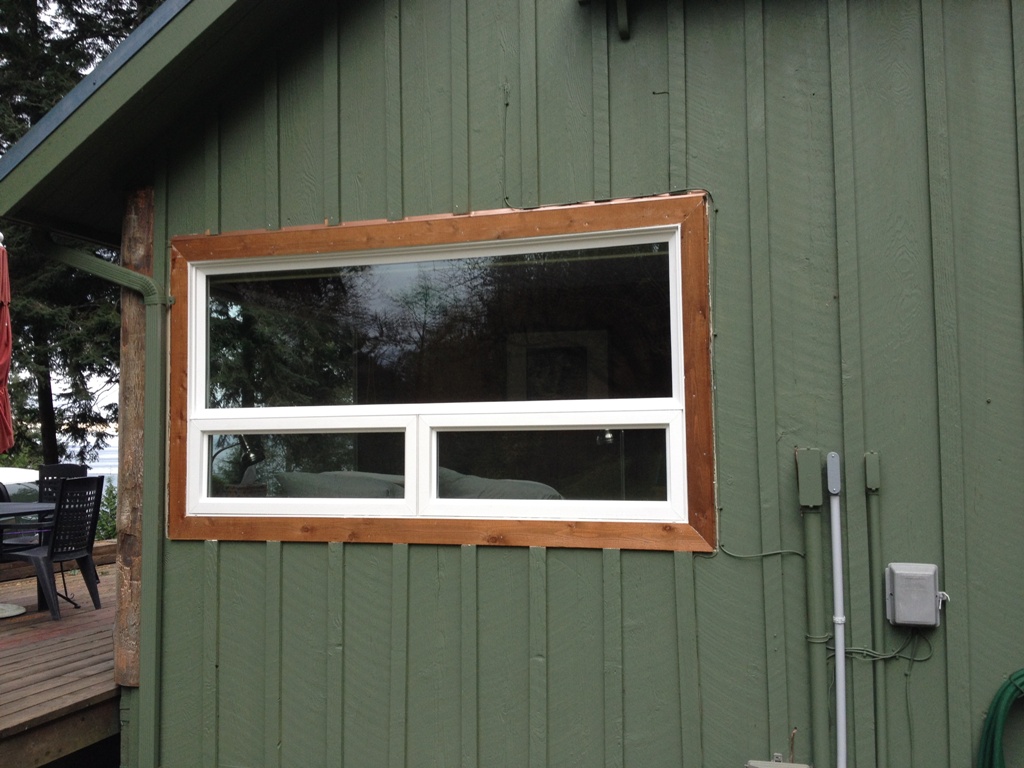
4:04 p.m.  Final assembly and weatherproofing of bedroom window is complete.  Still need to do touch up paint but we need to wait for warm weather, so that won’t happen until next spring.  And we still need to do inside trim but we need to wait until I drywall so that won’t happen until 2015.  But the windows are in and are warmer and quieter by far than the old aluminum crap windows we had.

Dining Side

Bedroom Side


Total install time:  3 months.

4:09 p.m.  The new windows change the view outside.  Which has made me realize I need to do some landscaping out there to make the view look nicer.


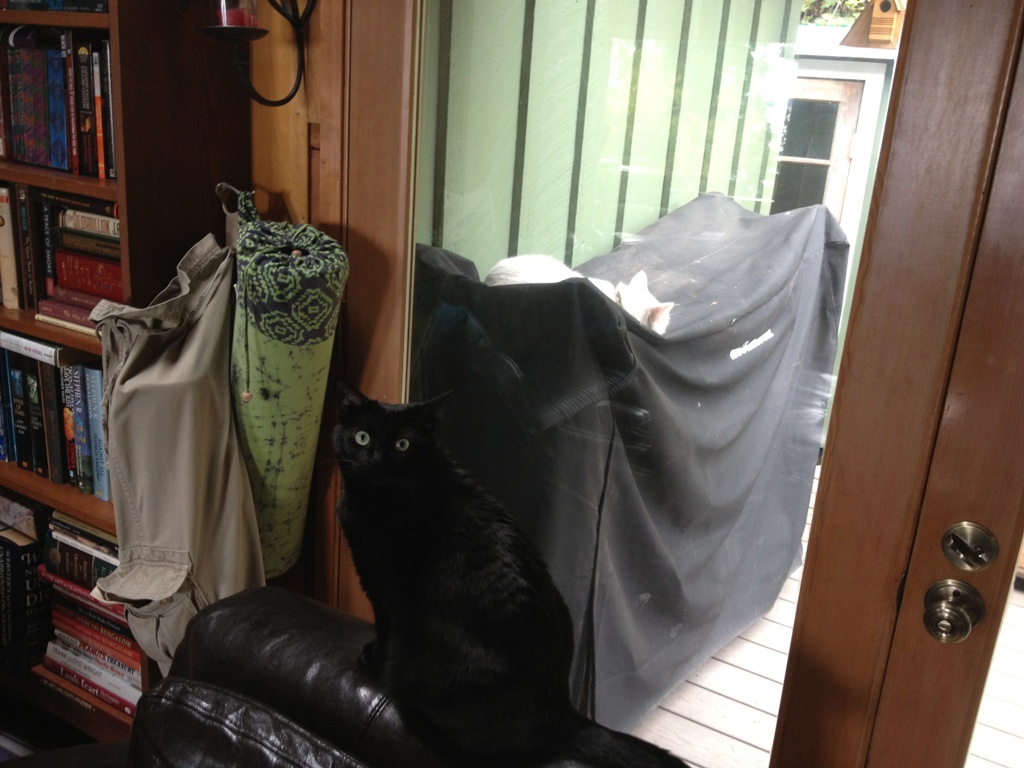
Murder Cat

my perchHigh atop my perch I lay
And think of murder every day


I think of murder day and night
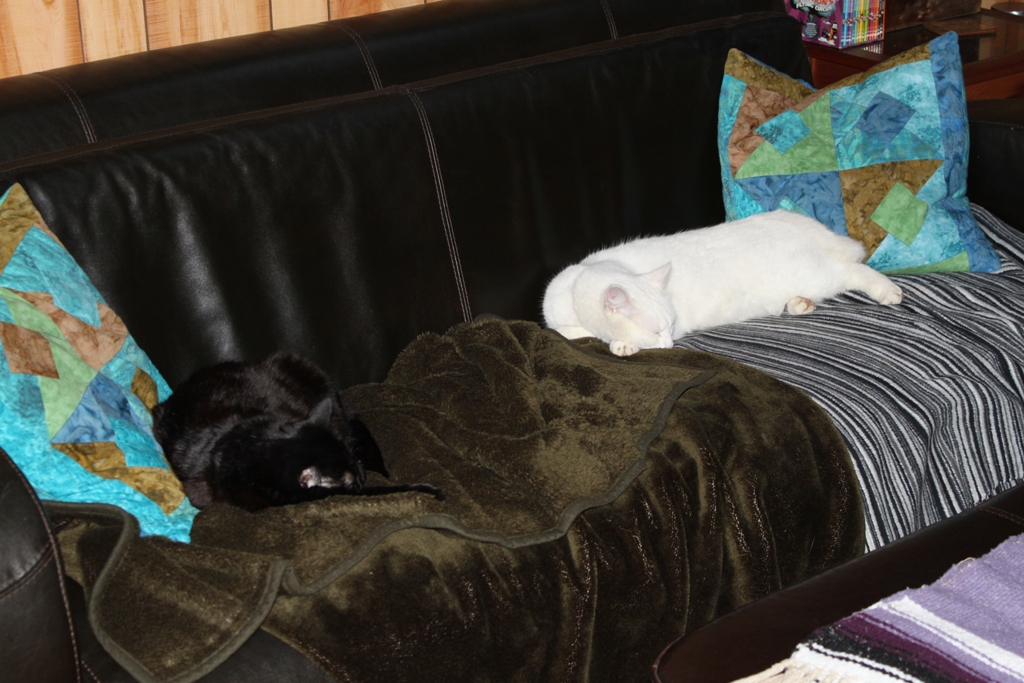
And when I see the cat who’s white


eats my foodThe humans deign to let him in
And cater to his every whim


They think he’s nice and icky sweet
I want to kick him with my feet


want to claw himHe comes inside and eats my food
Which I believe is very rude


When I see that mouse he’s caught,
REDRUM fills my every thought


sits in my spotMy warning hiss he does ignore
And enjoys my catnip on the floor


He bites and plays with all my toys
His stupid bell jingles with noise


my catnipHe sits and sleeps while in my spot
It think it is some kind of plot


I want to bite and claw his face
And send him into outer space


murder catI wish he would just go away
And leave me here alone to play


I would like to tell him that
He shouldn’t mess with Murder Cat

The Dead of Night

Just as there are things that cannot be sufficiently described in words, there are sights that cannot be captured by a camera.  Many of the hours between sunfall and sunrise, when the light is most distant from us, are like that.

creepy


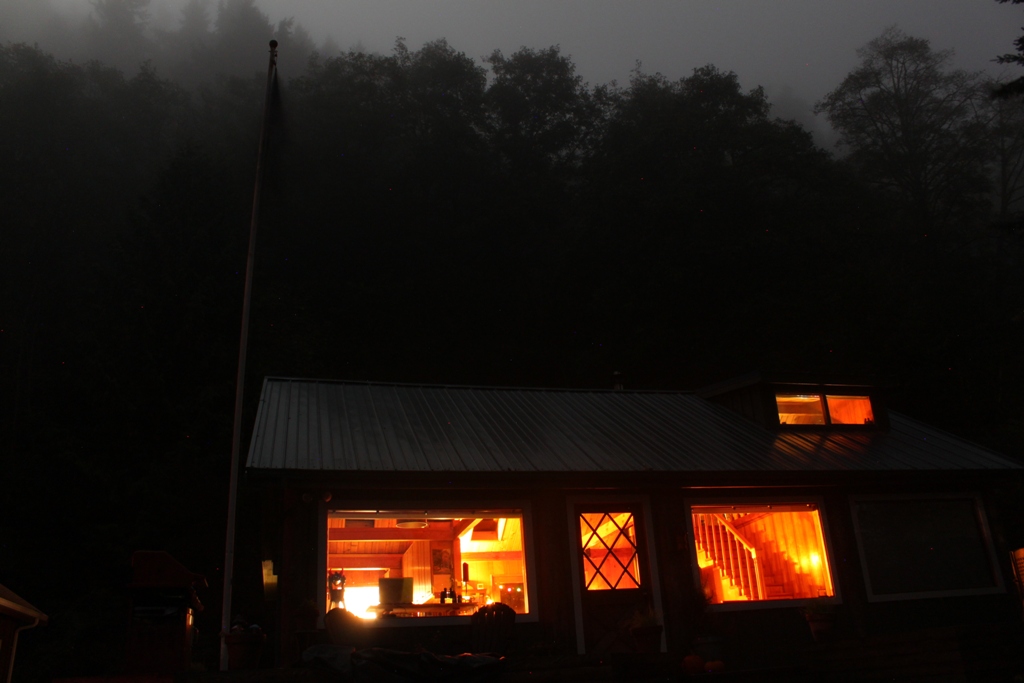
We were beset by an eldritch fog the other night, a fog that may have lurked imperceptibly at the edges of our senses were it not for the dazzling brightness of a full moon just over the mountain.  Absent illumination, we may have felt that the air was just a little thicker than normal, that the sounds of the night were just a little closer, but just another dark night save for a creepiness we could not quite place.  The night’s strange echoes and odd ticks may have been attributed to our own over-active imaginations.

kooky

But the moon’s light shew us the true source of our unease, a fog so thick you could grasp it in your fist.  The moon hung pale and cold like a distant sun over an alien planet.  This was the stuff of werewolves and zombie apocalypses.  The very air glowed with a phosphorescence that is hard to describe, let alone photograph.

mysterious

If you look at that picture and don’t immediately think our house is about to be devoured by Cthulhu, I just don’t know what to say to you.

spooky

Not only does the camera fail to capture the depth, but nothing can convey the eerie sound.  The fog makes noises feel closer, like you’re in a cave.  The effect is just surreal.  Like you’ve wandered into another world, and you better not wander past the orange glow of the windows of your house, lest you become so lost you can never be found again.

ooky


If only every Halloween could be like this


Pics from the new telescope

I got a new telescope, one that makes my old telescope look like one of those plastic magnifying glasses you find buried in a box of cracker jacks.  It’s a Celestron reflector with a nice wide opening that lets lots of light in.  If you’re shopping for a telescope, you really want to look for two big things:  a sturdy tripod, and the biggest diameter you can afford.  The diameter of the opening dictates how many photons the telescope can see.  More photons = more light.  More light = more of what you can see.  Reflection power doesn’t mean crap.  Go for diameter.

To give you an idea of the magnitude of the telescope, here is a picture of the trees on Matia Island, which is about 3 miles away from our house.

Mattia

You can see woodpeckers if you look hard enough.  Seriously, this telescope gets up close and personal.  I can sort of fit my camera over the eyepiece to get pics like that.  It’s not perfect but I think I can devise some way of fastening it securely and maybe find a fine-tune focus knob to get crisper images.

Now, here is a picture of the moon, which is 238,900 miles from our house.

Moon

I hope to get crisper images and once I can get the camera better secured to the telescope I can connect it all to the laptop and I’ll have my own little observatory right out on my front desk.

Being on the north slope of a mountain, most planets rise and set out of my view.  And being on Orcas, clear nights are not very common.  So I’ll have to be opportunistic to get some nice pics of planets and things up there.  I’ve seen Jupiter’s moons through my camera’s zoom lens before, so I think I can do better once I get this new telescope fully set up.

A special and heartfelt thanks to Charlie, Judy and Mindy for conspiring to bequeath the telescope to me in the first place.  I promise to be a worthy custodian, and when/if ever I take cool pics with it I’ll be sure to post them here.  Thanks, guys.  This telescope is a lot of fun up here.

Stormy Days

Seagulls


The winds have been so loud at night that Inky’s been hiding under the bed.  If the wind isn’t howling, the rain is hammering on the roof.  I turned the outside lights on one night at 2 a.m. and the rain was going every direction there was – up, down, sideways, diagonal, you name it.  It felt like we should have been rocking back and forth like we were out to sea ourselves.

Sometimes the winds drive all the clouds away and you get a clear shot of the sky.  We had this big cyclopean moon up there like a flashlight shining on our little snowglobe.  And yet, all the spiders and snails and birds and assorted critters out there are doing just fine.  Wind hasn’t blown anyone away yet.  Including us or our house, though we’ve wondered when that’s going to happen.

stormy

Ironically, most of the tourists have gone home now after spending a lovely summer here thinking we have the best weather on the whole planet and they can’t wait until next May when they come back and visit us.  Great.  See you then, guys.