How To Attach Your Bookshelf To The Wall And Not Look Like A Redneck

So, almost two years ago I made the Jeff Foxworthy inspired joke “You might be a redneck if you mount your bookshelf on the wall with 2×4’s.”
IMG_0242s

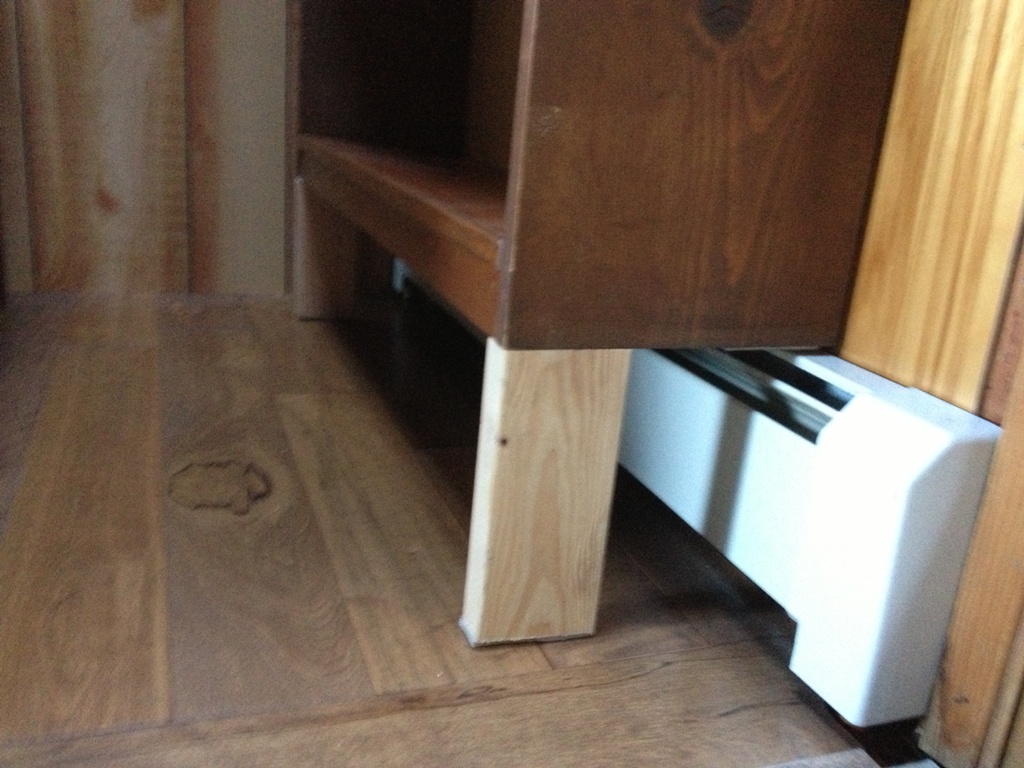
Yeah.  You see, we have these little hot water radiators that heat the house.  They work ok.  I guess.  But you can’t really put furniture in front of them or you lose all that heat.  Plus, the furniture doesn’t go right up against the wall.  Ergo, I mounted my bookshelf up on 2×4’s and installed it into the wall.  The resultant space beneath the bookshelf was a favorite cat hangout, due to the nice warmth it gave and the opportunistic view of the birds out the back door.

Well, I always knew that when I got around to destroying the paneling and replacing it with drywall, I’d make something a tad nicer than a 2×4 block to support the front load of this 600 pound bookshelf.  But first, a bit of history about the stupid bookshelf.
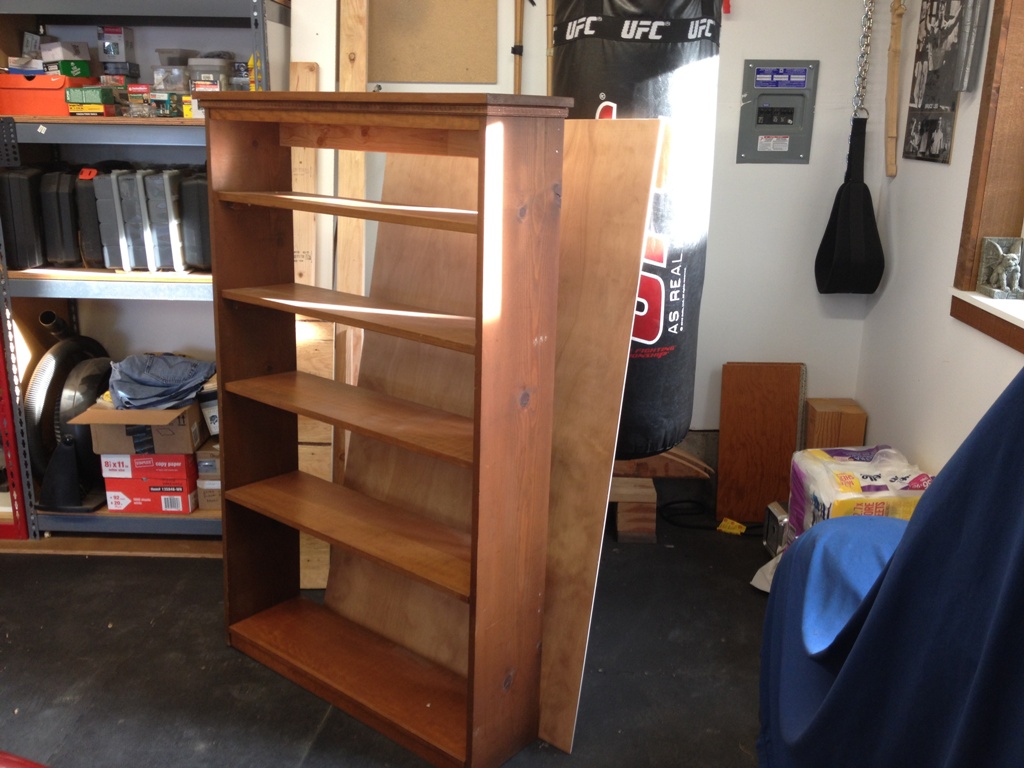
bookshelf

This was one of the first pieces of furniture I ever made.  I had some spare boards from my old house in Denver, good aged fir 1x12s with really nice patina and very good strength.  These were from old growth trees, and the wood is nice and dried now.  It’s a shame they were butchered by my amateur techniques but there you have it.

The poor thing has been through the war and crossed several state lines to be where it is now.  It’s never had a proper backing, so I bought some 1/4″ plywood that I’ll stain and affix to the back. Other than that, I’ll give it a few coats of polyurethane that it always deserved and patch it up nice.  And when I put it back on the wall, it’s not going to be on crappy paneling but real sheetrock, just like modern homes.  And it won’t be on 2×4’s!!
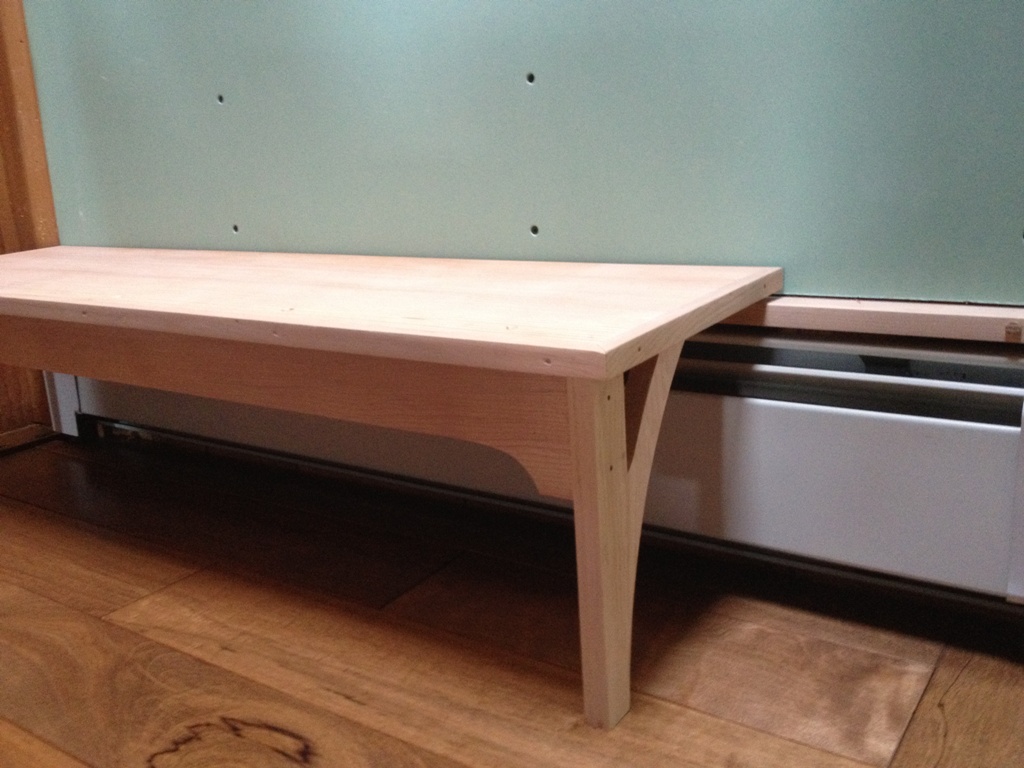
footer

I made this little base to support it, and it rests on a ledge that’s screwn directly into the wall studs.  I’ll stain this to resemble (not match, I never have any luck trying to color match) the bookshelf and I think it will go together nicely.  In another week or two, this monster bookshelf will be built into the wall and suspended over the heaters and our cat will have a nice warm place to watch birds from.
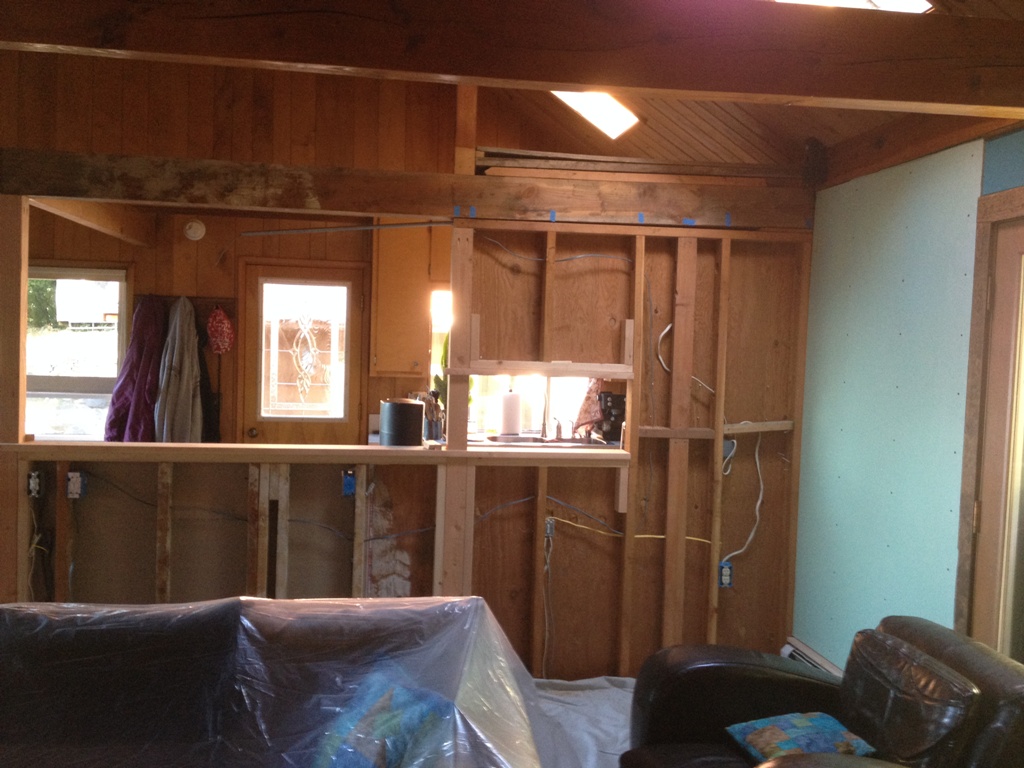
progress

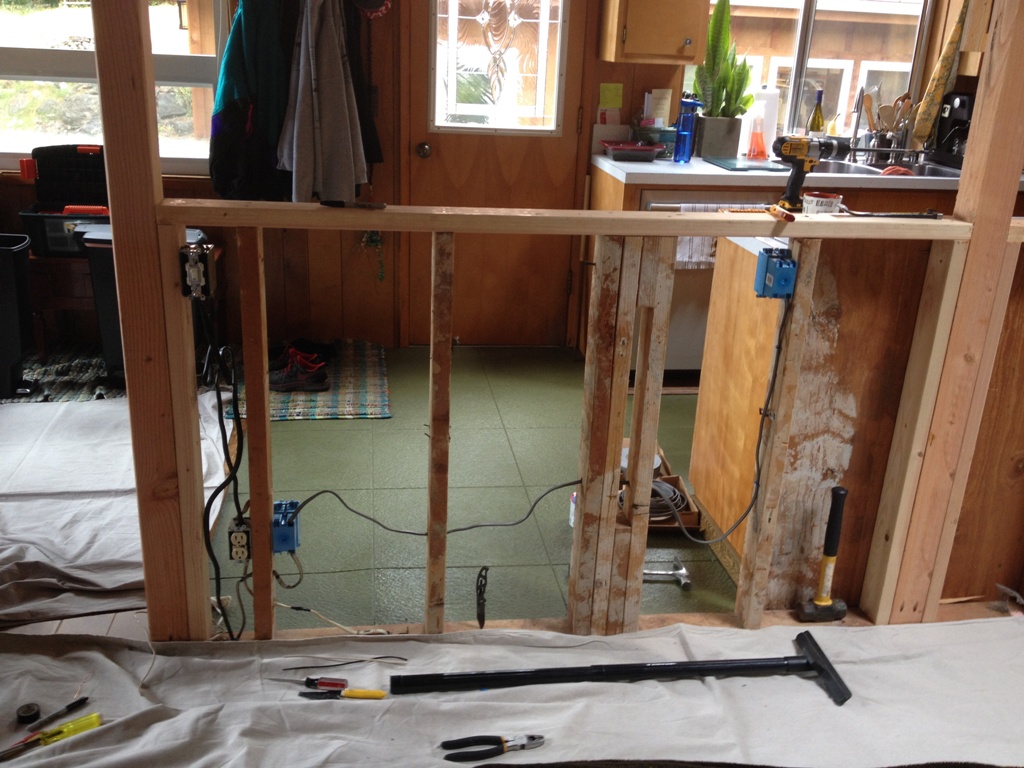
In other news, we’re making progress on the wall demo.  I’ve almost finished all the electrical work.  It was finished last week but we decided we wanted lights dangling in that little open space so now I have more electrical work to do.  I had to run the wire through a 4″ post, a 4″ post with 2×4’s joined to each side (that was fun to drill through) and now I get to decide which of the three circuits I want to draw power from.  That wall has wires from (1) the bathroom circuit, (2) the laundry room circuit, and (3) an unknown circuit that has some kitchen outlets on it now.  I’ll sleep on it but I’m probably going with (3).
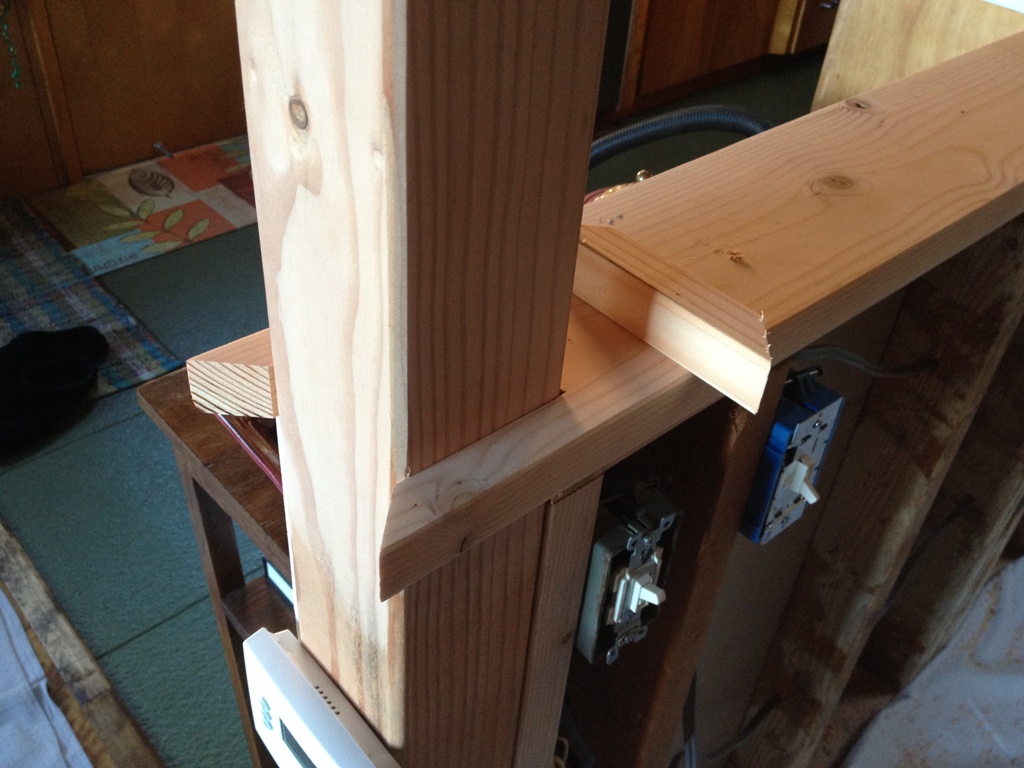
cap

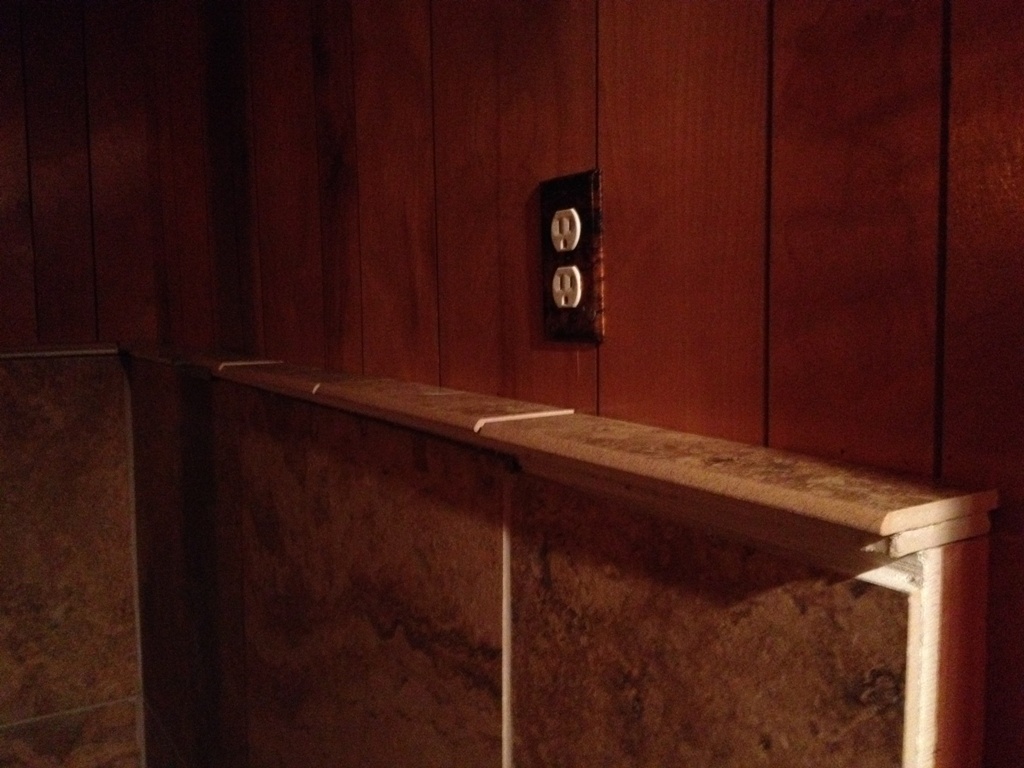
One of the funner bits of woodworking I got to do was make a cap for the half wall.  I used one of the remaining 2×6’s I had left over from the garage construction, and planed it down to about 1 1/8″ so it doesn’t look like a 2×6.  I had to cut holes for the posts and install them around like that.  I was going to do some fancy pants joinery like triangular feather joints at the corners, but I really need to finish this project by 2016.  And I have a full time job that eats up more of my time than I spend sleeping.  So I’m probably just going to use tenpenny nails.
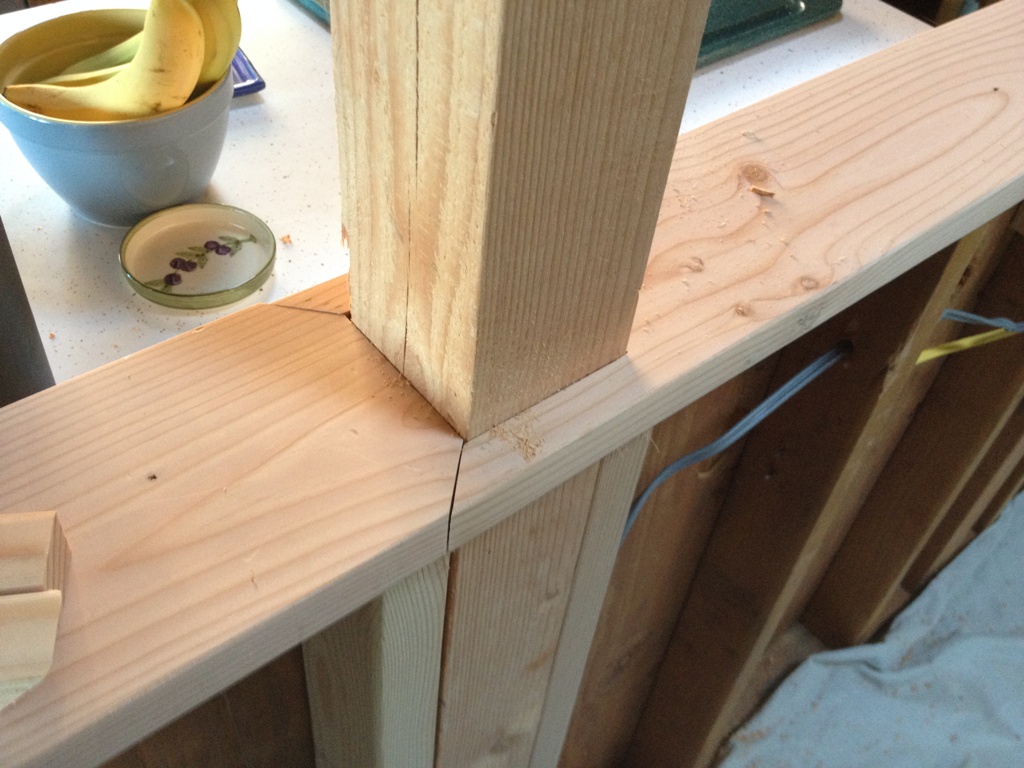
joinery

A little glue, some cabinet mounting screws, some time with the Festool sander, and it’ll look great.  Okay, it’ll look adequate.  And I’m proud of myself:  it’s one of the few things in this house that is actually level.  It’s kind of weird.  Makes the rest of the house look lopsided.
no help

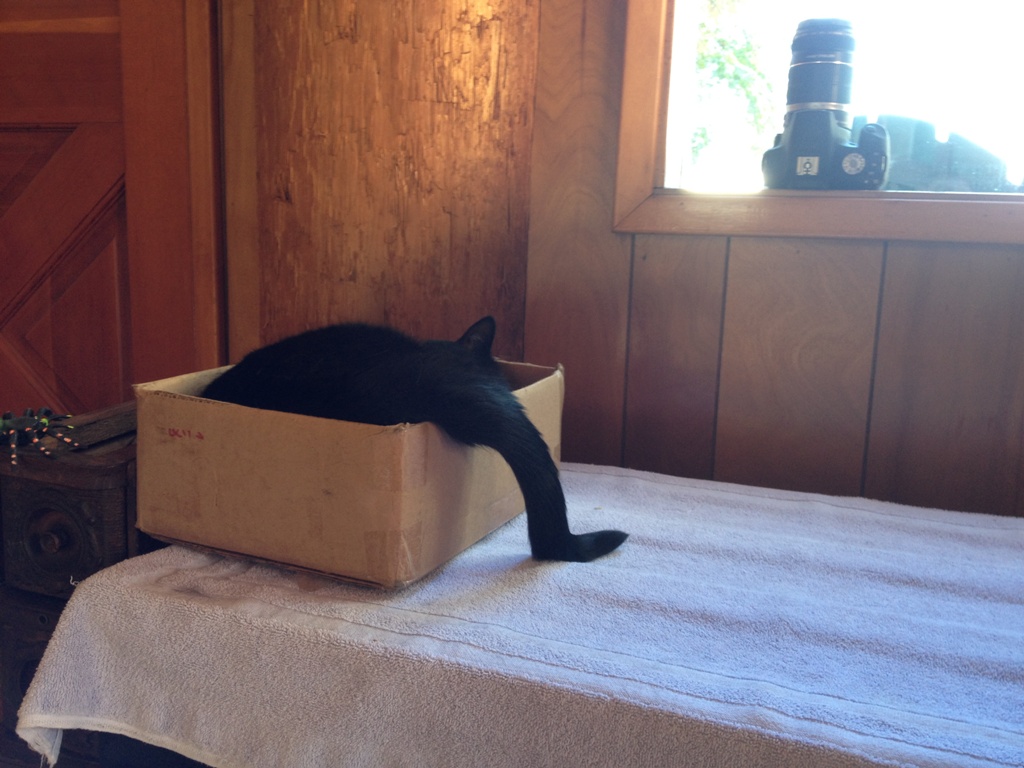
Of course, some of those who live here would be perfectly happy if everything was made out of cardboard.
Down With Crappy Wood Paneling!

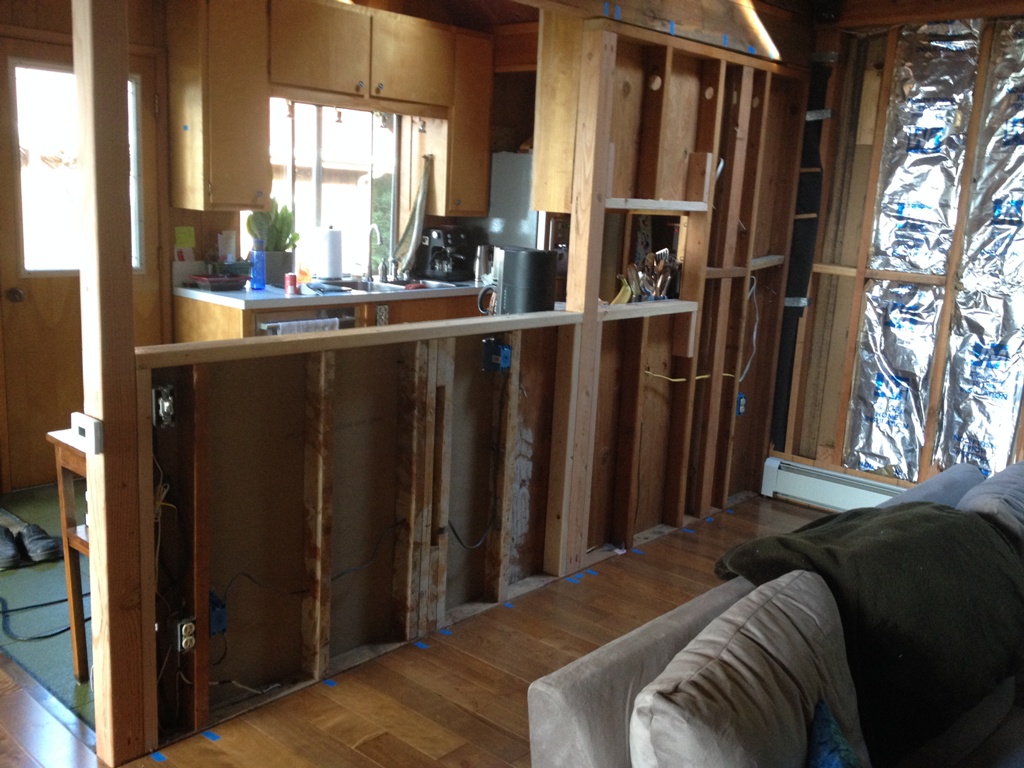
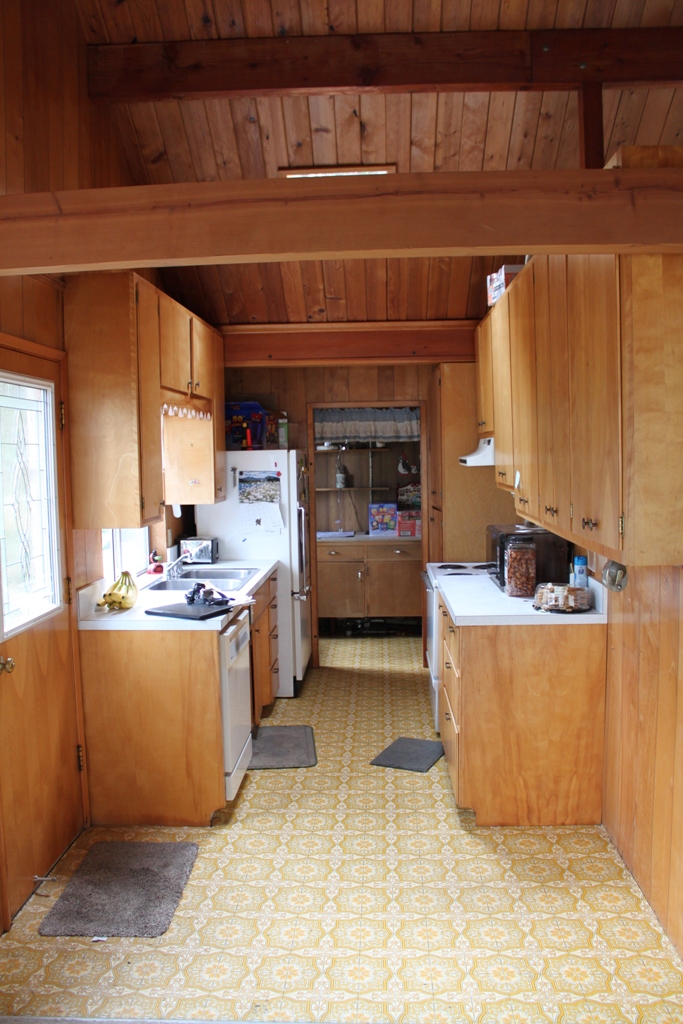
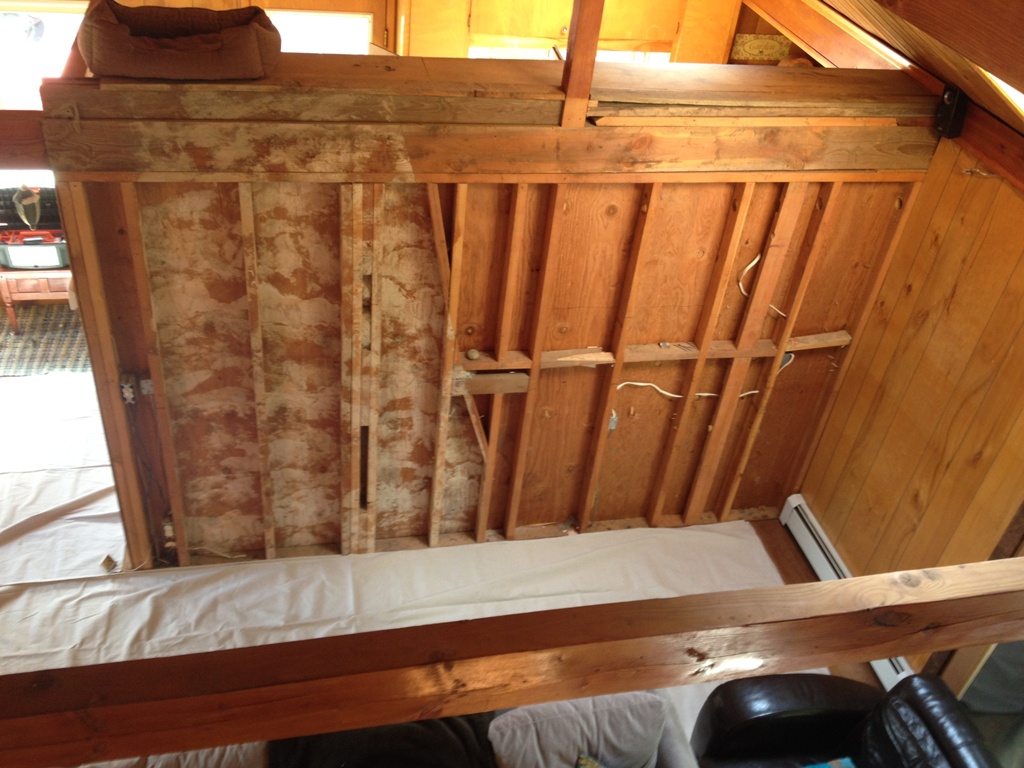
Now, we’ve always wanted to remove the wall between the kitchen and living area.  We’re really sick of having to run around the corner every time someone scores a hockey goal.  With the wall out of the way, we can raid the fridge and watch hockey at the same time!  And, it really opens the house up, making the tiny kitchen bigger.

And we hated the paneling.  HATED!

It wan’t even real paneling, just the cheap imitation pressed cardboard stuff.  Removing it took about 15 minutes.  Didn’t even put up a fight.  Just popped right out like it knew its time was up.  Naturally, it’s what you find behind the wall that sets the tone, and budget, of the project.

WTF

I’m not terribly sure what to make of the slanted wall area.  It’s a shadow of its former self, and I think it used to be a tepee of stone and mortar.  I think that’s about where the old wood stove used to be.  Or an open fire pit.  Or something.  No idea what they were thinking.

Cabinets

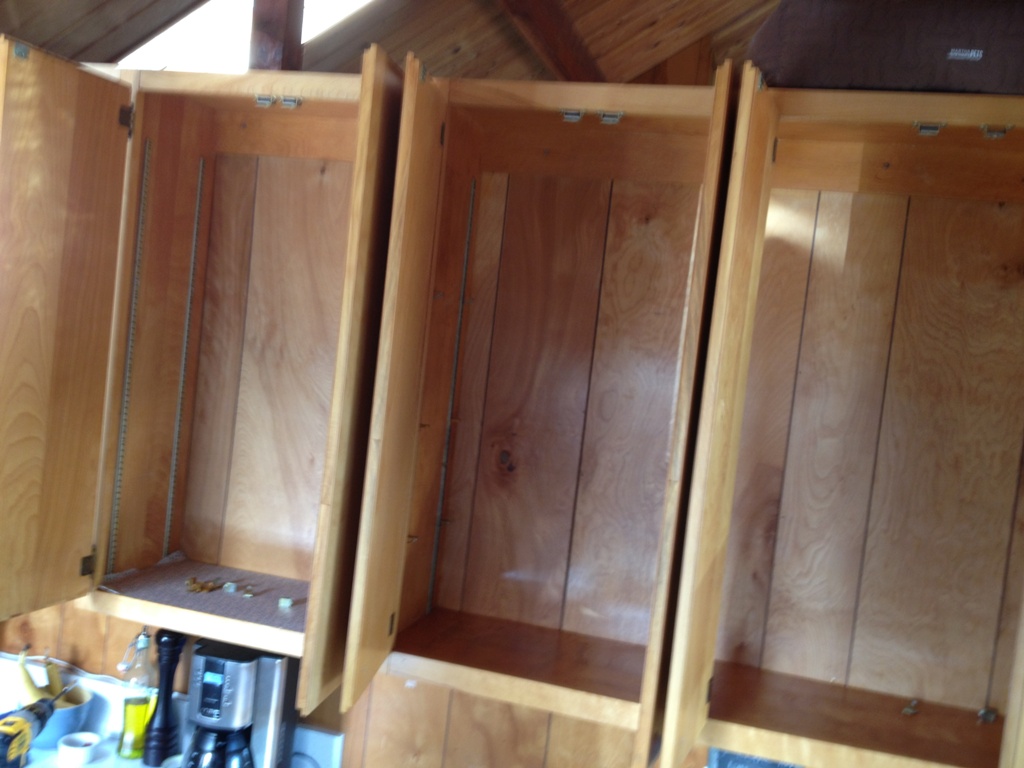
Now the first thing we had to do is empty out some valuable cabinet space.  There was about 24 cubic feet of storage area in those cabinets.  There is not a lot of storage here so we had to get creative.  And throw a lot of crap out, too.  But once those shelves were empty, I could proceed to demo the cabinets and get working on that wall.

Surgery

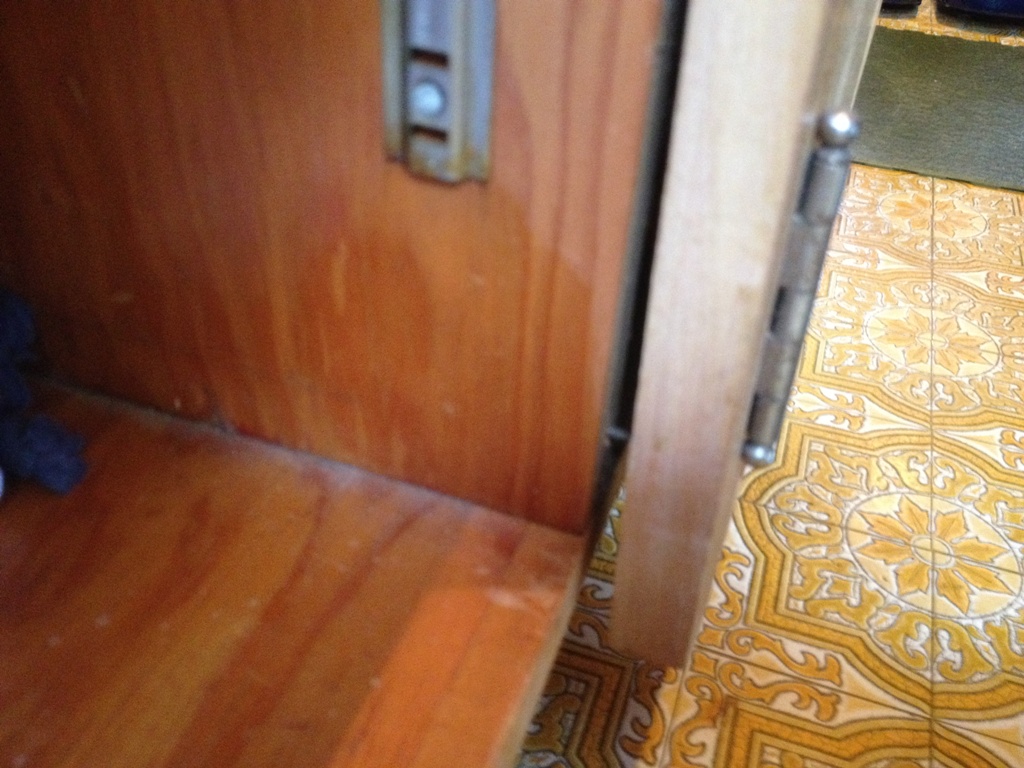
The cabinets were all one piece, so it required a little surgery to separate them.

Hinges

And a little brute force.

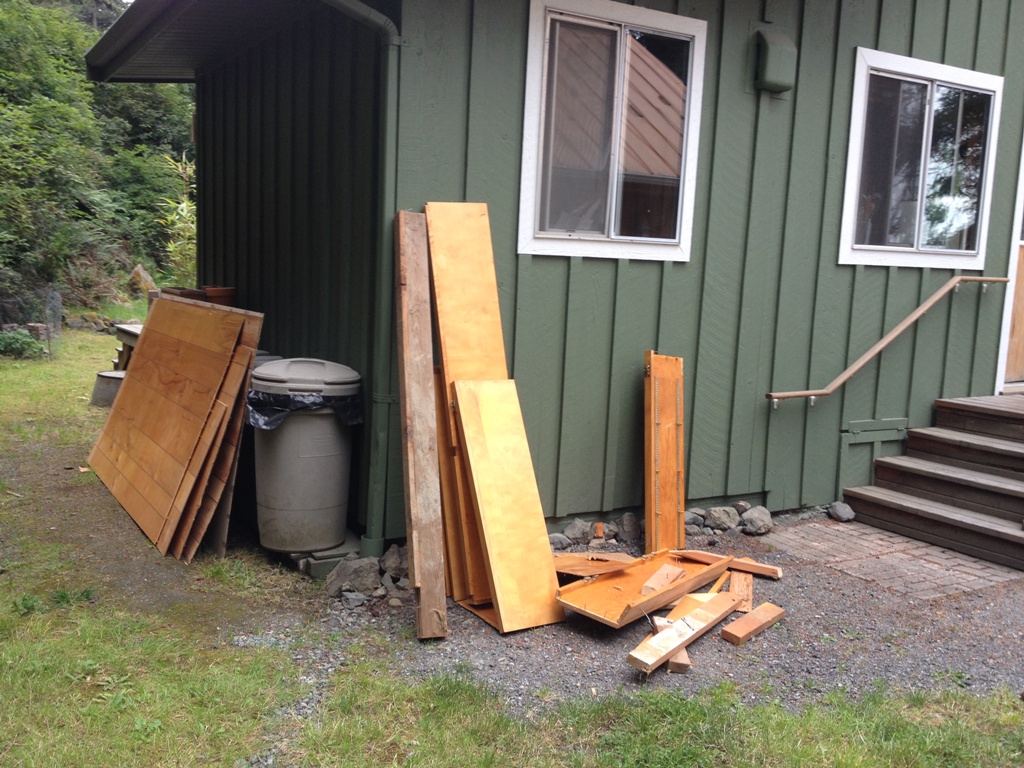
Garbage

There’s about half the cabinets and most of the paneling.  Out by the trash where it belonged.

Open

After one weekend, we’re not even close to being finished.  In addition to demo and framing and re-framing, there was a lot of electrical work that needed to get done.  There was an outlet hidden behind the cabinetry, a perfectly good outlet that no one could get to.  We used to plug in the coffee by using an extension cord that reached behind the stove.  Shameful.

Much Better

So now all the framing is complete and I have one sheet of drywall in on one side of the half wall.  There’s some more drywall to put up and quite a bit of finish trim to do, but it’s coming along.

Restored Laundry Room Cabinet

at least it is cleaner

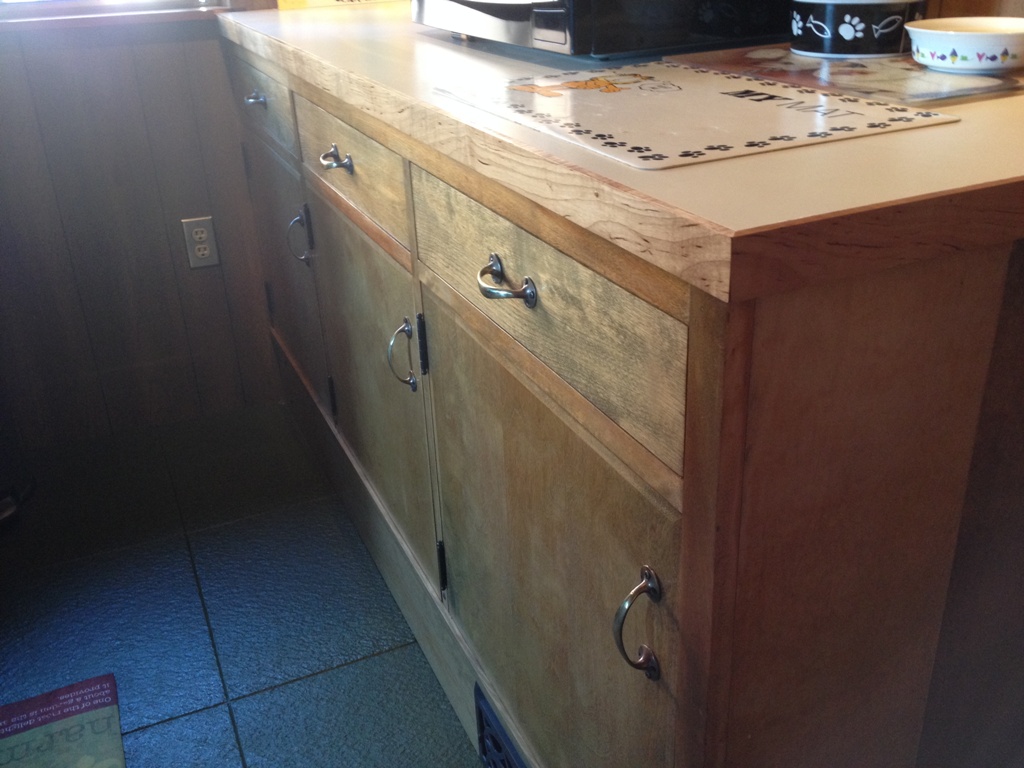
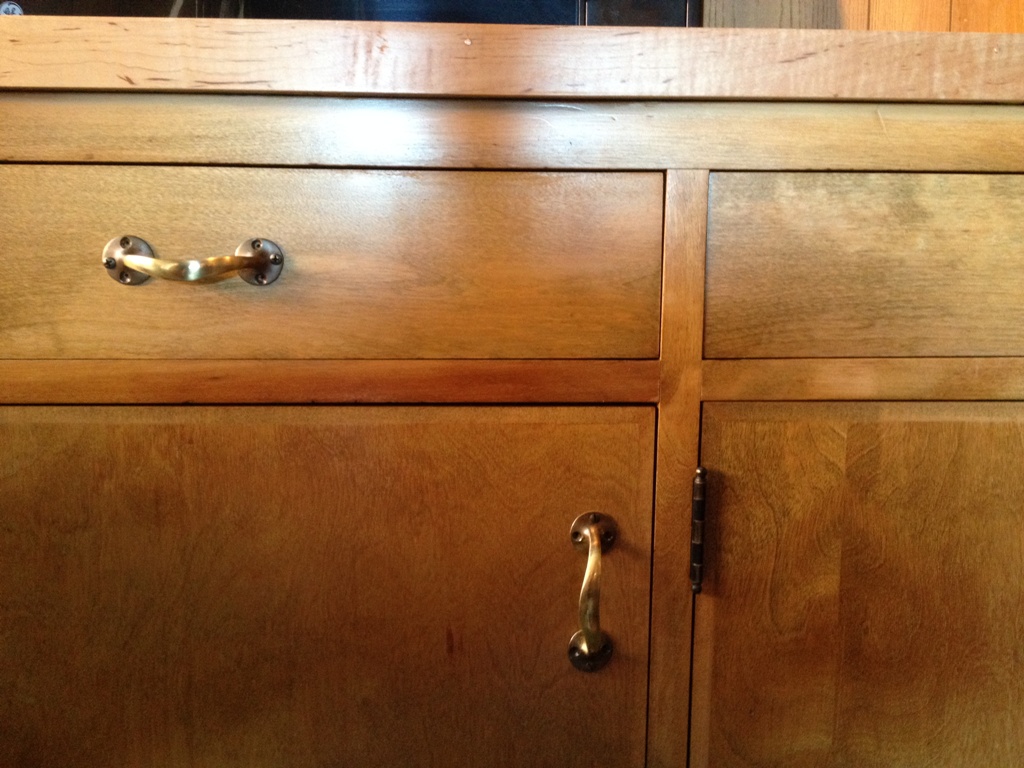
Alright, $24 for a melamine top, $28 for a register cover, $85 (ouch!) for new hinges, and I used drawer pulls, scrap wood, stain and polyurethane that I already had, and this cabinet lives another day.  Oh, and I needed to order some special cabinet screws for those drawer pulls, so another $8.  (I had existing screws but the heads kept popping off; I have a real low tolerance for that.)

little trick

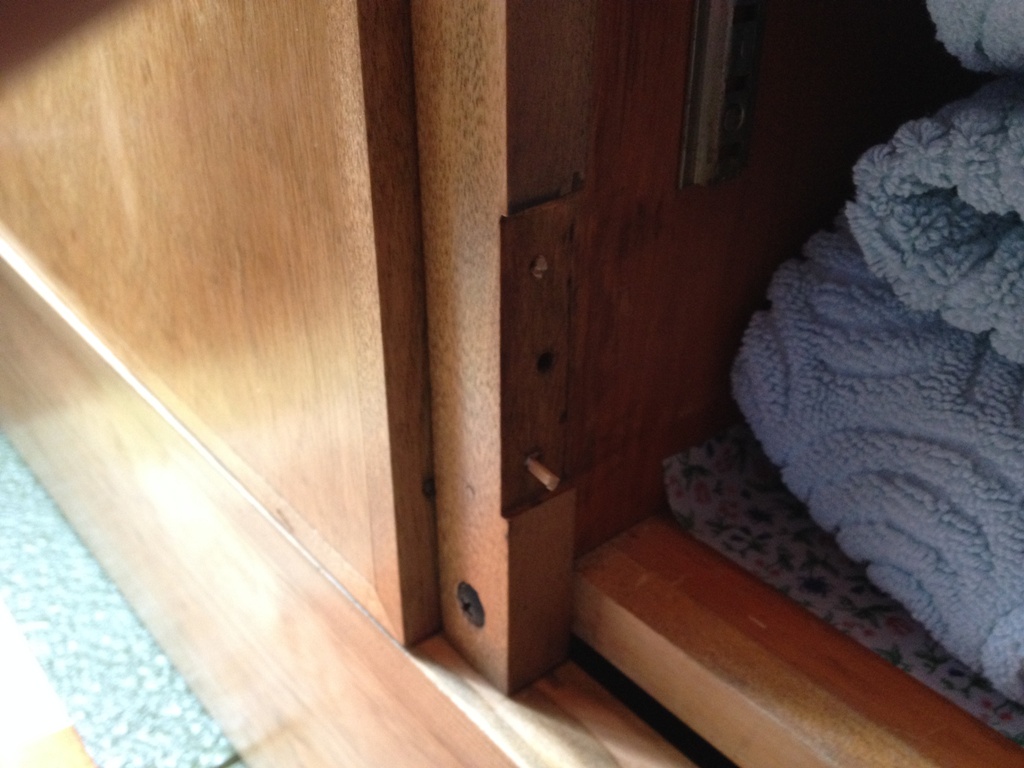
Here’s a little trick for when the holes for your new hinges don’t line up with the old holes.  Now, you’re going to drill new holes in new locations and that’s fine.  But this is such a small area that if you leave the existing holes alone, the wood gets really weakened.  So you want to stuff something into that hole, a little dowel or even a couple toothpicks and wood glue will seal it up fine.  Maybe it’s overkill, but it does prevent the new screw from trying to wander into the old hole, making your hinge install go wonky.

new hardware

One challenge I faced is that the door frames were all skewed.  I think when this cabinet was moved, the whole thing kind of slanted over, making distinct parallelograms where you really want rectangles.  Oh well, huh?  So no matter how I cut and trim and shim the cabinet doors, they’re not going to close straight.

BUT THEY DO SHUT!  And they shut cleanly, That alone is an improvement.

still from hell

Nonetheless, it’s still the Cabinet From Hell.  It’s just less of an eyesore now, and it will serve and function until such time as I decide to make a new cabinet for the laundry room.  A task that I can now put off another few years while I work on fixing other broken things around here.

The melamine top is the biggest difference by far.  You can clean it.  You can spray it with windex and it actually comes clean.  Amazing.

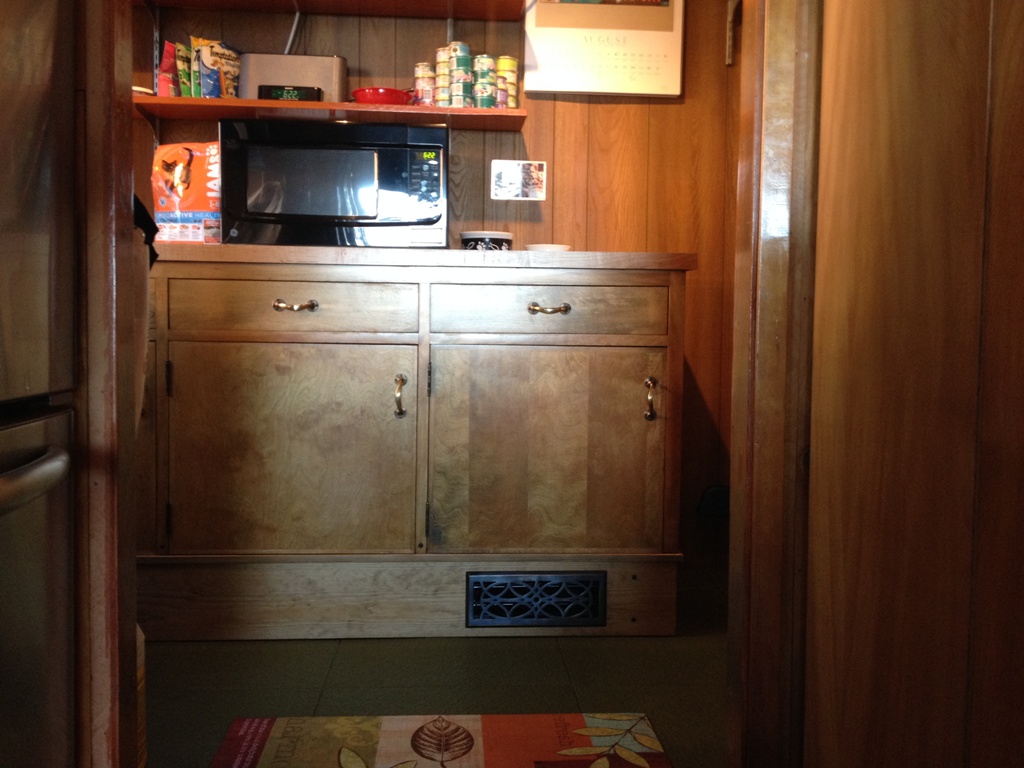
Our laundry room is a hard working room.  A lot gets done in that small space; not only laundry but storage, cat dining area, and the only place in the house that the microwave will fit.  And now it’s just a little less embarrassing.  New flooring too, but I’m holding off on pics until that’s finished.

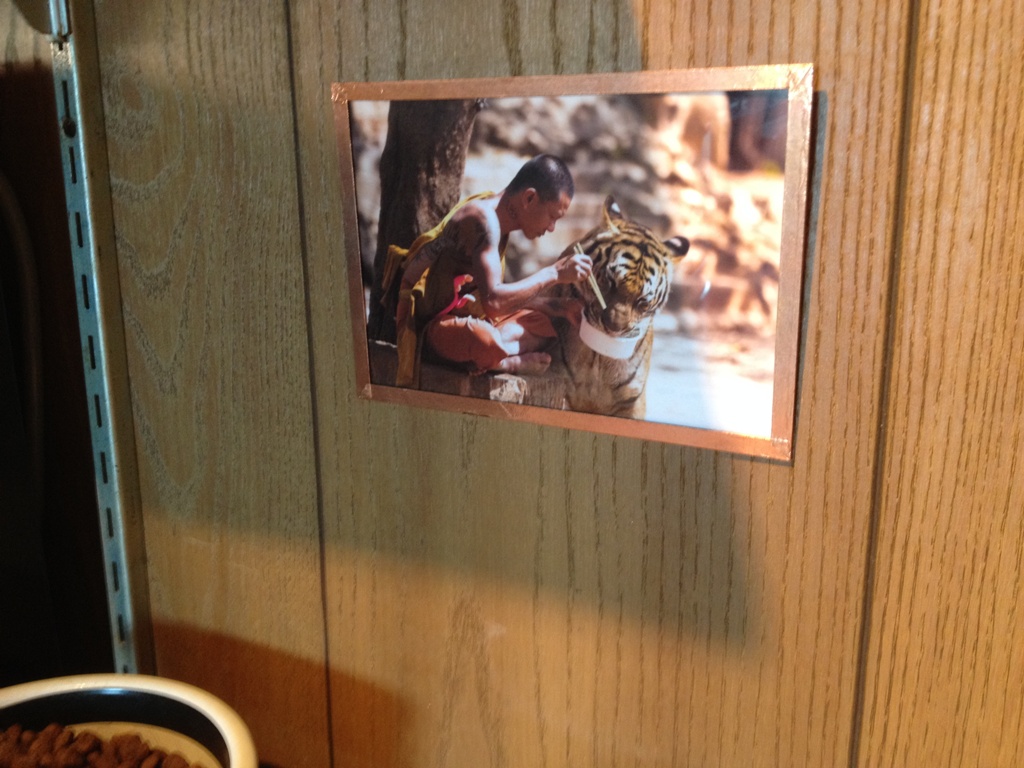
cat pic

If I owned a cat restaurant, that’s the pic I would put on the wall.

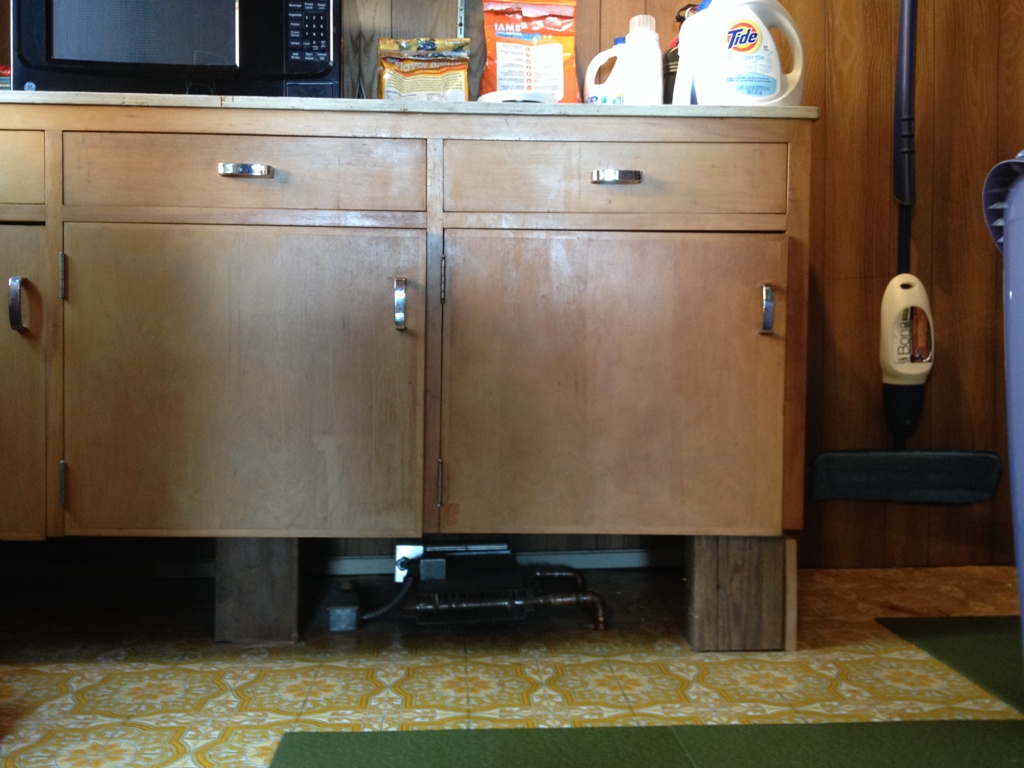
The Cabinet From Hell

attractive

It’s time to face facts.  We can do whatever we want to make the kitchen look better, but this hideous cabinet is all you see whenever you’re in there.  All the new appliances and knobs and flooring in the world won’t hide this demonic thing.  I’ve considered covering it with a drop cloth but then Inky wouldn’t know where to eat.  I’ve considered destroying it with a flamethrower but I doubt I could keep the rest of the house from burning down with it.

This cabinet is old, and it rests on scrap 2×4 pieces the way an el camino rests on cinder blocks in someone’s front yard.

precision

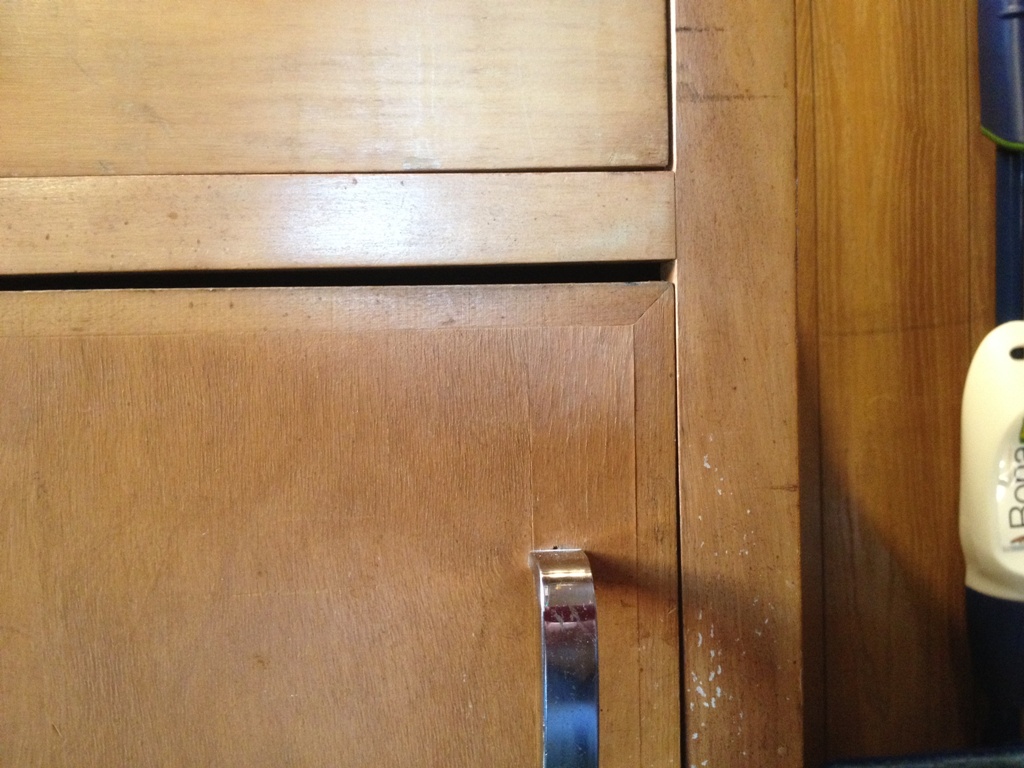
Nothing meets at a right angle.  The doors do not stay closed without the aid of a rubber band or a thumbtack.  I’d love to get rid of it but that’s 24 cubic feet of storage I don’t have anywhere else.

craftsmanship

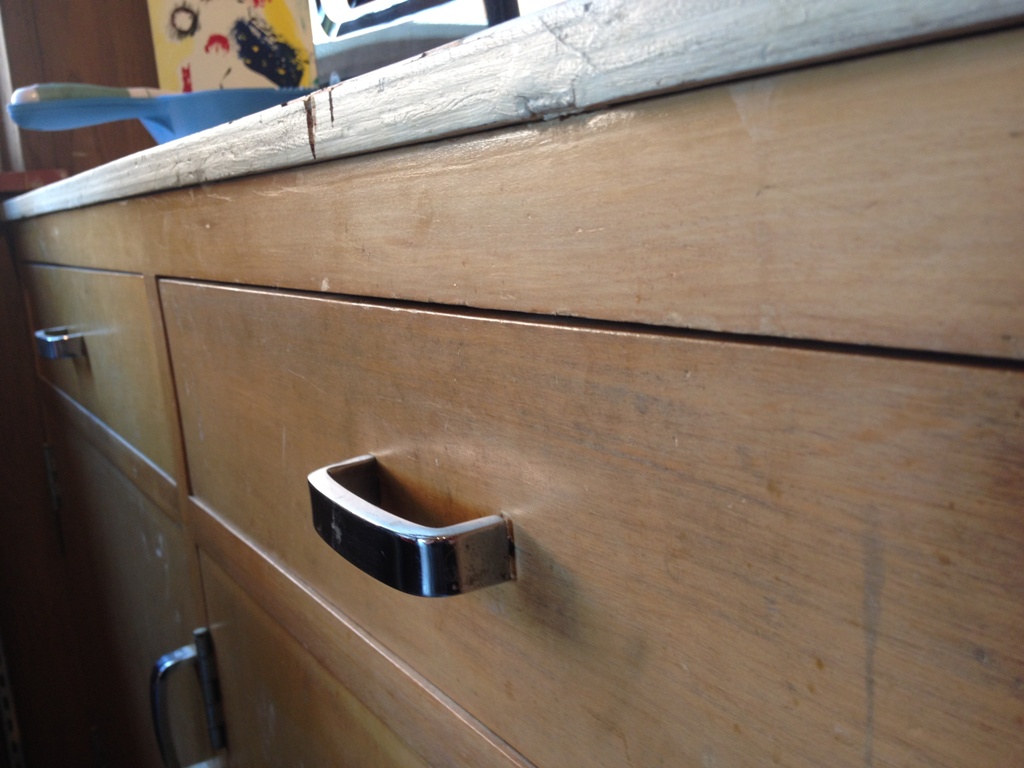
The frame is literally coming off the cabinet.  Look closely – you can see the frame is just held to the cabinet by a nice, smooth, bright finish nail.  I could pull it out with my fingernails if I wanted to.  The one across from this was repaired with glue, so now it’s permanently 2 1/2 degrees off.    Ugh.

style

The worst of it is the top, which is just painted construction grade plywood.  Painted a long time ago.  It does not come clean.  It’s pitted, stained, moldy and warped.  The only really good thing about old paint is that it was made before a lot modern environmental laws, so it’s generally better quality than new paint.  Plus it’s fully cured so it forms a hard shell that’s arguably stronger than the plywood it envelops.  Other than that, it’s disgusting.

Do not ask me why, but I decided to restore this thing rather than smash it to bits with a fireman’s ax.  The drawer pulls are easily replaced, and I even have some good pulls in mind for it.  And replacement hinges are affordable, right?  (answer:  no.  $25 per pair is not affordable, but that’s what well machined hinges cost).  What else would need to be done?  A melamine top is not hard to do.  A band of wood around the bottom wound conceal that weird heating apparatus underneath so we don’t have to see it.  And I can take the doors off, sand them down, stain them and polyurethane them and they would look significantly better.

restoration

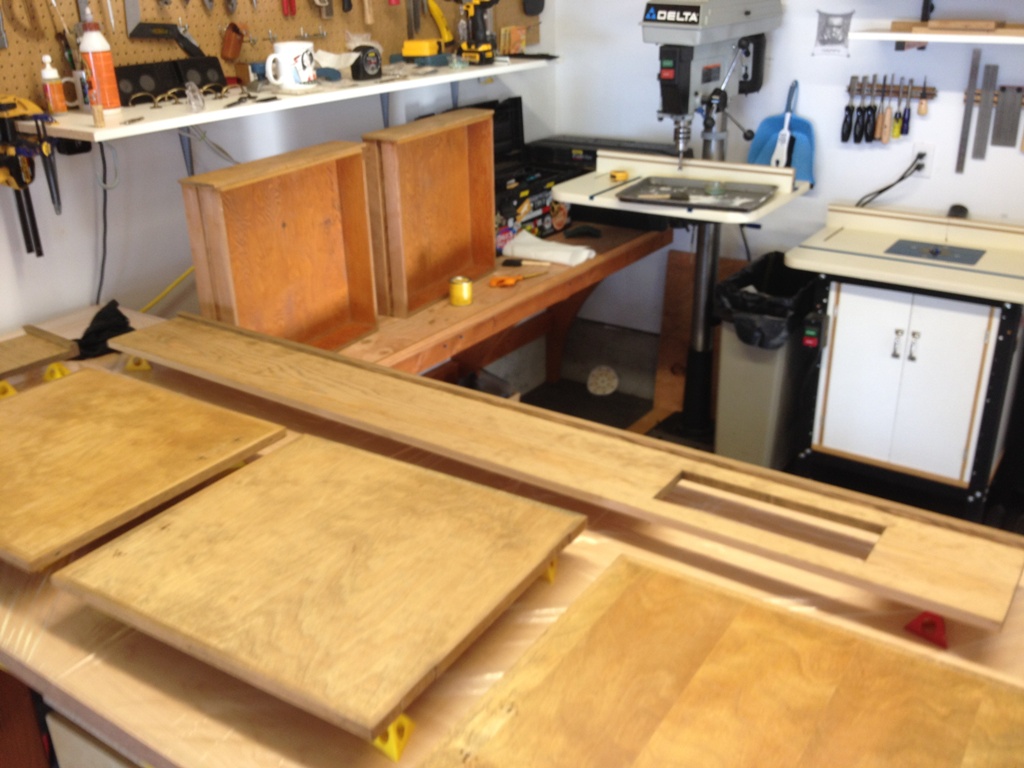
And so, it’s come to this.  50 year old cabinet parts are in my shop, sanded smooth, re-squared, fitted, stained, and ready to go.  The cabinet will live again.  It’s still a piece of crap, but at this point, it’s like a personal challenge.  See how long I can keep this box limping along, serviceable, and in working order.  See if I can get the doors to close straight, or close at all.

I love making cabinets, and sometimes restoring the old ones teaches you a thing or two about making new ones.  But that’s really not the case here.  This Cabinet From Hell is a textbook example of all the things not to do when you’re making new cabinets, from the materials and hardware not to use to the way not to join wood together.  Well, let’s see how long I can keep it going. I have to move it out when I drywall the laundry room, then put it right back in.  If it survives that, it can probably last a while longer.

Shop Work

view

This is the view from my shop.  This is what I see when I look up from whatever I’m working on.  Whenever I think this house is falling apart faster than I can fix it, whenever I despair that there’s so much wrong with it that I’ll never get it all done, this is a wonderful reminder of why we moved here and why we live here.  Today is the 2nd anniversary of when we bought the house, and as much of a challenge as it’s been, I have loved every day of it.

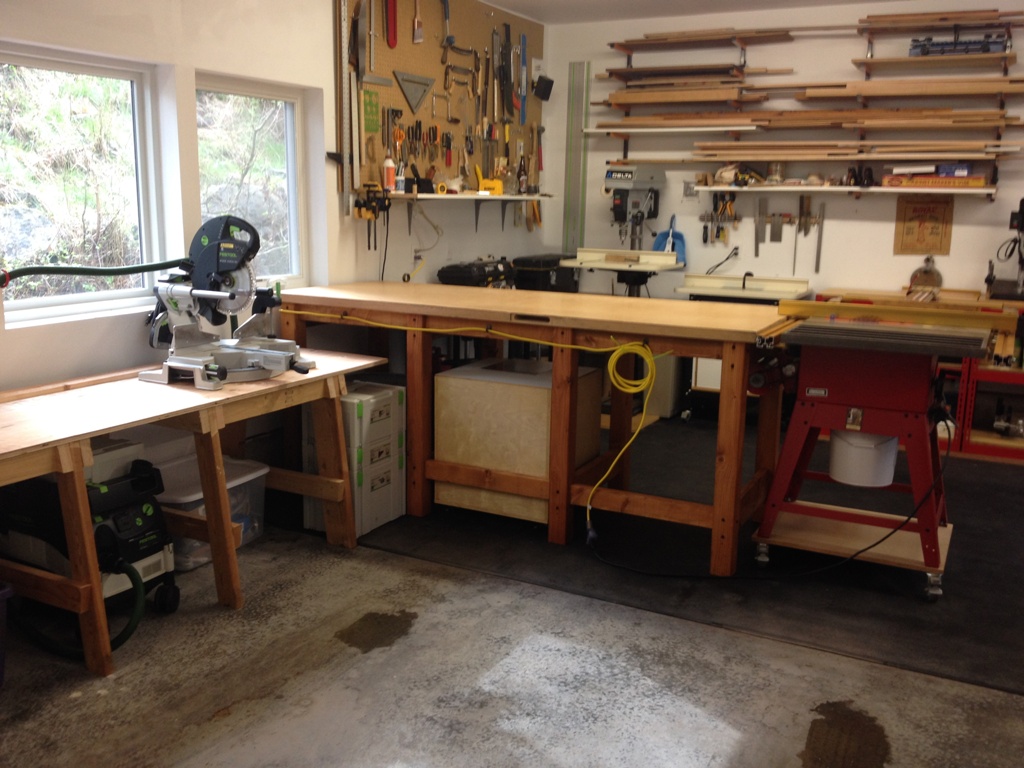
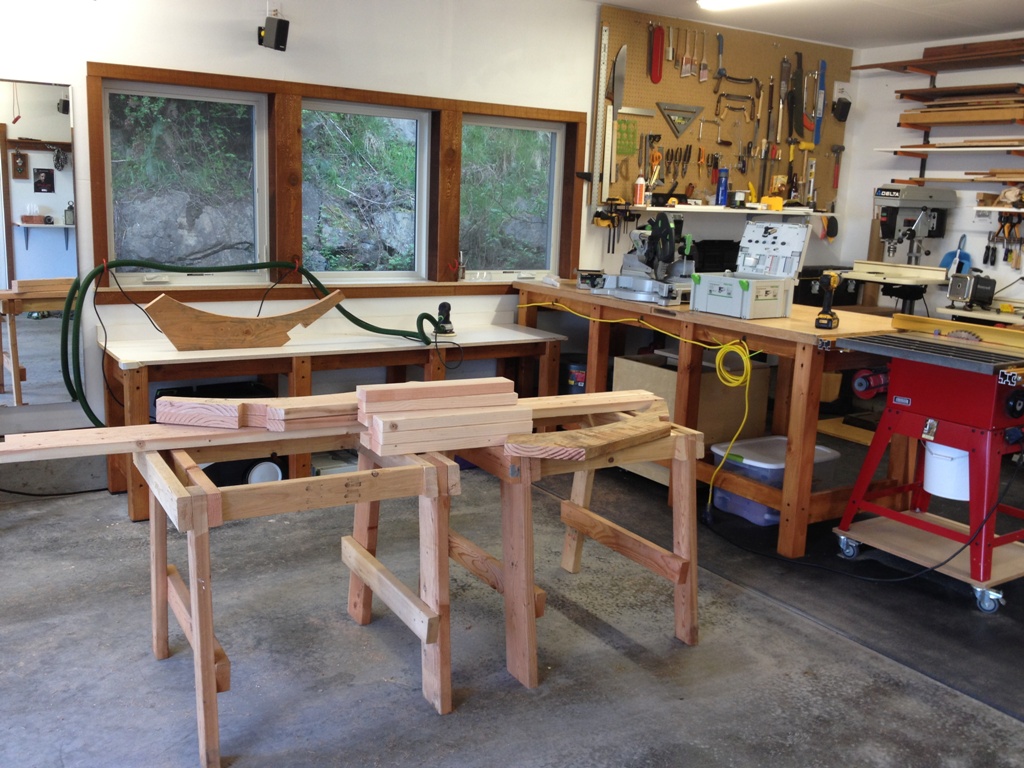
shopSo yeah, with a view like that, it’s no mystery that I like to spend a little time working on the shop itself.  It’s my base; it’s where I go to repair old work or create new things, and practice my craft.  Here, all things are possible.  Here, there is nothing I can’t do.

table legs

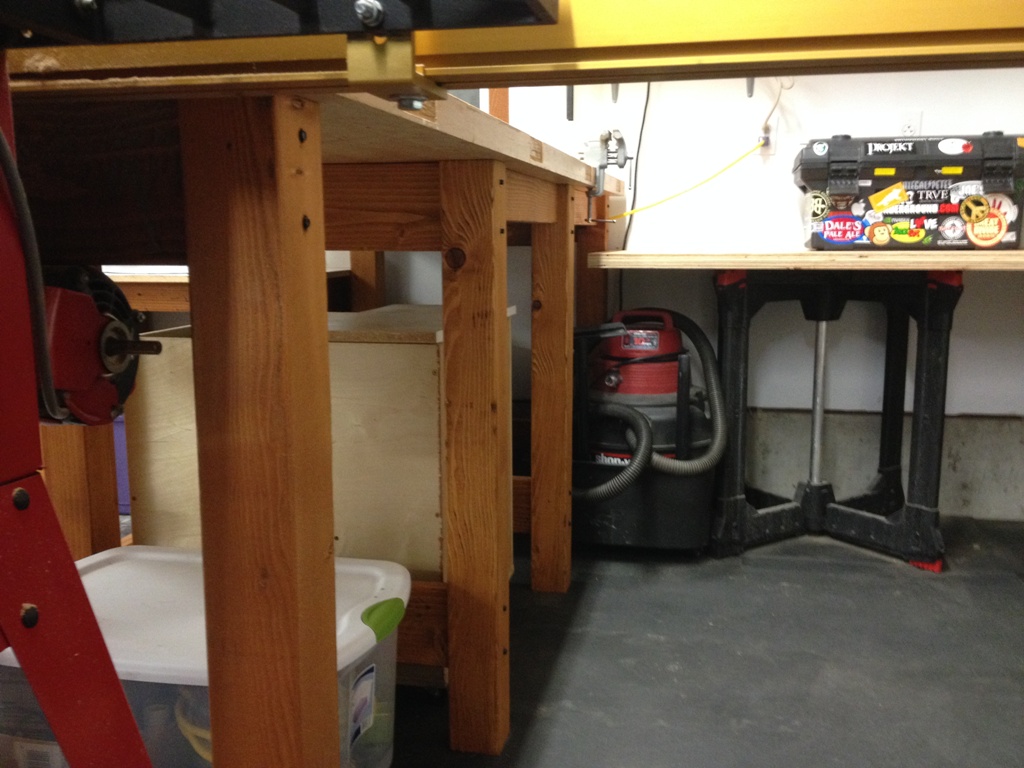
It makes sense to me that I want my shop as good as it can get.  That bench used to be on some old sawhorses I made two hundred years ago.  They were sturdy enough, but I like a bench that is the exact same height as the table saw.  This way, when I cut lumber on the saw it can just slide onto the table.  That’s called a Return Feed Table.  I’m happy that I have enough space for a big one like that.  Plus, I can now work on things without my lower back complaining from bending over all day.

plans

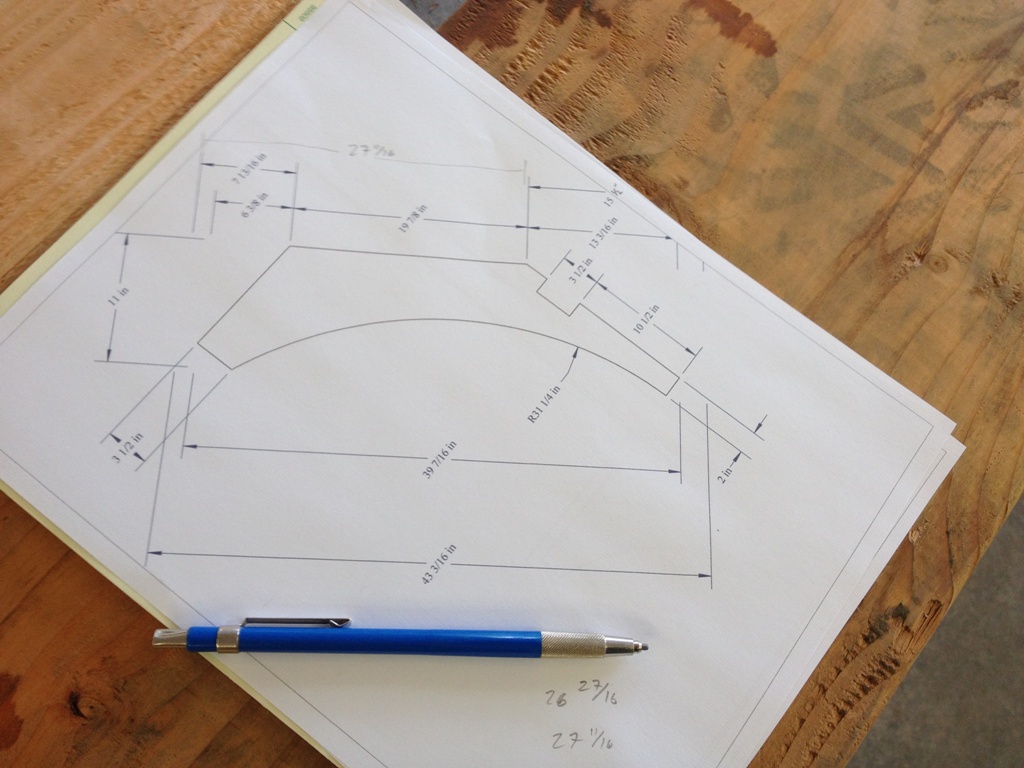
Two years later, and I still have about 500 board feet of construction lumber up at the shed.  Some of it is exposed to the weather and it’s getting mossy and green, which I actually don’t mind.  I like the weathered look.  Today I decided to take down some 2×12’s and make them into brackets for a side table next to my bench.  Not only will this thing be nice and sturdy, but the brackets keep any table legs out of the way so I can keep things under it, and I can also clean back there a lot easier.

saw

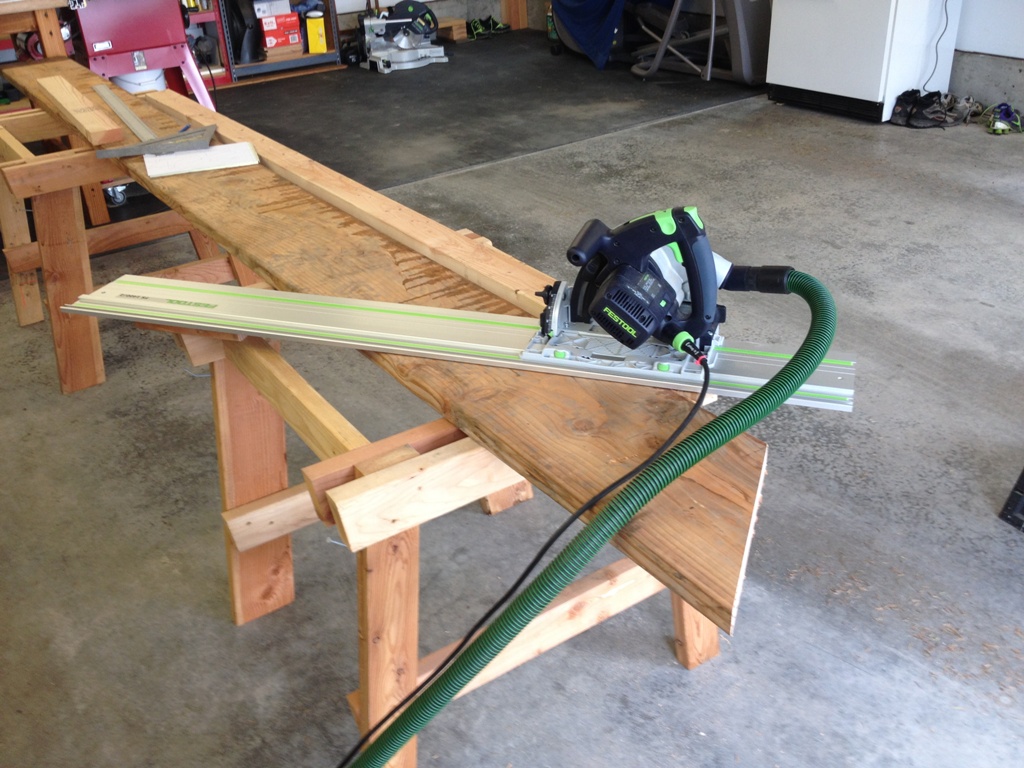
I really need to cut these as accurately as I can.  There’s two angled cuts there, and if they don’t make a precise 90 degree angle the table is not going to be flat.  I want my tables flat.  It’s the least I can ask of them.  Working with construction lumber can be like measuring with a micrometer, marking with chalk and cutting with an axe.  No matter how careful you are, the wood is a little bowed and knotty and not all the same thickness and the sides aren’t even really straight.  Yeah, I could put it all through the planer, but what’s the fun in that?

sanded

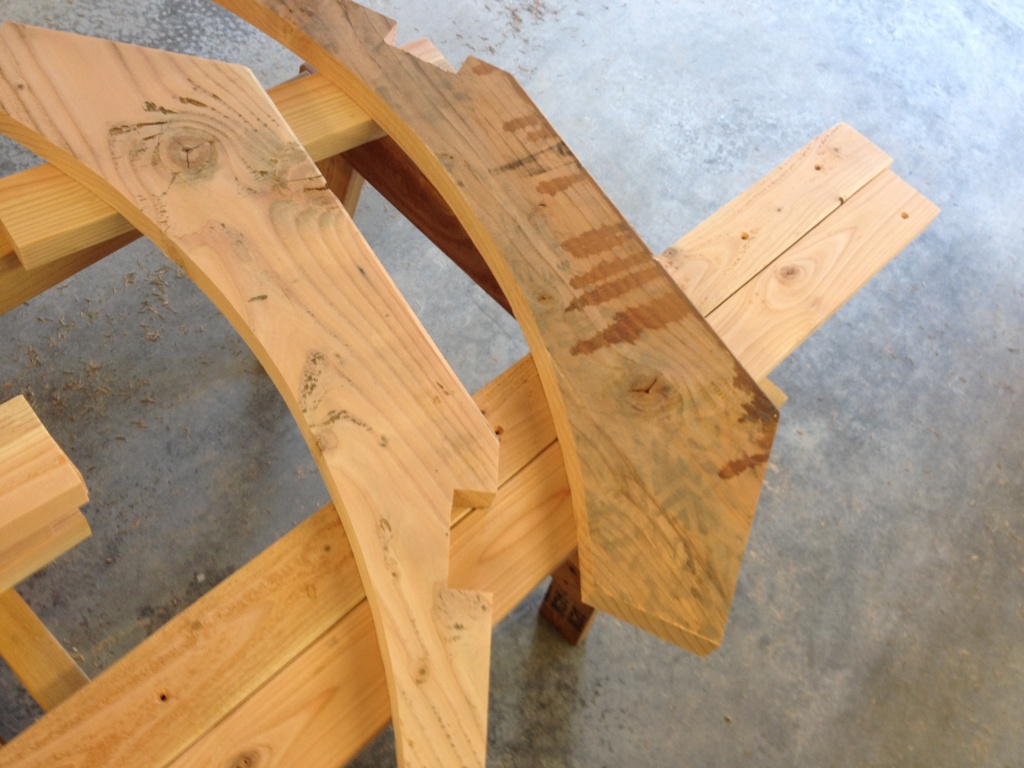
Now, here is what I really like about weathered wood.  The piece on the right is as I found it outside, and on the left is sanded.  I don’t sand it perfect, just enough to give it some smoothness and get most of the dirt and mold off it.  It comes out looking random and naturally distressed.  And it’s still a very, very strong beam.

wood

So I got all the pieces cut and I think this week I’ll get a coat of finish on it and let it cure for a couple days before I affix it to the wall.  The shop is really coming up great, the workflow is good and there’s lots of space to spread out and get things done in there.  I’ll be ready to start making some kitchen cabinets real soon.

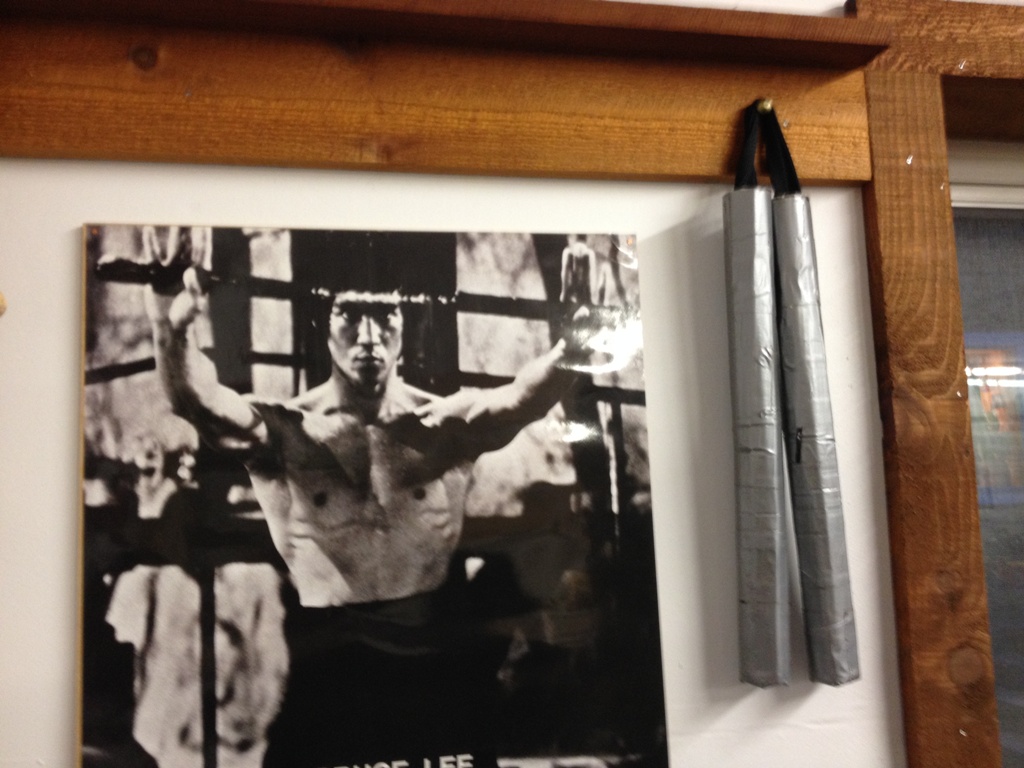
bruce lee

I’ve also added a lot of trim and shelves and hooks in the garage.  I’m just using rough cedar and leftover T-111 boards for the trim.  For a garage, they work great!  You may have noticed the punching bag that hangs in the corner from previous pictures.  It’s not just for looks.  About once a week, or every other week, I’m using it for a workout.  I spend some of the toughest 48 minutes of my life in front of that bag.  We use our garage for a lot of things.  I think it’s worth it to fix it up nice.


A little kitchen makeover

You want a ‘before’ picture?  Well, if you insist …

Before


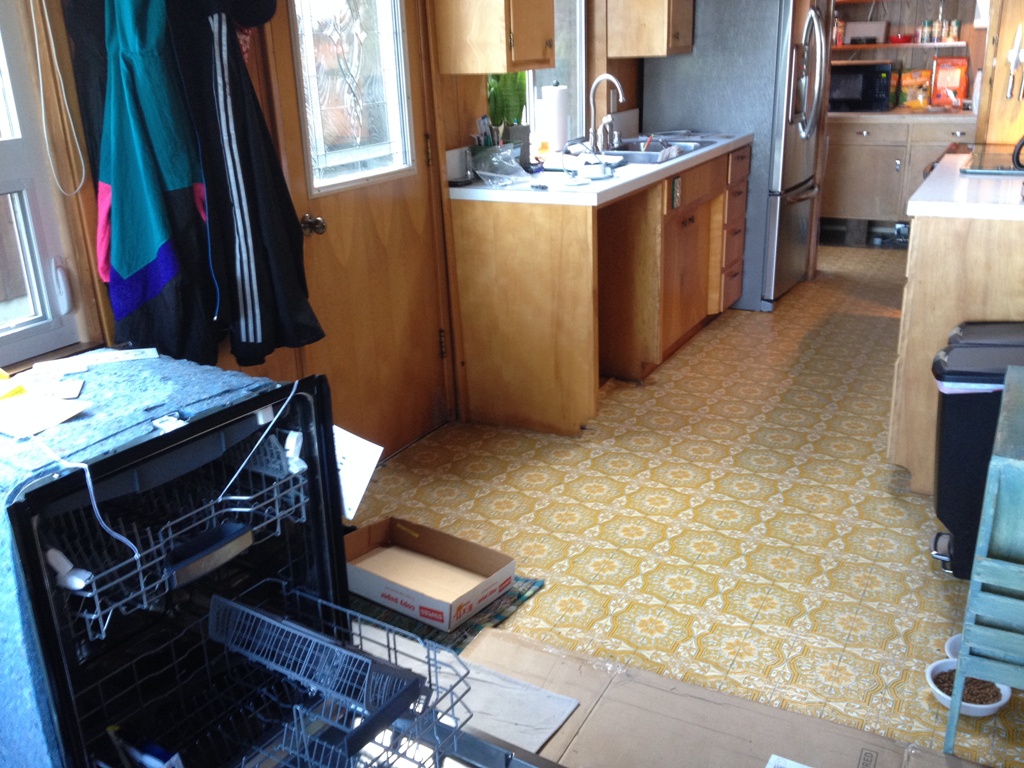
Yeah, lovely.  I know you think the floor is abhorrent but honestly it’s my favorite feature.  Even with all the cigarette burns and places where it’s peeling up, you just really can’t hurt that old linoleum.

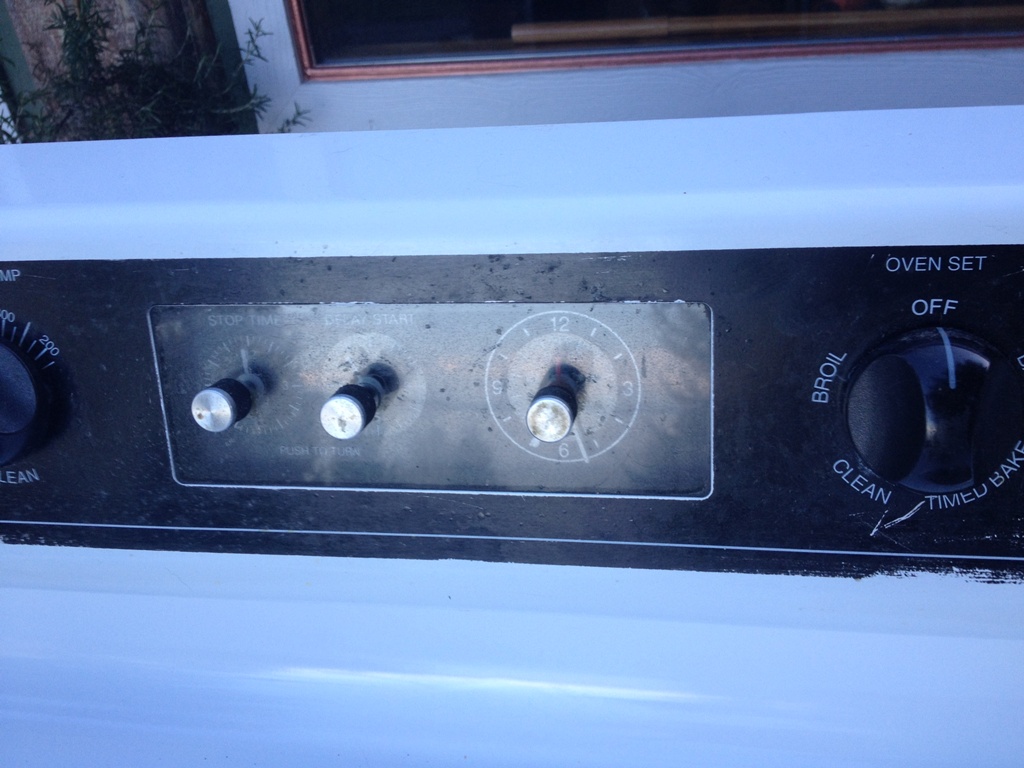
Okay, fast forward.  We decided to spend our tax return money on new kitchen appliances.  I planned on waiting until I made cabinets and was ready to put in flooring but honestly, we just could not wait.  The dishwasher sounded like a dinosaur eating a helicopter, the stove had fewer and fewer knobs that actually worked, and the fridge is actually a good fridge but that big swinging door completely blocks off the laundry room when opened.

None ever workedNone of these grease-coated knobs worked.

We don’t have fast food on the island.  We cook every day.  We run the dishwasher every other day.  New appliances became a priority.

Cardboard Flooring

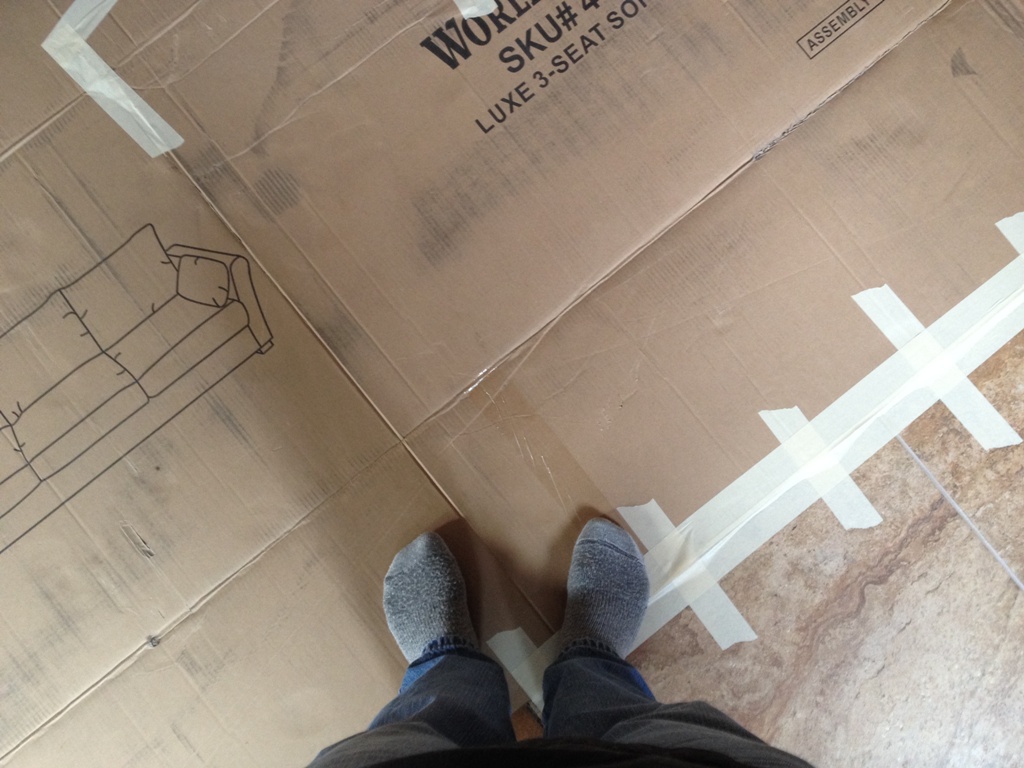
Well, as cool as linoleum floors are, cardboard flooring is completely awesome.  You can trounce on them all you want and you don’t hurt the shiny hardwood floors underneath!  Cardboard is soft on the feet, fairly non-slip, and takes a furniture dolly very well.

War Zone

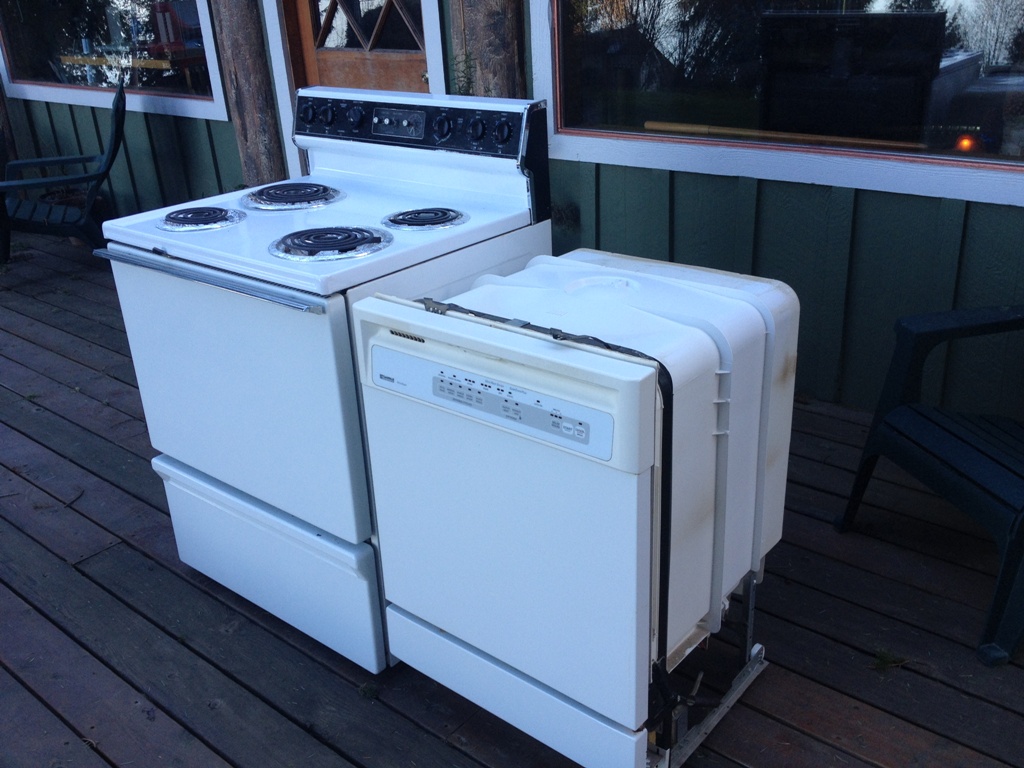
Delivery day was relatively painless.  I got the fridge out to the garage (yes, I moved it myself ) (yes, it was a big pain in the butt) with all our food, and put the stove and the dishwasher on the front porch so the deliverymen could take them to appliance heaven.  If you’re on a diet, consider moving your fridge out to the garage.  It really makes you think about that snack you want to get.  Especially if it’s raining.

Last SunsetIn addition to new appliances, we decided to make a few simple changes and fixes to the kitchen.  A new light fixture to replace the 48″ fluorescent tubes over the sink.  Ships at sea would complain about that light diverting them off course.  Well, now it’s gone.  Your shipments from overseas should start arriving on time now.

Absurd

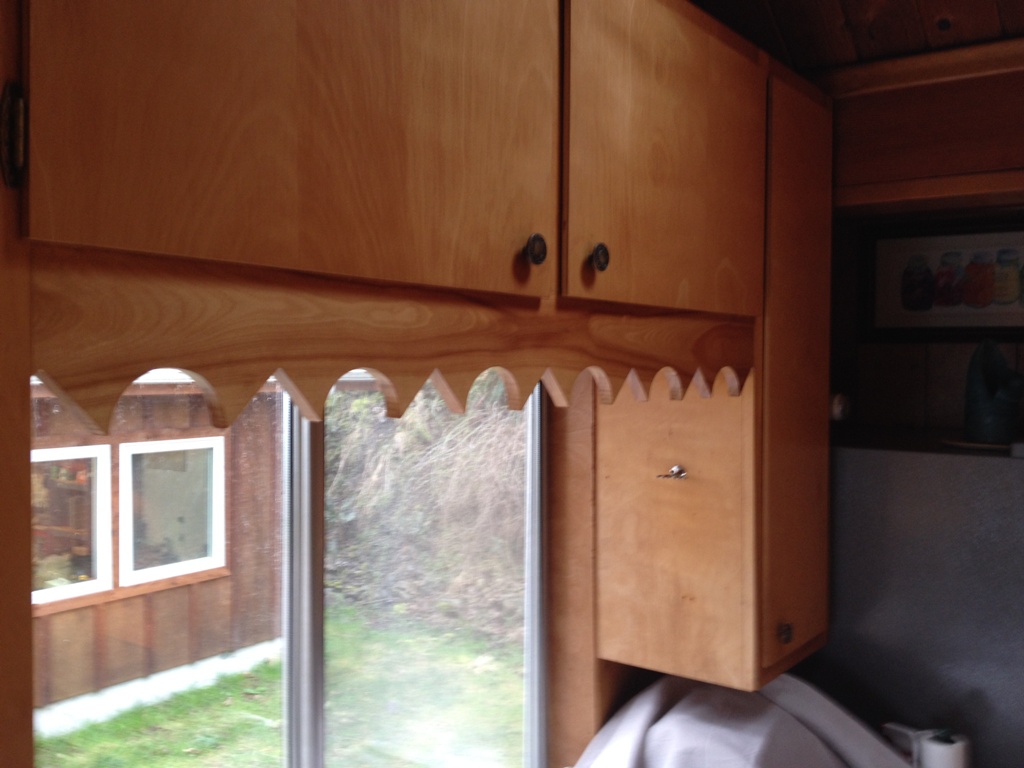
And that absurd cut-out in front of the light?  I took a machete and whacked it until it was straight.  That stupid arrangement of half-circles and triangles made me grimace every time I saw it.  We had something similar in our house in Denver, and we lived with it for ten years.  Not this time.  It’s gone.

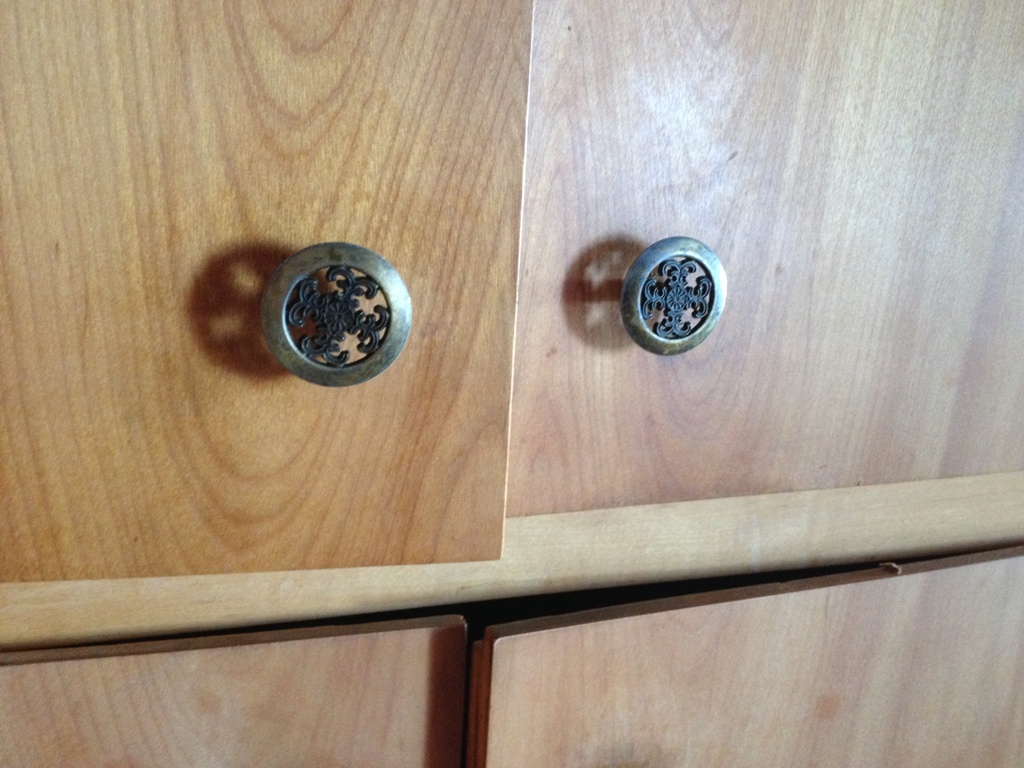
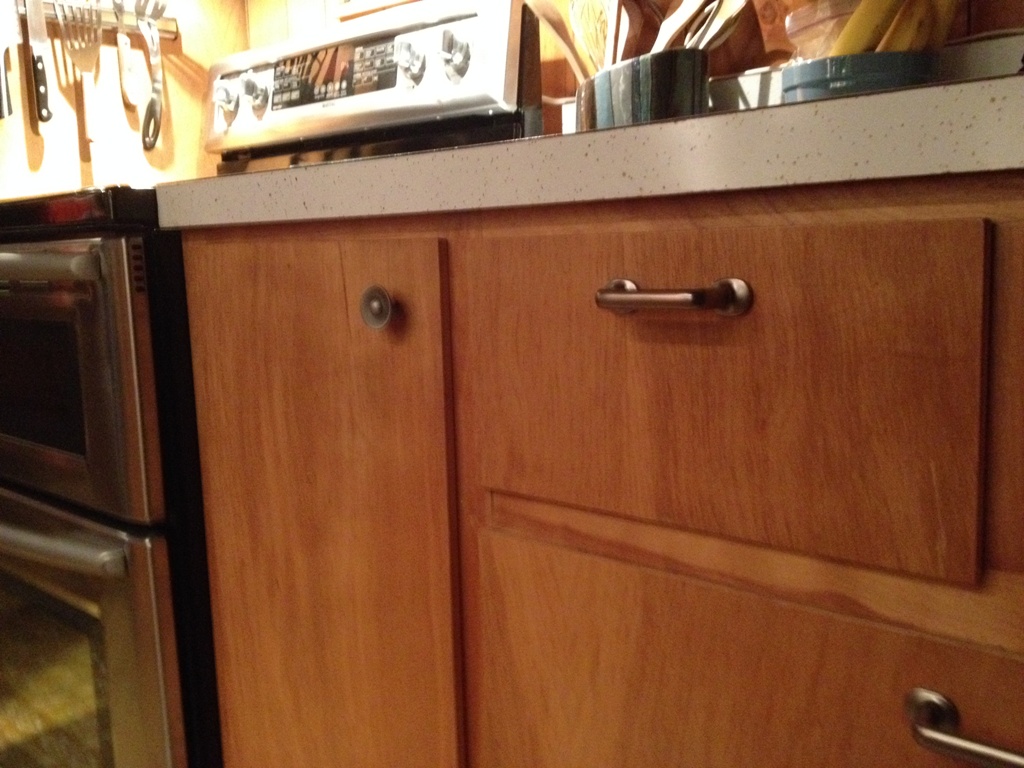
And we decided to replace the old knobs and drawer pulls too.  What was wrong with the old ones, you ask?  Everything.

Old Knobs


Ignore the fact that the cabinets are now lopsided because they were so cheaply built, but the knobs themselves just exude tastelessness.  Fun fact:  they still sell that exact same model of knob at the hardware stores here (both of them!) for about $1.29 a pop.

Old Pulls


And here’s the old drawer pulls.  My chief complaint was that the sides acted like grapnel hooks, and they snagged my jeans, my sweats, any article of clothing they could.  When I’d try to back away from the cabinet, my pants would get pulled off me and the cabinet drawer would simultaneously open.  It was as if the house was clawing at me with its very fangs.

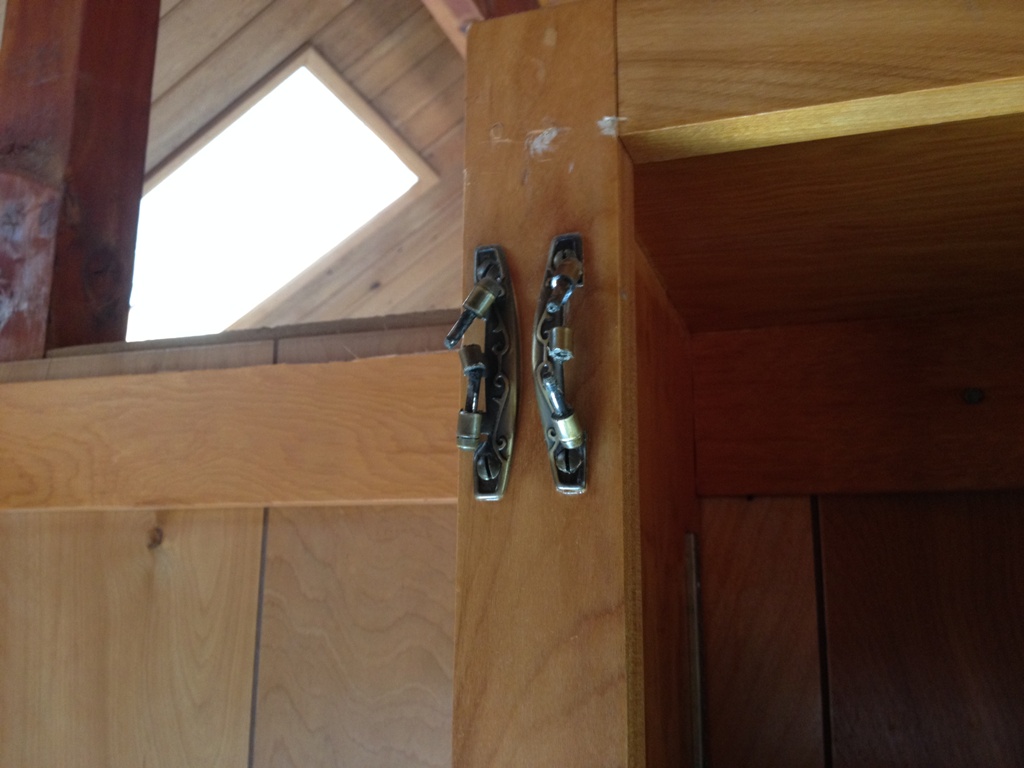
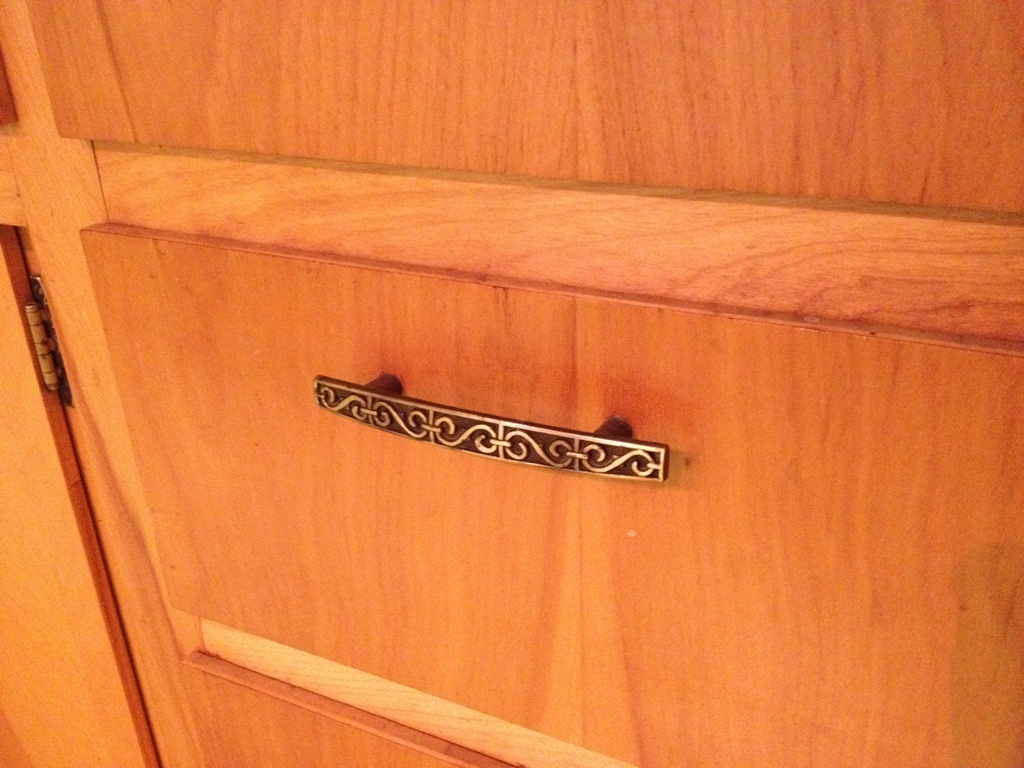
New Hardware


Screw you, house.  Sometimes the squeaky wheel gets the grease, and sometimes it gets replaced.  Above are the more anatomically friendly knobs and pulls that don’t claw at me like the fricking creature from the black lagoon.

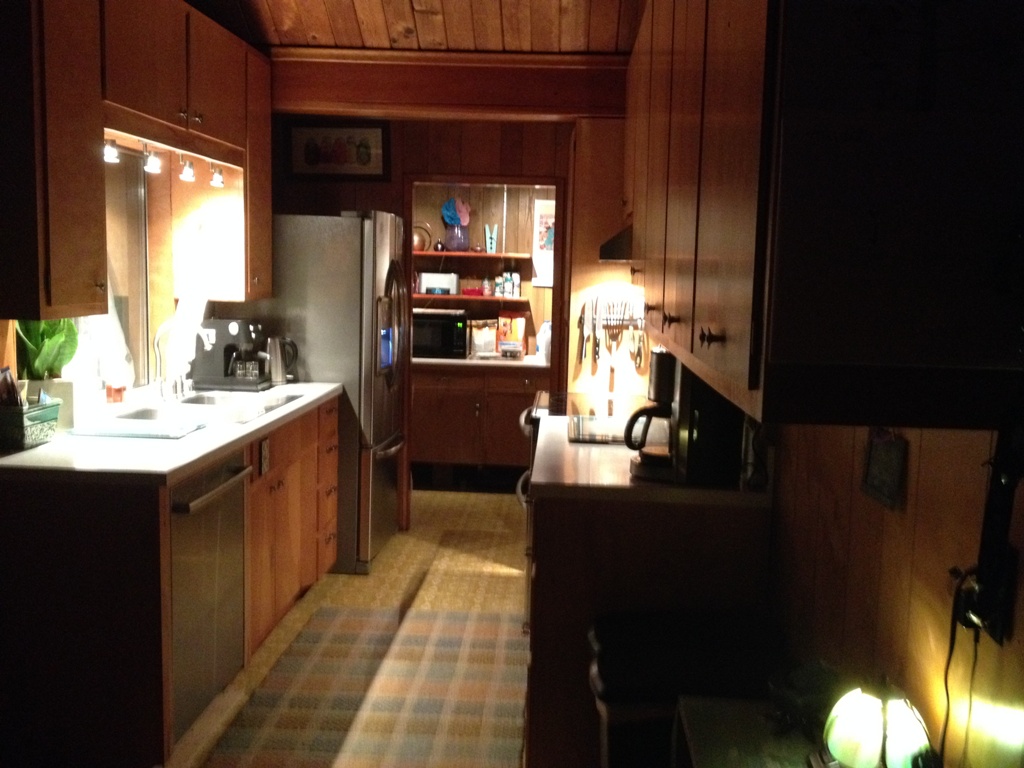
New AppliancesAt long last, new appliances are in and working.  I had to put plywood under the stove to bring it up to the correct height, and plywood under the dishwasher to cover up some extensive floor damage.  They work.  They fit.  They are lovely.

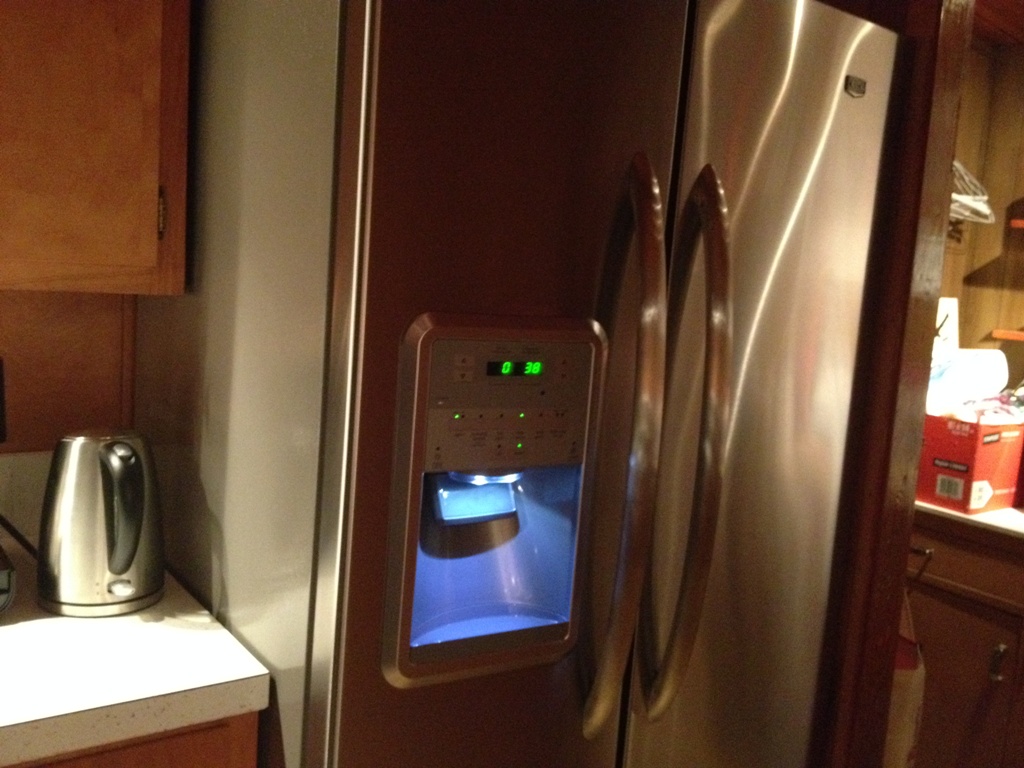
Fridge

The fridge dispenses ice and water right out of the front door.  Seriously, you just push a lever and out comes the hydro of your choice, in liquid or solid form.  It’s an engineering marvel!  It has been my lifelong ambition to own a refrigerator that serves cold water out the front door.  Everything leading up to this moment has been building up to this pinnacle of achievement.  Nothing from this moment on will ever compare.  It comes with other bells and whistles (and beeps, literally) but who cares about them?  Not me.

Stove


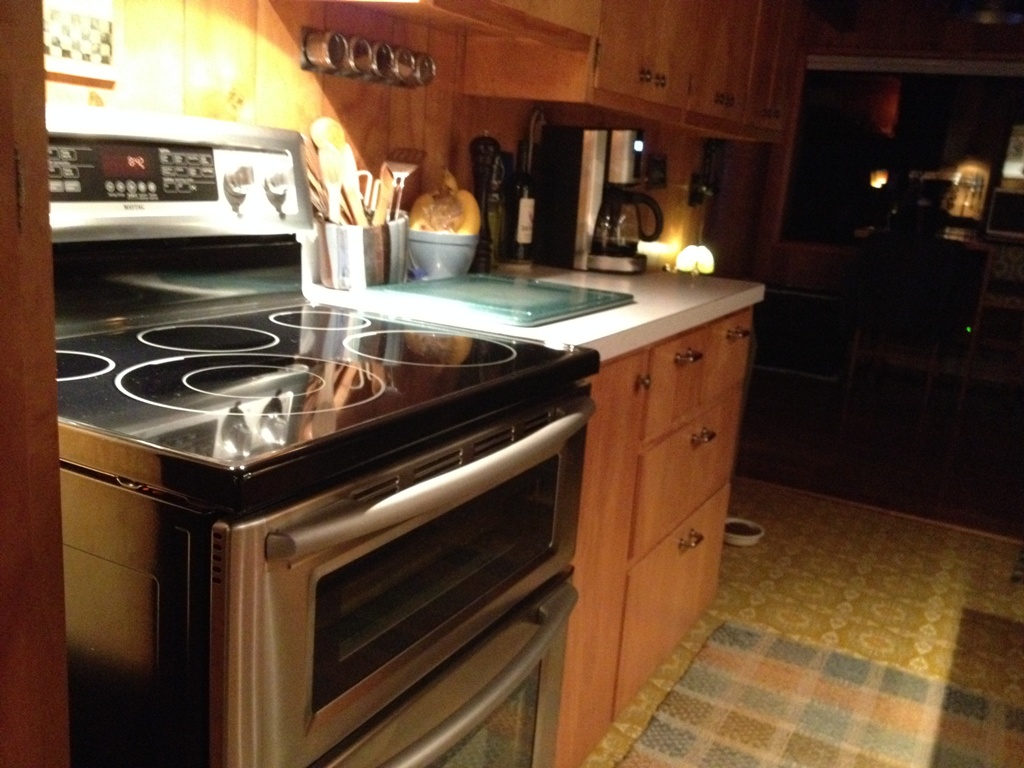
The stove is really cool too; it has lots of buttons and lights and stuff that works.  And the dishwasher is about as quiet as those deer grazing in our side yard.  Who freaking cares?  The fridge dispenses water from the front door!!!  We can get water out of the fridge!!!  Without even opening the door!!!!  Oh man, I’ve waited my whole life for this.  I can now die happy.

Oh, in the myriad of pics above, please ignore the ridiculous countertops, the awful paneling, the crappy kitchen cabinets and the lousy floor.  If you do that, it actually looks like a nice kitchen.  Just focus on the water dispenser in the fridge door, and you’ll be happy.


How To Make (lots of) Curved Brackets


I use brackets a lot in my projects.  I like the look of little brackets spaced at intervals along a band of wood, like you see in old craftsman houses.  They add structure as well as charm.  As I’m re-doing all the trim pieces in the house, the new trim is going to have plenty of these little curved brackets for added support, as well as architectural style.

Here’s an example of ones I did in a past project:

example

So they run along a band of wood with a little shelf on top, which makes for a convenent place to put your beer, collect D&D lead figures, or simply accumulate dust.  But I think it adds some character.  Anyway, in this house, I’ll probably need about 100 to 200 of these brackets.  When you need that many, you need to find a way to make lots of them and all the same size and shape.

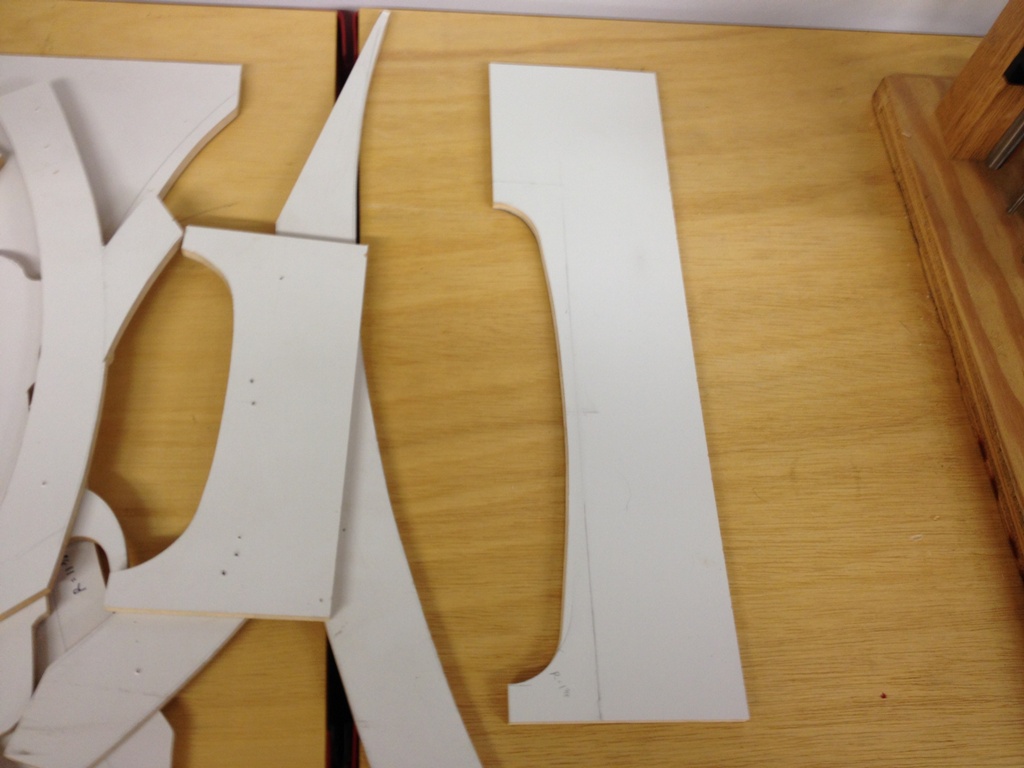
I start by making a template.  I use 1/4″ laminated MDF.  It’s very easy to work with and retains its shape well as long as it’s not abused.  I’ve got a growing collection of templates for various brackets and curves that I’ve done.  I first make a rough cut with a coping saw, then file it smooth, then sand it even smoother, checking the final shape for symmetry and correct geometry.  The one on the right is the one I’ll be using.

FormsUsing the template, I scribe out the line I need to cut on the wood.  I make a fine line right along the edge, then use a bolder pencil to line out where I’m going to cut with the jigsaw.  The idea is that the rough cut is not going to go all the way to the line, it’ll leave about 1 or 2 mm of wood left to shave off.  See, I’m so freaking close to Canada that I’m starting to use metric units.

Marking


Each piece is very carefully marked.  That little hatched area is the area the saw will cut away.

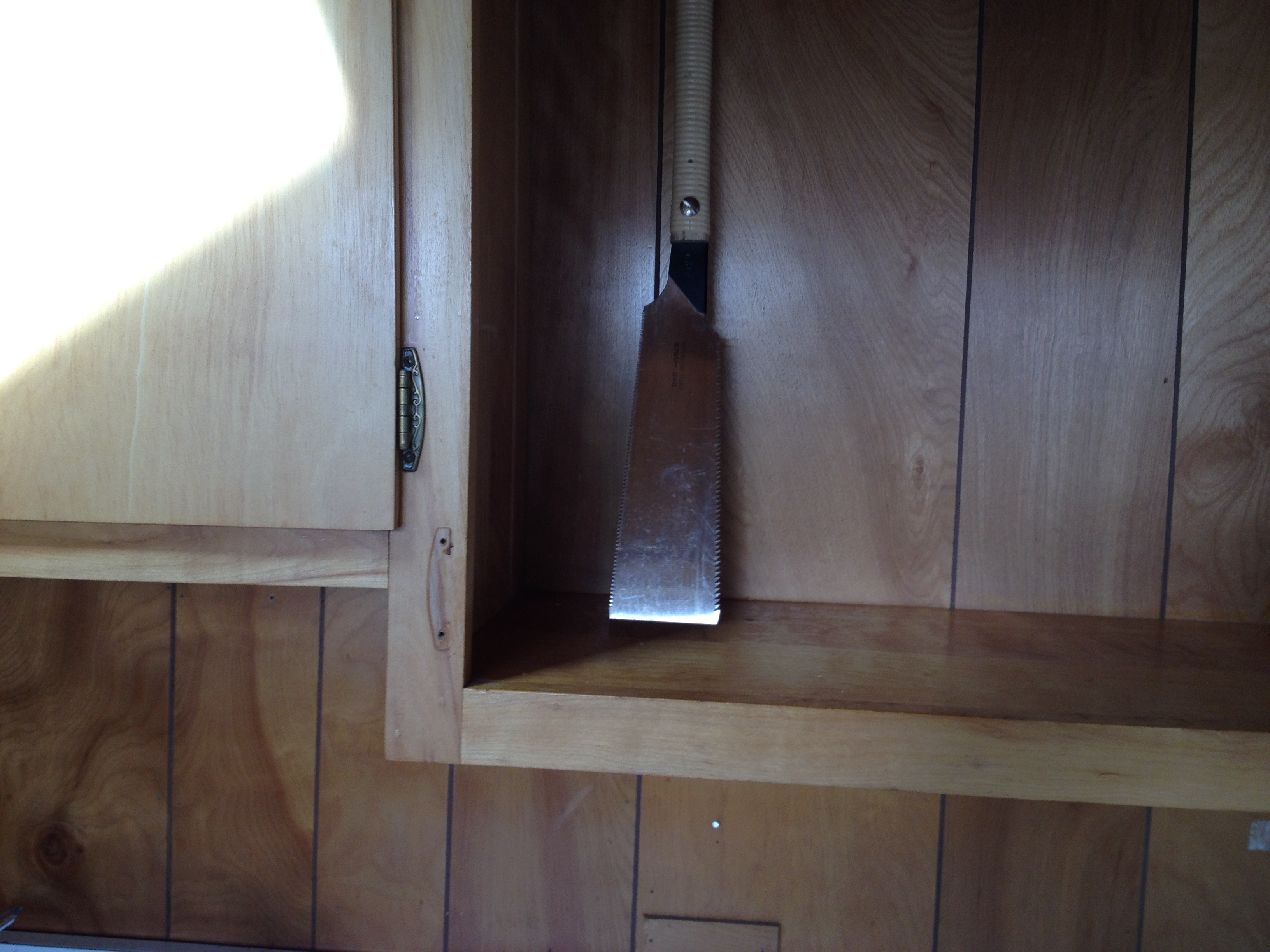
Cutting


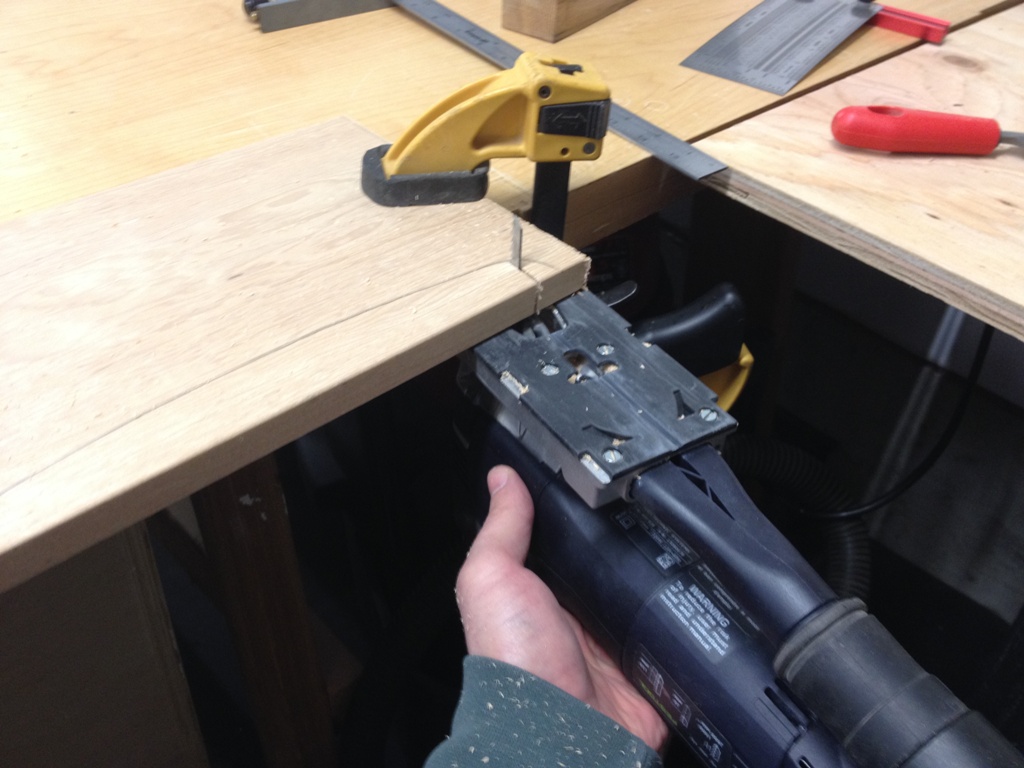
With this jigsaw, I like to cut from underneath the piece.  This way you see exactly where the blade is cutting.  The trick is to keep the jigsaw plate square to the wood.  If it’s not square, or if there’s some movement or vibration in the wood, you run into trouble.  Press firm.  Watch the blade carefully.  Cutting freehand along a scribed line is not something I’m particularly good at, so I need to take my time with this step.Festool Jigsaw

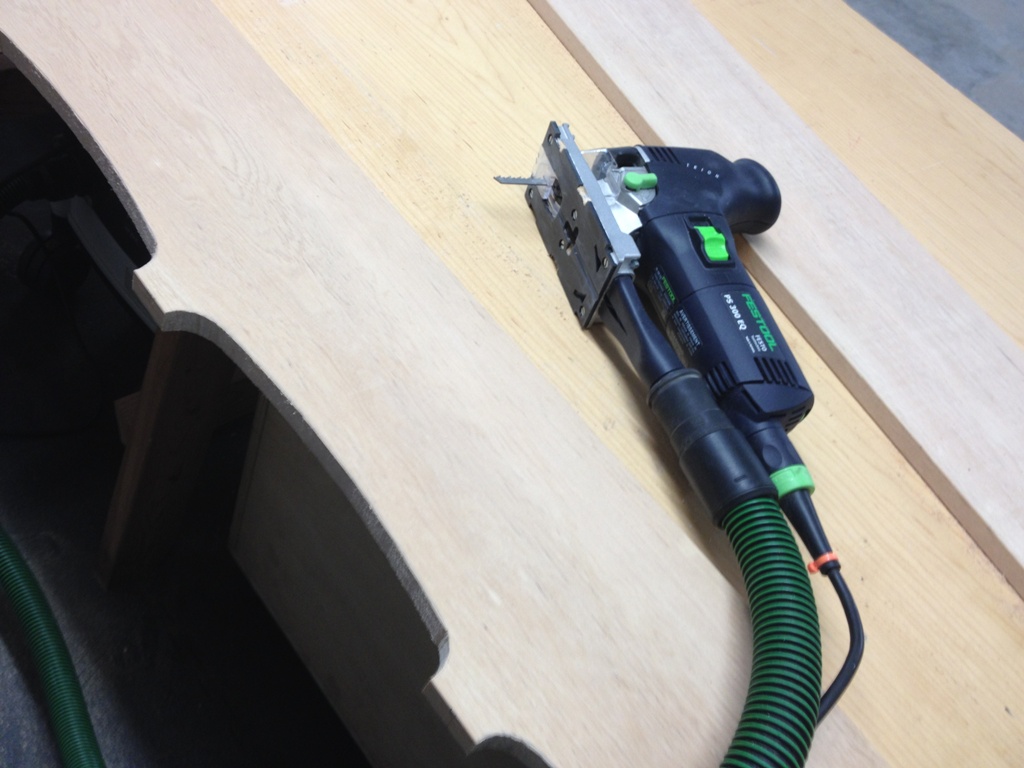
Again, Festool makes short work of the project.

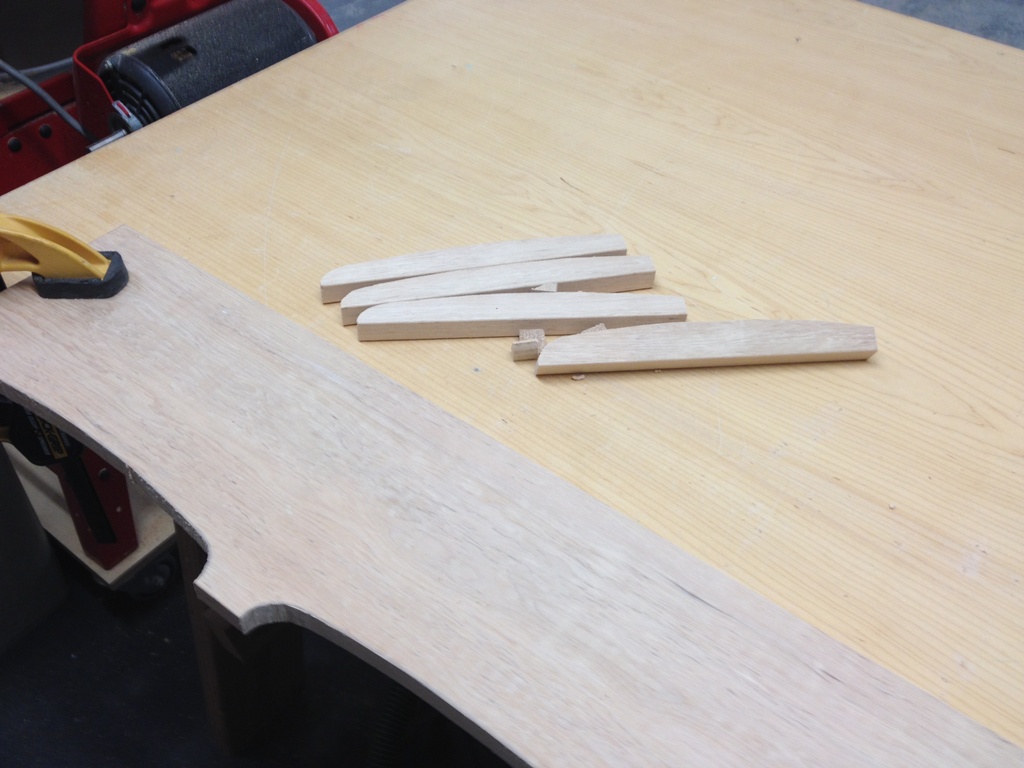
Kindling


The nice thing about being a woodworker and owning a wood burning stove is that every project I work on makes my house warmer.  As I type this blog post, those little pieces of wood are on fire and heating my home.  We don’t let much go to waste out here.

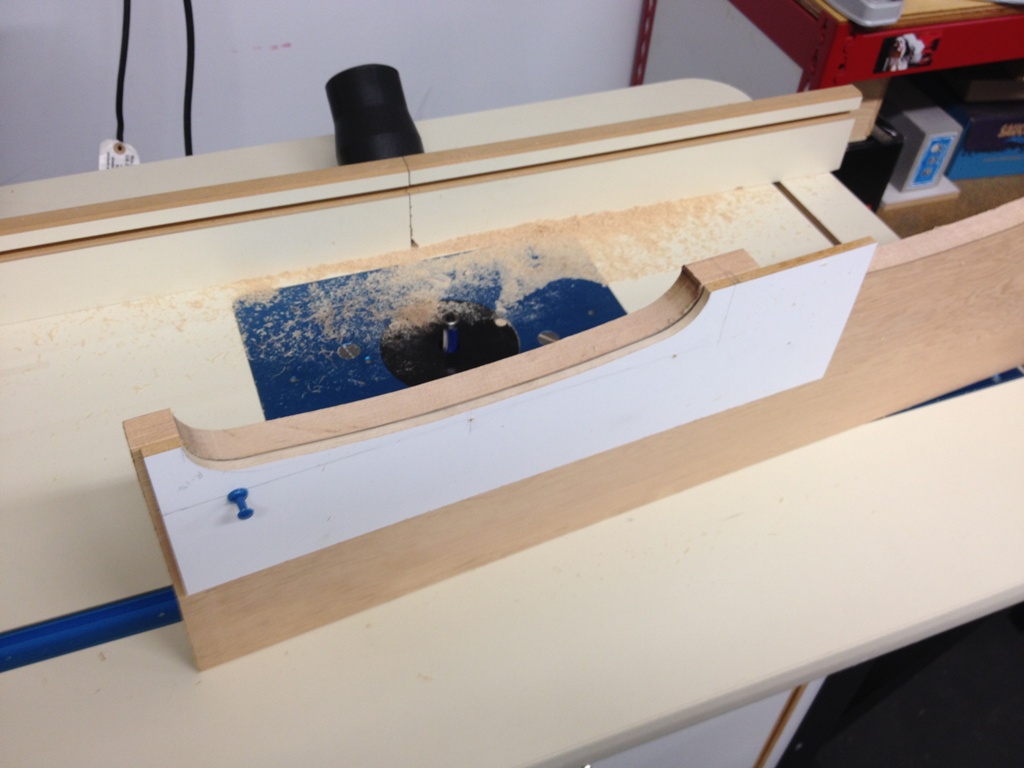
Next thing I do is affix that template to the work piece and give it a few passes on the router.  Using a nice smoothing bit, it cuts right along the template edge, and gives me an exact cut that’s going to be the same shape every time and typically I don’t even need to sand it.

Router Work


I attach the template to the board using push pins.  Yes, push pins.  I used to have push pins made entirely of steel but they are now lost and I have no idea where they are.  They went to push pin heaven or something.  Now all I have is a dwindling number of plastic push pins that tend to break when I push them into the wood.

Now if you plan this appropriately, you can drive the pin through a section of the wood that’s going to get sawn off.  Therefore there’s no need to fill or repair the hole it made.  But I’ll be honest here.  I’ve made a lot of brackets and the vast majority of them have little pin holes in them where the template attached, and I made no attempt to repair them.  And no one ever notices.  Anyway, these particular brackets will have the hole marks sawn off.

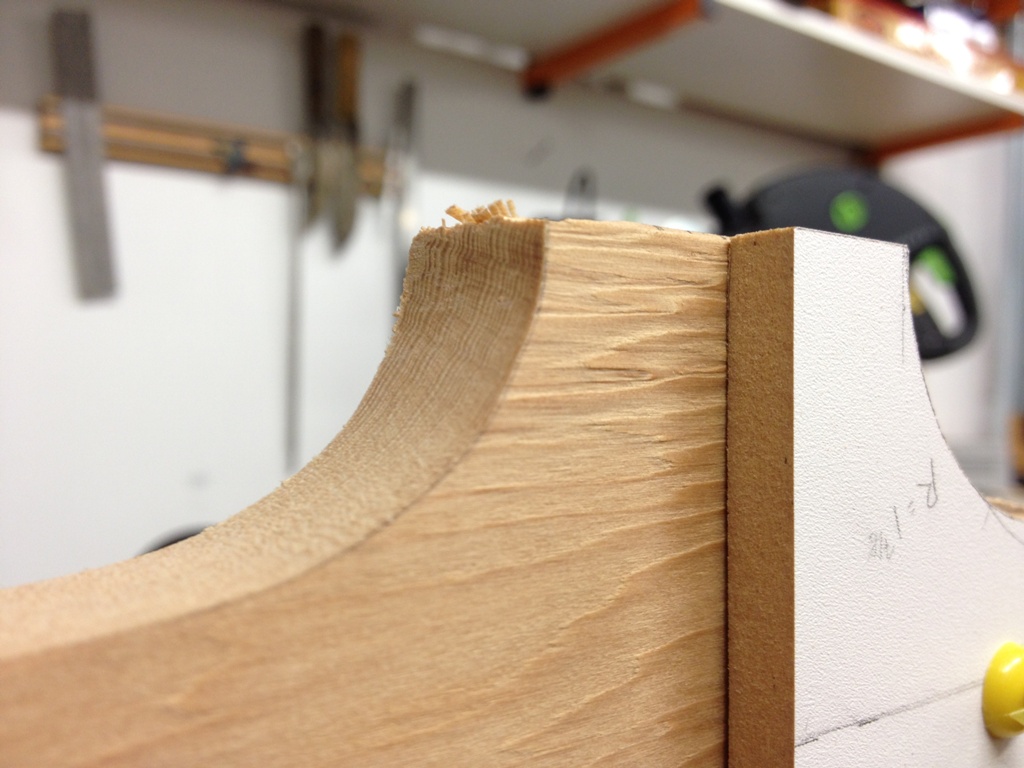
Tearout

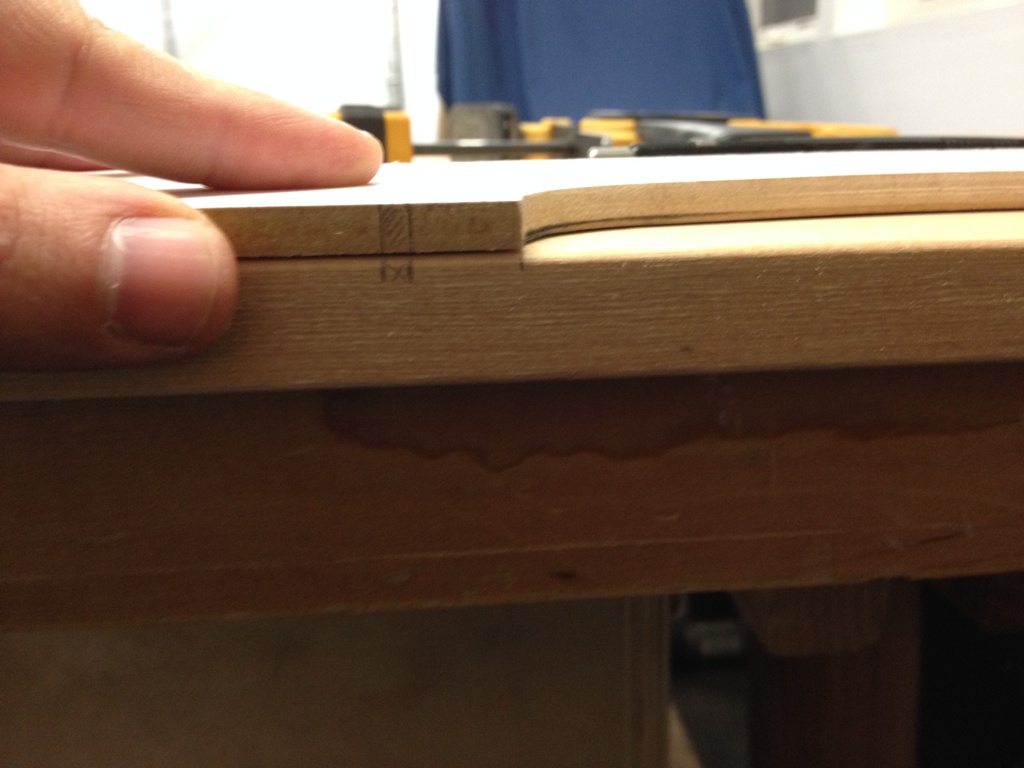
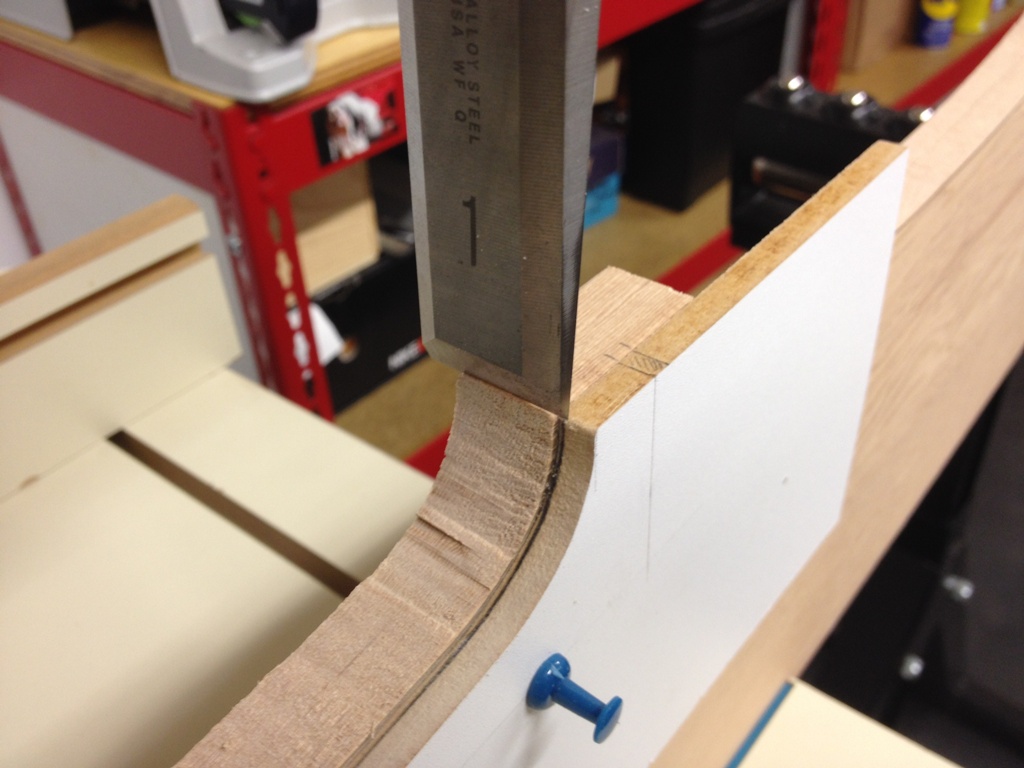
Now there is a problem with tear out when you do it this way.  That’s when the router bit tears the wood at the corner, like in the pic above.  Sometimes it’s pretty minor, sometimes it ruins the piece.  There’s a few ways to avoid tearout but the method I prefer is to cut the wood with a chisel right where the router bit is going to tear.

Chisel


It’s a pain in the butt to do it for every single bracket, but you really want that point to look neat and clean.  It’s going to be the most prominent point on the bracket, very visible.  So I take the time to do it right and ensure a clean look.

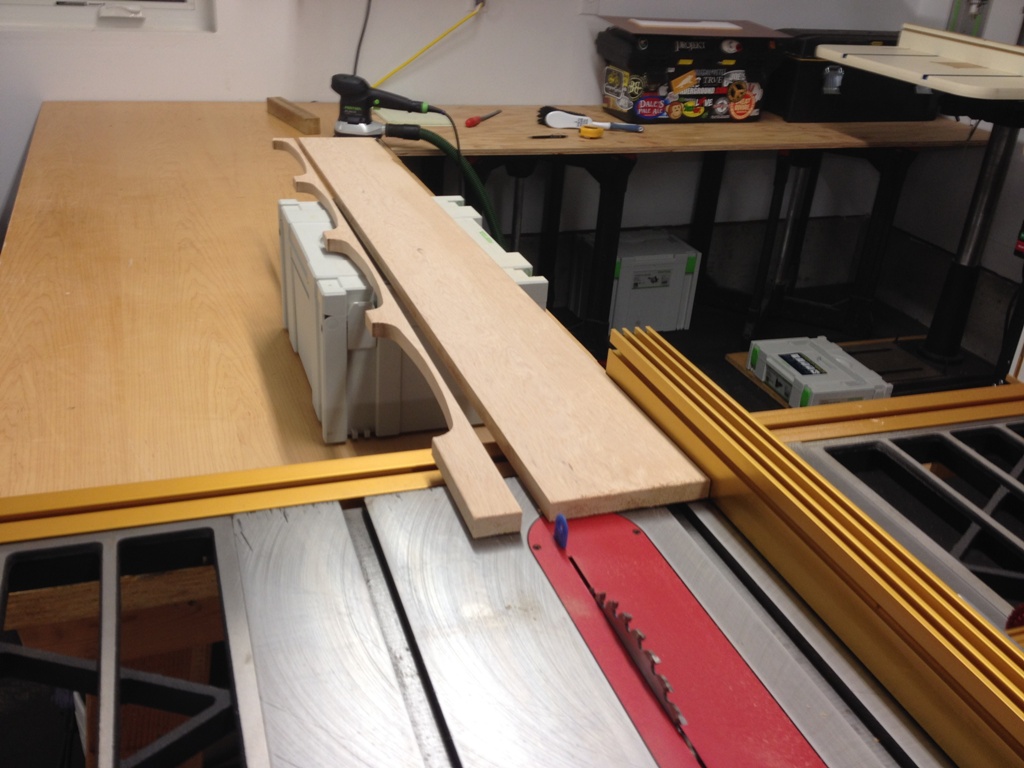
Once each bracket is hollowed out, it’s time to rip it down to the correct width.

Ripping


The table saw made this cut flawlessly and effortlessly.  Which is pretty much the only thing that has gone flawless and effortless since I moved to this island and started working on projects.  So immediately my guard was up, waiting for the next thing to go wrong.

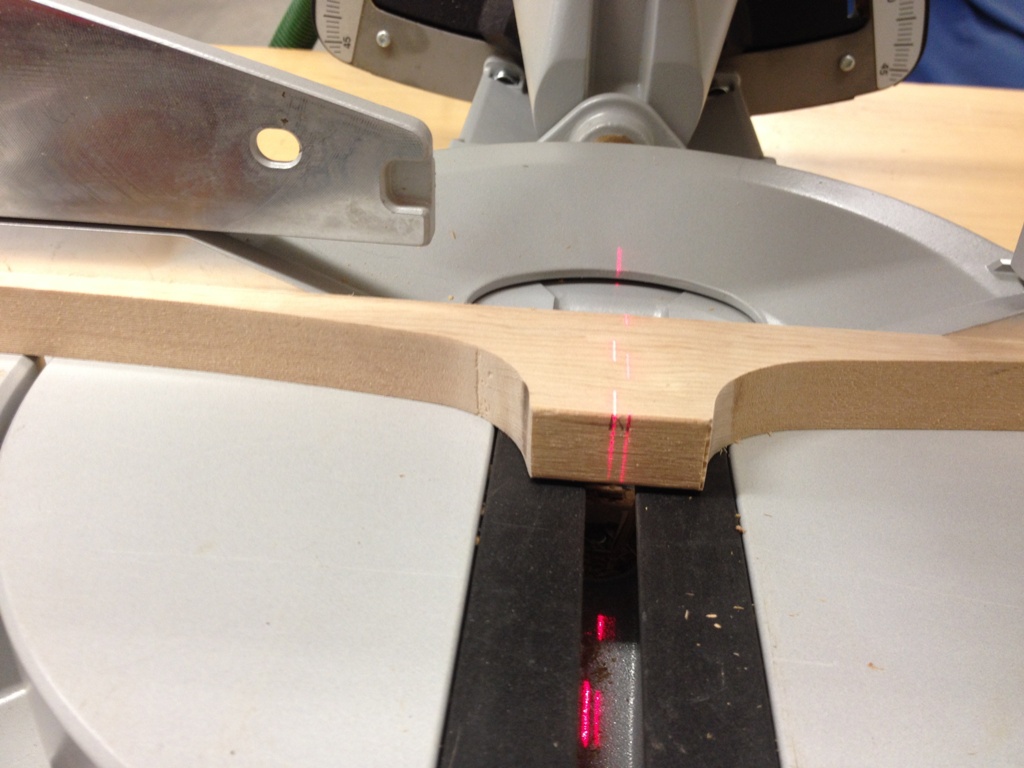
I cut out the individual brackets on the chop saw.  I don’t like cutting small pieces on the table saw, as small things have a tendency to want to go flying and poke someone’s eye out.

Final Cuts


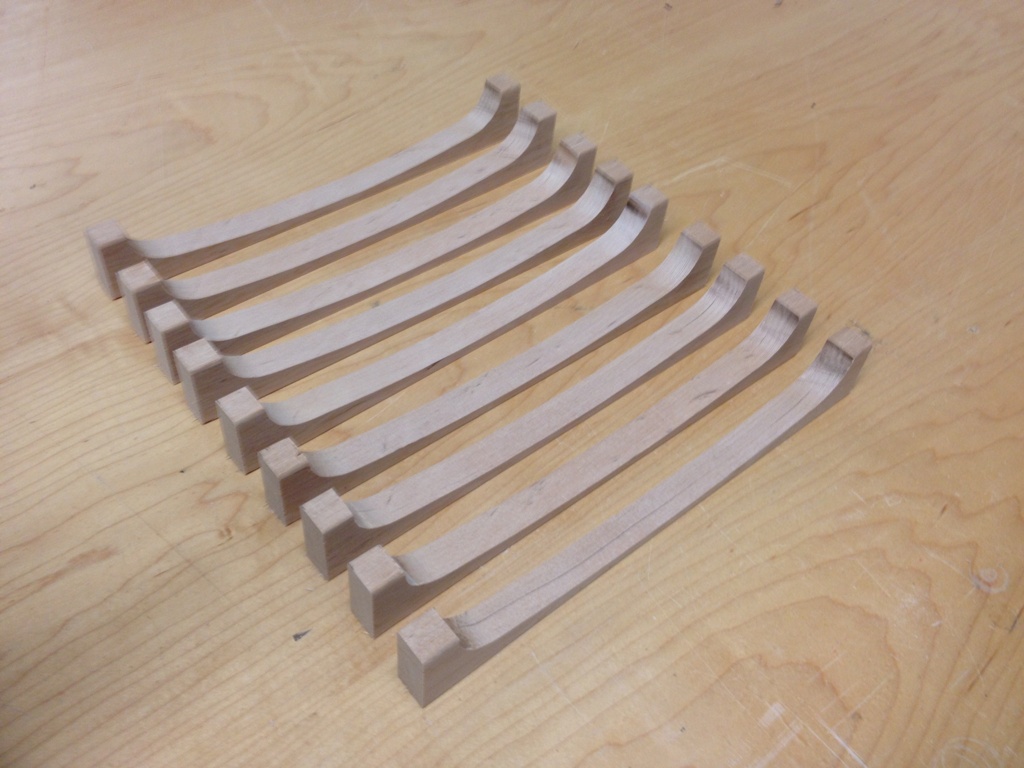
My template pre-marked where the saw needs to cut to make each bracket symmetrical.  After cutting this way, it looks like I have a stack of ribs, ready to make a boat or something.

Ribs


Ha ha!  A boat.  That would imply I have time for recreational activities.  Ha ha ha.  I’m so funny.

Back to reality.  One more cut and they finally look like brackets.

Brackets


Just some final sanding needed now to get rid of those stubborn burn marks.  A nice drum or spindle sander should get rid of those marks pretty easily (problem:  I don’t own a drum or spindle sander).

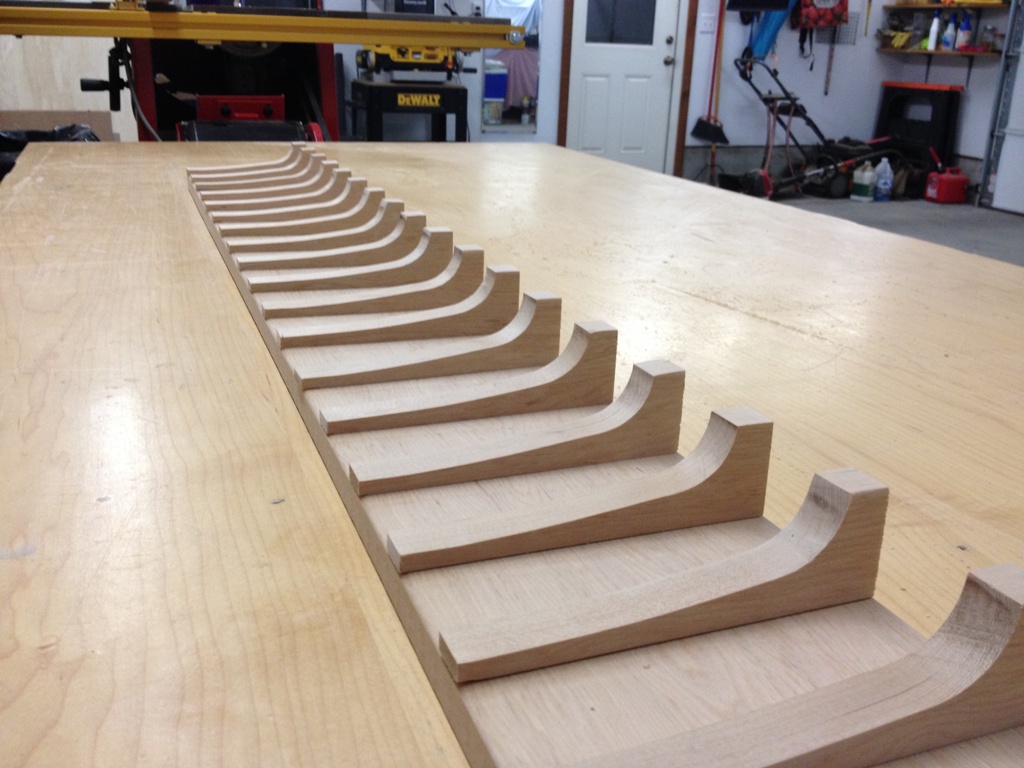
This is a good technique to make any number of curved pieces with repeatable accuracy.  These brackets are going to be along a band and shelf that goes around most of the interior of the house so it’s important they all look uniform.  They don’t need to be down to the tenth of a millimeter or anything, but they have to look the same when viewed with the eye.


A to Z Plans

A brief glimpse into the mind of an Orcas Island Homeowner.

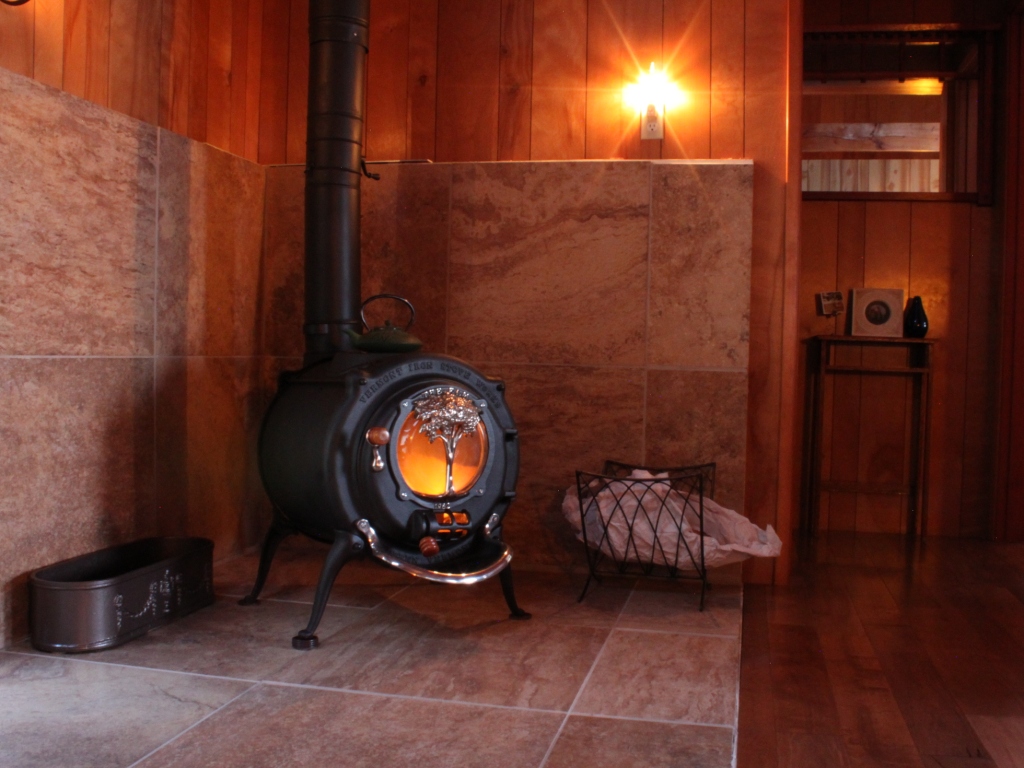
So, about a year and a half ago I installed some big 24” pieces of ceramic tile around our wood stove.  It looked lovely and was nice and fireproof but area above the tile has remained unfinished.  In fact, it’s on a long, long list of unfinished projects.  As with every project, it goes through a number of iterations before it reaches its final state.

Wood Stove Before

Plan A:  I’ll just drywall it.  Put a little wooden shelf over the tile and put drywall on the wall behind it.  Problem:  Okay, that area gets hot.  I put my hand on the wood paneling above the stove when it was burning and it was almost too hot to touch.  I’m surprised that wood paneling hasn’t ignited by now.  It’s a deathtrap the way it is.

Plan B:  Okay, not a wooden shelf but a stone shelf.  Long blocks of cultured stone set into place right on top, and we’ll figure out a wall surface later.  Problem:  Never did find stone that I liked.  I’d have to find something that matched the ceramic tile, which isn’t as easy as it sounds.  And attaching it would be problematic.

Plan C:  Build a hardwood shelf since I think that would look best.  But treat it with some kind of fireproofing compound.  Problem:  Good luck finding a fireproof compound that doesn’t stink or look horrible.  No point making a nice wooden mantle just to ruin it with the fireproofing agent.

Plan D:  Build a metal shelf.  I have stacks of roof metal sheeting left over from the prior owner’s project.  I could strip that down, paint it whatever color I like and it would be completely fireproof!  Problem:  Okay, I spent about six hours cleaning, cutting, bending and filing that crap and the final product looked awful.  Absolutely cheesy.  Stupid.  I hated it.  Can’t I just make the mantle out of wood, a material I know how to use?  No!  Wood is flammable.  Choose something else.

Plan E:  Fine.  I have a bunch of leftover ceramic tile from the wood stove surround.  I can rent a tile saw, cut them into strips, and make a shelf and a little runner to go along the front so it looks like it’s a little sturdy.  Let’s just do that.

MantelPlan F:  The idea of renting a tile saw when it’s 36° F outside just horrifies me.  It sprays water everywhere.  Your hands get drenched in it and they will freeze.  So I’ll just use some edging pieces that I have that don’t look as nice but I don’t want to cut big pieces of tile in this weather.

Plan G:   No front strip either.  Hey, I can use a piece of window flashing to at least make a metal lip that will cover the backerboard.  I can even paint it copper.  I have some hammered copper spray paint that looks great.
Plan H:  The copper spray paint isn’t made for hot applications.  Need to special order high heat paint.

Plan I:  How about the area over the tile?  Painted drywall would probably work ok, as long as you get the special stuff with no combustible paper.  Hey, how about copper sheets!  That would look so freaking cool!!

Plan J:  Copper sheeting would run about $800.  A pity, that’s $700 more than I wanted to spend on this crap.  Maybe I can cut up some of that metal roofing material I have in surplus.  I have enough to roof a small airplane hangar.

Plan K:  No, that would look hideous and take way too much work.  Hey, the hardware store sells these 24” steel sheets for like $6 each.  I could buy a bunch of those, paint them copper, set them in a diamond pattern and it would look great!  Like a copper backsplash.

Plan L:  Sorry, they’re $16 each.  And they only had enough to do most of that wall.  Not all of that wall.

Plan M:  I can do a built in bookshelf on the section of wall it won’t cover.  It’s in an area that doesn’t get hot at all.  Problem solved.

Plan N:  Alkyd based paints will not adhere to galvanized steel.  F#@&^#!

Plan O:  They sell primers that adhere to galvanized steel, but they’re water based latex.  I’m not sure how they will take to heat.

Primer

Plan P:  High heat engine paint is proof up to about 800°.  As long as they’re not exposed to direct flame they are good.

Plan Q:  High heat paints should not be used with a primer, so sayeth the label.  HOWEVER – they are toluene based which means they will adhere to galvanized steel without a primer!!  I can just paint the stupid things.  This is the first thing that has gone right on this project since its inception.

Plan R:  Some of the tiles are coming loose from the wall.  The temperature variation is not good for them.  Get some epoxy resin that will take the heat, and attempt to fit it into the cracks to keep them affixed.

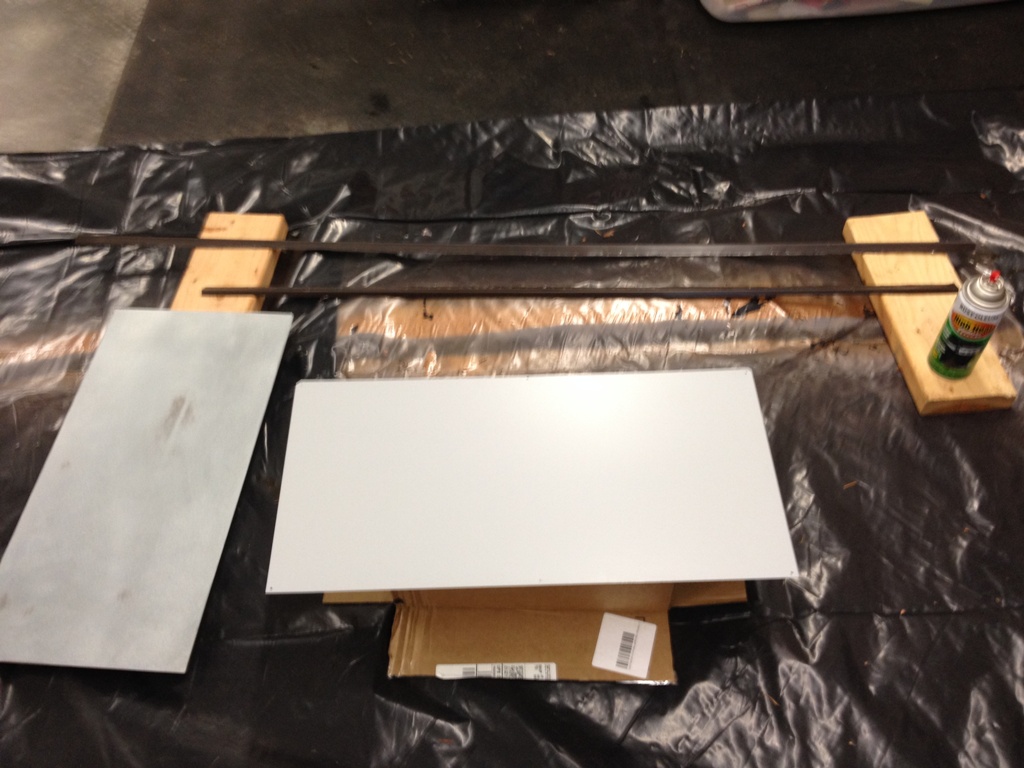
Plan S:  Paint some test sheets of galvanized steel with my high heat paint.  One was primed, the other was not.  The two strips of flashing are not galvanized and I actually don’t care if they rust, melt, rot or jump out of the wall.  I’m using them and that’s that.

Will Paint

That’s where I’m at now.  Maybe in a month or so it will all be finished and I can show you how it turned out. Still need to move some electrical, mill some trim pieces, and get everything situated so it’s safe and fireproof and doesn’t look embarrassing.

Plan Z:  If all of the above fails, I will just order the stupid copper sheets for $800 and nail it to the wall with a nail gun.  By the time we get to this letter of the alphabet, I won’t care what it looks like or how much it costs anymore.

It’s finally gone

yuck


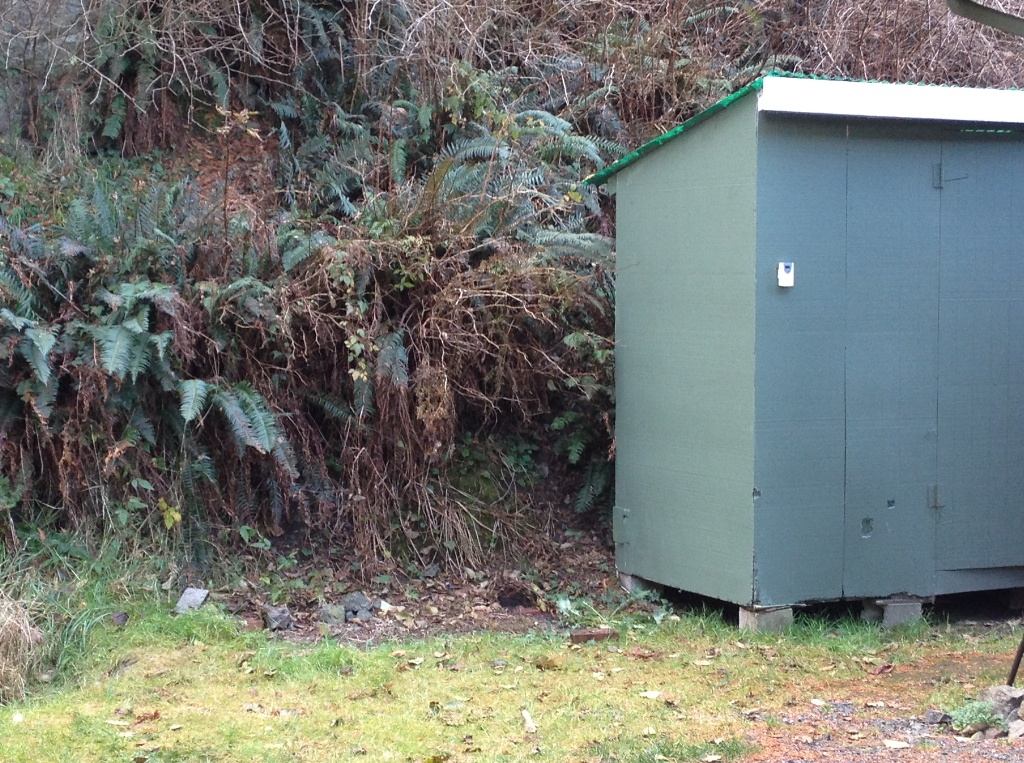
That’s the old oil tank.  It held the fuel that fed our dilapidated furnace.  It had no redeeming qualities.  It weighed about 600 pounds when empty and Zeus only knows what when full.

it's goneYeah, now we know how Frodo felt when he finally got rid of the Ring of Doom.  Seriously it is like a huge weight lifted off our minds, something far heavier than steel and hundreds of gallons of diesel fuel.

The plants back there may look a little dead, but you’ll be surprised how rapidly the earth takes it back and makes it lush and verdant again.  It’ll soon look fine. Now that the tank is gone, the healing process can get underway.

This was kind of the last domino before we could start landscaping.  I couldn’t finish the shed with the tank in the way.  Now that it’s gone, I can work on that ugly shed, lay down a brick patio, put up some deer fence and make a nice courtyard garden.